Sulfur: what it is used for, where it comes from and which countries produce it
Sulfur is barely mined: it comes from refineries and gas plants. What it is used for, how much is produced and which countries lead, with USGS data.
In this article
Sulfur is a raw material almost nobody sets out to find: most of it is recovered while cleaning oil and natural gas. Nearly all of it ends up as sulfuric acid, the chemical input used to make phosphate fertilizers and to process metals. In 2025 the world produced about 84 million tons, and China supplied 19 million of them, according to the U.S. Geological Survey (USGS).
How we made this article: sources and methodology
Key points
- Estimated world production in 2025: 84 million tons, almost the same as in 2024 (83.9 million).
- The largest producers are China, the United States, Russia, Saudi Arabia and the United Arab Emirates.
- In the United States, about 90% of sulfur is consumed as sulfuric acid.
- It is obtained mainly as a byproduct of refineries and gas processing plants.
- The price is very volatile: the U.S. average went from $46 to about $180 per ton between 2024 and 2025.
Where does sulfur come from?
Crude oil and natural gas contain sulfur. It has to be removed before fuels or pipeline gas can be sold, and that recovered sulfur is now the market's main source. The USGS puts it this way: because most production results from processing fossil fuels, supplies are expected to be adequate for the foreseeable future.
In the United States, elemental sulfur is recovered, in descending order of tonnage, at petroleum refineries, natural gas processing plants and coking plants. In 2025, 31 companies did so at 81 plants in 25 states. Another part, about 6% of the total, comes as sulfuric acid from five nonferrous metal smelters that capture the sulfur in sulfide ores.
One detail shows how this market works: sulfur is not always produced in the country that owns the oil. The USGS gives an example: sulfur from Saudi oil may be recovered at refineries in the United States.
Which countries produce the most sulfur
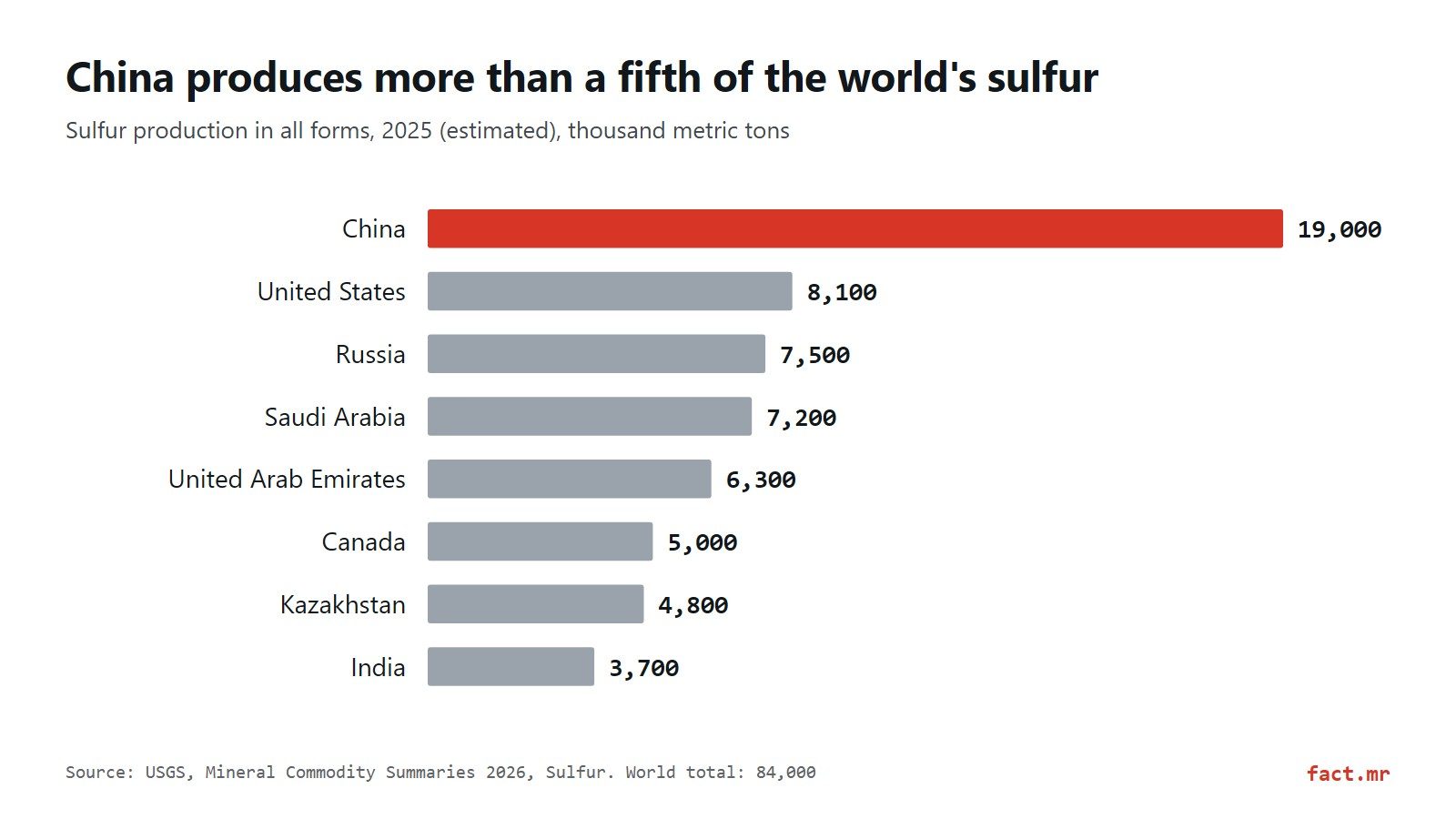
The chart above shows the eight largest producers according to the USGS. The full table, in thousand metric tons of sulfur in all forms:
| Country | 2024 | 2025 (estimated) |
|---|---|---|
| China | 19,000 | 19,000 |
| United States | 8,320 | 8,100 |
| Russia | 7,400 | 7,500 |
| Saudi Arabia | 7,200 | 7,200 |
| United Arab Emirates | 6,300 | 6,300 |
| Canada | 5,060 | 5,000 |
| Kazakhstan | 4,740 | 4,800 |
| India | 3,700 | 3,700 |
| Republic of Korea | 3,100 | 3,100 |
| Qatar | 3,000 | 3,100 |
| Japan | 2,750 | 2,700 |
| Iran | 2,000 | 2,100 |
| Chile | 1,500 | 1,400 |
| Kuwait | 1,300 | 1,300 |
| Poland | 1,000 | 1,100 |
| Australia | 900 | 900 |
| Turkmenistan | 880 | 870 |
| Other countries | 5,100 | 5,700 |
| World total (rounded) | 83,900 | 84,000 |
China produces more than a fifth of the total (22.6% in 2025). The list includes several of the largest oil and gas producers, which fits with sulfur being mostly a byproduct. In China's figure the USGS includes sulfur recovered from gas and oil, the sulfur content of acid from metallurgy and that of acid made from pyrite.
What is sulfur used for?
The dominant use is sulfuric acid: in the United States, about 90% of the sulfur consumed took that form. Two supply chains the USGS tracks closely depend on it:
- Phosphate fertilizers. Turning phosphate rock into fertilizer requires sulfur. That is why sulfur use rises and falls with phosphate rock use, and the USGS expects new demand from fertilizer projects mostly in Africa and west Asia.
- Nickel for batteries. High-pressure acid leaching, a technique that uses acid to extract nickel for battery materials, consumes sulfur. The USGS expects growth in those projects to raise sulfur demand.
According to the USGS, there are no satisfactory substitutes for sulfur at current prices; in some applications other acids can replace sulfuric acid, but usually at a higher cost. In addition, between 2.5 and 5 million tons of spent sulfuric acid are reclaimed each year from petroleum refining and chemical processes.
The United States and its suppliers
The United States produced about 8.1 million tons in 2025 and consumed about 9.1 million. Net imports covered 14% of its consumption. From 2021 to 2024, 53% of total sulfur imports came from Canada and 11% from Mexico; for sulfuric acid, Mexico's share was 22%.
| United States (thousand tons) | 2021 | 2022 | 2023 | 2024 | 2025 (est.) |
|---|---|---|---|---|---|
| Total production | 8,070 | 8,640 | 8,650 | 8,320 | 8,100 |
| Apparent consumption | 10,600 | 10,800 | 10,200 | 9,360 | 9,100 |
| Net import reliance | 24% | 20% | 15% | 14% | 14% |
Louisiana and Texas accounted for about 54% of U.S. elemental sulfur production in 2025.
Price: why it moves so much
Because most sulfur is a byproduct of oil and gas, how much is produced depends on those industries more than on the price of sulfur itself. That is our reading of the USGS data, which show sharp swings from year to year. The average U.S. plant value, in dollars per ton, was:
| Year | 2021 | 2022 | 2023 | 2024 | 2025 (est.) |
|---|---|---|---|---|---|
| Dollars per ton | 90.40 | 177.8 | 58.90 | 46.42 | 180 |
Within 2025, the contract price in Tampa, Florida, started the year at $116 per long ton, rose to $270 in April, fell to $252 in July and reached $310 in early October. Those were the highest prices since the second quarter of 2022, according to the USGS. With that rise, U.S. shipments were worth about $1.4 billion, $1 billion more than in 2024.
Can sulfur run out?
Not in any foreseeable horizon. The USGS estimates about 5 billion tons of resources in evaporite and volcanic deposits and associated with natural gas, petroleum, tar sands and metal sulfides. Coal, oil shale and organic-rich shale hold another 600 billion tons, and the sulfur in gypsum and anhydrite is "almost limitless." The limit is not quantity but the cost of extracting it from those sources.
To compare sulfur with minerals whose supply is far more concentrated, see the article on rare earth production. For where the gas cleaned at processing plants comes from, see natural gas explained.
Frequently asked questions
Is sulfur mined?
Very little. Most is recovered as a byproduct at refineries, gas plants and metal smelters.
What is sulfuric acid and why does it matter?
It is the compound almost all sulfur ends up in. Without it, phosphate fertilizers cannot be made and some metals cannot be processed, such as nickel obtained by acid leaching for batteries.
Why did the sulfur price jump in 2025?
The USGS records the rise (from $46 to about $180 per ton on average in the United States) without attributing it to a single cause. It does note that it expects more sulfur demand from nickel projects for batteries and from new fertilizer plants in Africa and west Asia.
Sources and methodology
Sources
- USGS, Mineral Commodity Summaries 2026, "Sulfur" (February 2026): world and country production, U.S. data, prices, resources and uses. Data for the main chart. pubs.usgs.gov. Accessed Oct 12, 2026.
- USGS, Mineral Commodity Summaries 2025, "Sulfur": previous edition, used to cross-check the series. pubs.usgs.gov. Accessed Oct 12, 2026.
Methodology
Every figure comes from source 1; 2025 figures are USGS estimates. China's share (22.6%) was calculated by dividing its output by the world total in the same table. The main chart is our own and reproduces the 2025 figures unchanged. Figures are for sulfur in all forms, measured as sulfur content.
How it was made
Written by fact.mr Editorial. Drafted with the help of AI tools; every figure was checked against the public sources cited. fact.mr is not affiliated with consulting firms with similar names.
Review date
Data reviewed on October 12, 2026. The USGS publishes a new edition of this summary early each year. If you find an error, write to [email protected].