Natural gas: what it is, where it comes from, how it is used and how much it pollutes
What natural gas is, how it forms and is produced, where it is used and how much CO2 it emits compared with coal and diesel, with EIA and World Bank data.
In this article
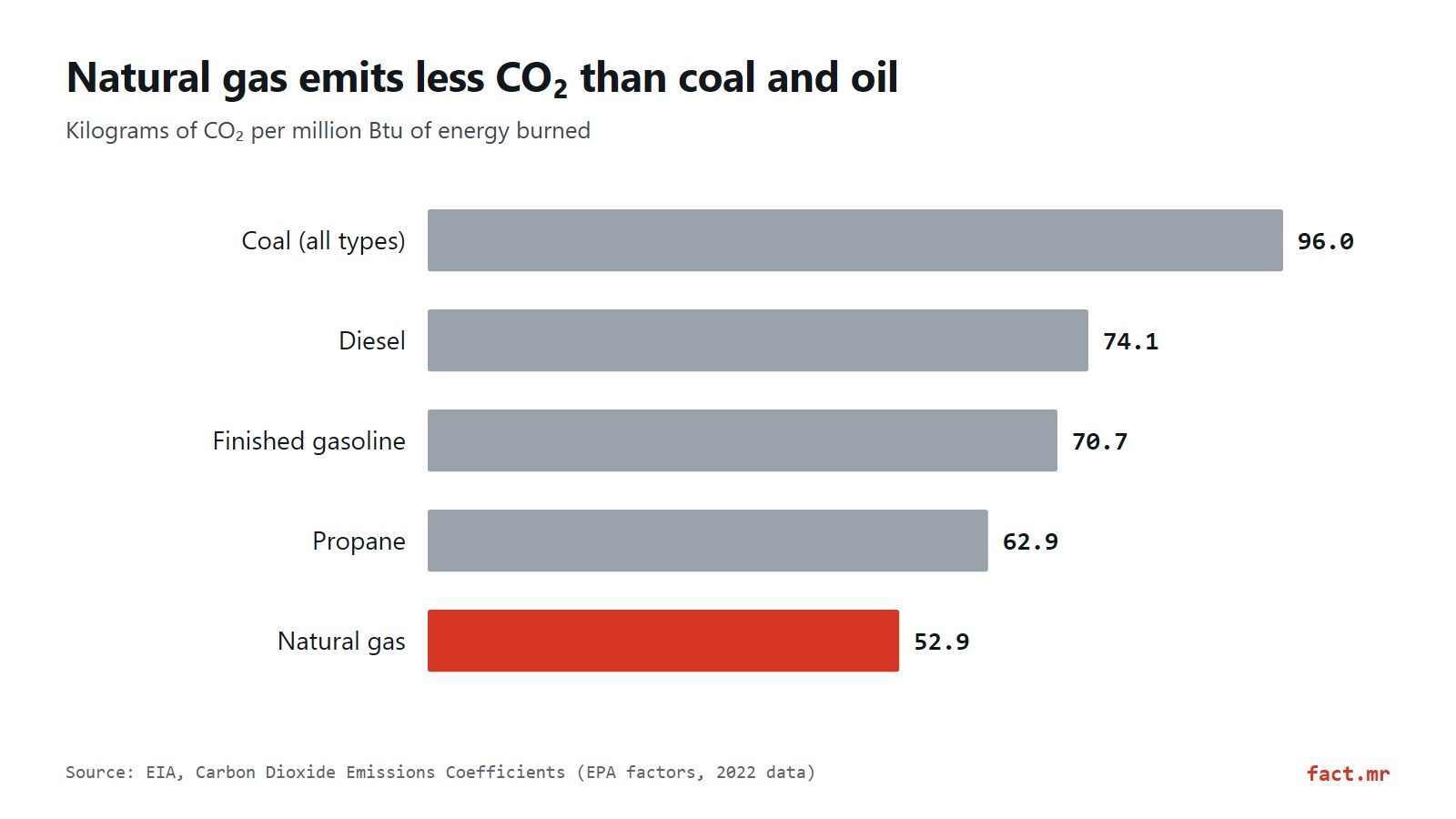
Natural gas is a fossil fuel made up mostly of methane (CH4). It comes from wells on land and offshore, is cleaned at processing plants and reaches power plants, factories and homes through pipelines. Burning it emits about 52.9 kilograms of CO2 per million Btu, compared with 74.1 for diesel and 96 for coal, according to coefficients published by the U.S. Energy Information Administration (EIA).
How we made this article: sources and methodology
Key points
- The main component is methane; it also carries liquids (ethane, propane, butanes), water vapor and gases such as CO2, nitrogen, helium and hydrogen sulfide.
- It formed from the remains of plants and animals buried for millions of years under layers of rock.
- In the United States, power generation is the largest user: 40% of the gas consumed in 2023.
- Per unit of energy it emits less CO2 than coal and petroleum products, but methane that leaks unburned is a strong greenhouse gas.
- Prices vary widely by region: in 2025 the average was $3.53 per million Btu in the United States and $11.96 in Europe.
What is natural gas?
It is a mixture of compounds dominated by methane, a molecule with one carbon atom and four hydrogen atoms. Alongside methane come smaller amounts of natural gas liquids and non-hydrocarbon gases such as carbon dioxide and water vapor. It is used as a fuel and as a raw material to make materials and chemicals.
It has no color, smell or taste. That is why gas companies add mercaptan, a compound that smells like rotten eggs, so a leak in a home pipe can be noticed.
How did it form, and where is it found?
Millions to hundreds of millions of years ago, the remains of plants and animals built up in thick layers on land and on ocean floors. They were buried under sand, silt and rock, and pressure and heat turned part of that carbon- and hydrogen-rich material into coal, oil or gas.
The EIA describes four kinds of deposit, depending on where the gas was trapped:
| Type | Where it is |
|---|---|
| Conventional | In large cracks and spaces between rock layers; it flows easily to the well |
| Unconventional (shale or tight gas) | In tiny pores of shale, sandstone and other sedimentary rock |
| Associated | Together with crude oil deposits |
| Coalbed methane | Inside coal deposits |
How is it produced?
First, it has to be found. Geologists run seismic surveys: they send waves into the ground or the sea floor and measure how they bounce back to map the rock layers. If the results look promising, an exploratory well is drilled and tested for the quantity and quality of gas.
When a deposit is profitable, production wells are drilled, vertically or horizontally. In conventional deposits the gas flows up on its own. In shale and other low-permeability rock, producers use hydraulic fracturing (fracking): water, sand and chemicals are pumped down at high pressure to crack the rock and release the gas. According to the EIA, most U.S. production growth since 2005 comes from horizontal drilling and fracking.
In 2022, the United States produced about 36.35 trillion cubic feet of dry natural gas, an annual record and 13% more than it consumed. Offshore production was only 2.3% of that total.
From the well to the home: processing
Gas straight from the well is called wet gas because, besides methane, it carries ethane, propane, butanes, pentanes and water vapor. It may also contain sulfur, helium, nitrogen, hydrogen sulfide and carbon dioxide, most of which must be removed before sale.
Processing plants remove water and unwanted compounds, and the liquids are sold separately. In the United States, most of those liquids, including the propane sold as LPG, are separated at these plants. What remains is dry, pipeline-quality gas that goes to underground storage or to distribution companies. Where there are no pipelines to take away the gas produced at oil wells, it is reinjected, vented or flared.
What is natural gas used for?
The EIA publishes how consumption splits in the United States, one of the most detailed open statistics available. In 2023 it looked like this:
| Sector | 2023 use (trillion cubic feet) | Share of total |
|---|---|---|
| Electric power | 12.93 | 40% |
| Industrial | 10.51 | 32% |
| Residential | 4.48 | 14% |
| Commercial | 3.31 | 10% |
| Transportation | 1.27 | 4% |
A few readings of that table:
- Electricity. Gas generated about 43% of U.S. utility-scale electricity in 2023.
- Industry. It is burned for heat and on-site power, and it is also a feedstock for chemicals.
- Homes. About 60% of U.S. homes use it for space and water heating, cooking or clothes drying.
- Transportation. Almost all of it (96%) runs the compressors that push gas through pipelines; vehicle use is limited to fleets running on compressed or liquefied gas.
How much does natural gas pollute?
Two effects need to be separated: what it emits when burned, and what escapes unburned.
When burned, gas emits less CO2 per unit of energy than any other common fossil fuel. The chart above uses the coefficients the EIA publishes with factors from the Environmental Protection Agency (EPA):
| Fuel | kg of CO2 per million Btu |
|---|---|
| Coal (all types) | 95.99 |
| Diesel and home heating oil | 74.14 |
| Finished motor gasoline | 70.66 |
| Propane | 62.88 |
| Natural gas | 52.91 |
For the same energy, gas emits about 45% less CO2 than coal and 29% less than diesel. Even so, in 2022 burning natural gas accounted for about 35% of U.S. energy-related CO2 emissions, because so much of it is used.
Unburned, the issue is methane, a stronger greenhouse gas than CO2. It leaks from wells, tanks, pipelines and plants. The EPA estimates that in 2021 oil and gas systems, together with abandoned wells, produced about 33% of U.S. methane emissions and about 4% of all U.S. greenhouse gas emissions. That is why gas's advantage over coal depends on how much leaks along the chain.
Production also has local costs: land clearing, noise, air pollution from engines and compressors, and large volumes of contaminated water that must be treated. One way to cut emissions from gas-fired plants is to capture the CO2. Gas is also the feedstock for grey hydrogen, compared in green hydrogen vs grey hydrogen.
What does it cost? Prices by region
There is no single world price for gas: to cross an ocean it has to be liquefied and loaded onto LNG carriers, and each region sets its own price. The World Bank publishes three benchmarks, in dollars per million Btu:
| Year | United States | Europe | Japan (LNG) |
|---|---|---|---|
| 2020 | 2.01 | 3.24 | 8.31 |
| 2021 | 3.85 | 16.12 | 10.76 |
| 2022 | 6.37 | 40.34 | 18.43 |
| 2023 | 2.54 | 13.11 | 14.39 |
| 2024 | 2.19 | 10.96 | 12.84 |
| 2025 | 3.53 | 11.96 | 12.04 |
Europe's 2022 spike ($40.34, more than six times the U.S. price that year) shows how much geography matters: the region that relies on imported gas pays the difference when supply is cut.
Natural gas, LPG and LNG are not the same
- Natural gas: methane, delivered by pipeline.
- LPG: mostly propane, one of the liquids separated from natural gas at processing plants; sold in cylinders or tanks.
- LNG (liquefied natural gas): the same natural gas cooled to about −260 °F (−162 °C), where it takes up about 600 times less space and can travel on LNG carriers.
- Compressed natural gas (CNG): natural gas at high pressure, used by vehicle fleets.
Frequently asked questions
Is natural gas renewable?
No. It is a fossil fuel that took millions to hundreds of millions of years to form, and what is extracted is not replaced on a human time scale.
Why does kitchen gas smell if natural gas is odorless?
Because gas companies add mercaptan. The smell is there to reveal leaks.
Does natural gas pollute less than electricity?
It depends on how that electricity is generated. If it comes from a coal plant, it emits more CO2 per unit of energy than burning gas; if it comes from renewables, it emits much less.
What does natural gas have to do with fracking?
Fracking is the technique that gets gas out of low-permeability rock such as shale. It explains most of the growth in U.S. production since 2005.
Sources and methodology
Sources
- EIA, "Natural gas explained": composition, formation, deposit types, exploration, fracking and processing. eia.gov. Accessed Oct 12, 2026.
- EIA, "Use of natural gas": consumption by sector in 2023 (Monthly Energy Review, table 4.3, May 2024). eia.gov. Accessed Oct 12, 2026.
- EIA, "Where our natural gas comes from": 2022 production and offshore output. eia.gov. Accessed Oct 12, 2026.
- EIA, "Natural gas and the environment": methane, flaring and share of emissions. eia.gov. Accessed Oct 12, 2026.
- EIA, "Carbon Dioxide Emissions Coefficients" (EPA factors, 2022 data): data for the main chart. eia.gov. Accessed Oct 12, 2026.
- EIA, "Liquefied natural gas": liquefaction temperature, volume reduction and shipping. eia.gov. Accessed Oct 12, 2026.
- EIA, "Where do hydrocarbon gas liquids come from?": separation of liquids at processing plants. eia.gov. Accessed Oct 12, 2026.
- World Bank, "Commodity Price Data" (Pink Sheet), nominal annual prices, October 2026 release. worldbank.org. Accessed Oct 12, 2026.
Methodology
Every figure comes from the sources above, with no estimates of our own. The reductions versus coal (45%) and diesel (29%) were calculated from the coefficients in source 5. The main chart is our own and reproduces those coefficients unchanged. Consumption and production data are for the United States because the EIA is the most detailed public statistic; other countries may split their use differently.
How it was made
Written by fact.mr Editorial. Drafted with the help of AI tools; every figure was checked against the public sources cited. fact.mr is not affiliated with consulting firms with similar names.
Review date
Data reviewed on October 12, 2026. If you find an error, write to [email protected].