Viscosity: what it is, how it is measured, units and examples with data
What viscosity is, dynamic vs kinematic viscosity, its units and how it changes with temperature, with NIST data for water and other common fluids.
In this article
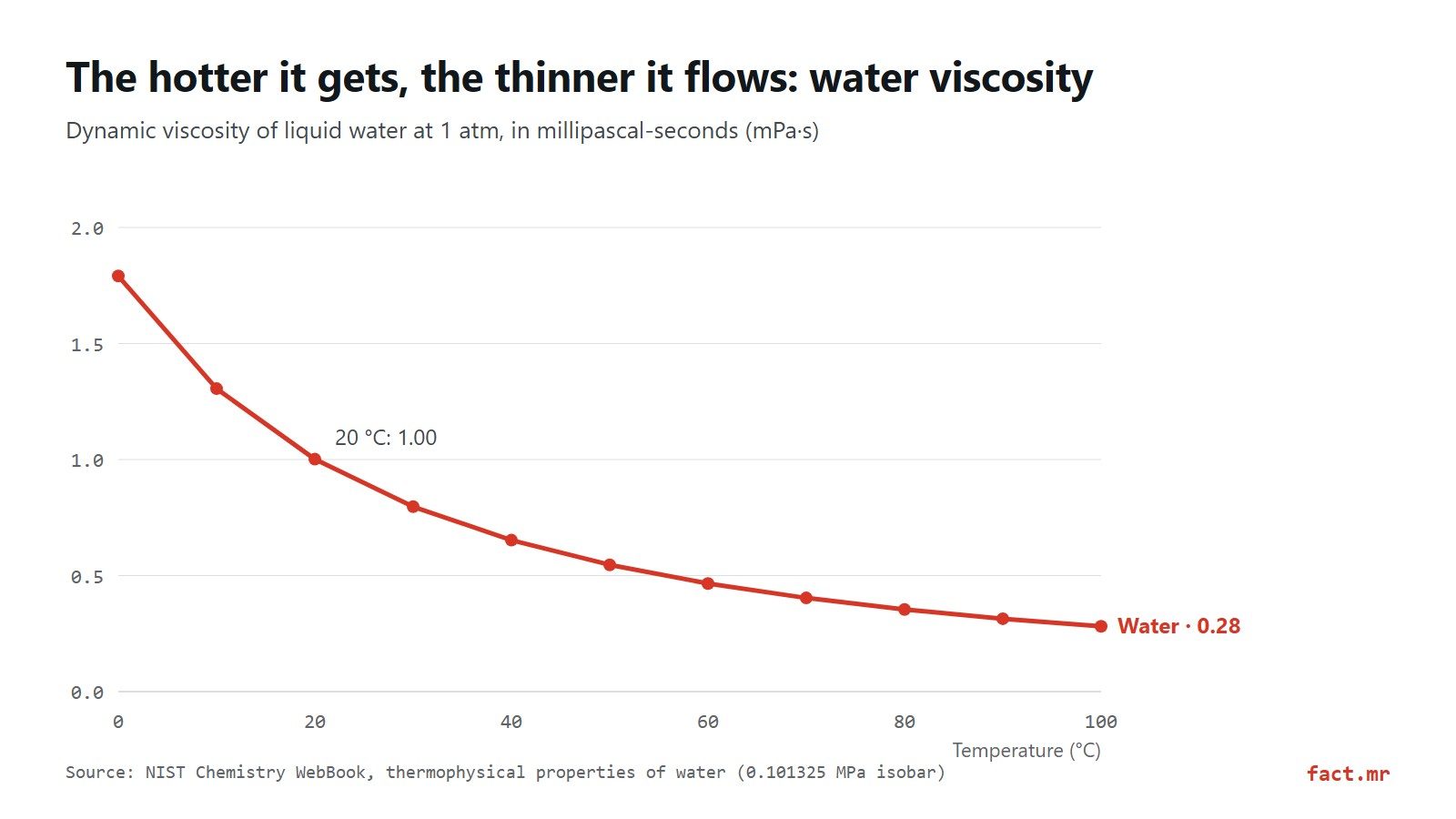
Viscosity is a fluid's resistance to flow: the more viscous it is, the harder it is for the fluid to slide over itself. It is measured in pascal-seconds (Pa·s) or, in practice, in centipoise (cP). Water at 20 °C (68 °F) has a viscosity of 1.00 mPa·s, equal to 1 cP, and heated to 100 °C (212 °F) it drops to 0.28, according to data from the U.S. National Institute of Standards and Technology (NIST).
How we made this article: sources and methodology
Key points
- Dynamic viscosity measures how much force it takes for the layers of a fluid to slide past each other. Its SI unit is the Pa·s.
- Kinematic viscosity is dynamic viscosity divided by density. Its SI unit is m²/s; in practice the centistokes (cSt) is used.
- 1 cP = 1 mPa·s and 1 cSt = 1 mm²/s.
- In liquids, viscosity falls as temperature rises; in gases, it rises.
- A gas such as nitrogen is about 57 times less viscous than water at 20 °C.
What is viscosity?
Picture a fluid as a stack of very thin layers. When you push it, the layers slide over each other and each one drags on its neighbor. That internal friction is viscosity. Honey flows slowly because its layers drag a lot; water runs because they drag little.
It should not be confused with density. Density tells you how much mass is in a volume; viscosity, how much the fluid resists moving. The clearest example is in the table below: decane is less dense than water (730 versus 998 kg/m³ at 20 °C) and almost as viscous.
Dynamic vs kinematic viscosity
Both are used, and it helps to know which one a data sheet is asking for:
| Dynamic (absolute) viscosity | Kinematic viscosity | |
|---|---|---|
| What it measures | Resistance to sliding between layers | That resistance relative to the fluid's mass |
| Usual symbol | μ or η | ν |
| SI unit | pascal-second (Pa·s) | square meter per second (m²/s) |
| CGS unit | poise (P) | stokes (St) |
| Practical unit | centipoise (cP) = mPa·s | centistokes (cSt) = mm²/s |
The relationship is simple: kinematic viscosity = dynamic viscosity ÷ density. With NIST data for water at 20 °C (0.0010014 Pa·s and 998.21 kg/m³), kinematic viscosity comes to 1.003 × 10⁻⁶ m²/s, or 1.00 cSt. That is why water is the handy reference: at 20 °C it is almost exactly 1 on both practical scales.
Viscosity units and how to convert them
The NIST Guide to the SI defines the equivalences:
- 1 poise (P) = 0.1 Pa·s, so 1 centipoise (cP) = 0.001 Pa·s = 1 mPa·s.
- 1 stokes (St) = 1 cm²/s = 10−4 m²/s, so 1 centistokes (cSt) = 1 mm²/s.
The poise and the stokes belong to the old CGS system and NIST does not accept them for use with the SI, but they still appear in catalogs of oils, paints and resins.
How viscosity changes with temperature
The chart above shows liquid water at atmospheric pressure. Between 0 and 100 °C its viscosity falls from 1.79 to 0.28 mPa·s: close to boiling it flows about 6.4 times more easily than just after melting.
| Temperature (°C) | 0 | 20 | 40 | 60 | 80 | 100 |
|---|---|---|---|---|---|---|
| Water, dynamic viscosity (mPa·s) | 1.79 | 1.00 | 0.65 | 0.47 | 0.35 | 0.28 |
Gases do the opposite. Nitrogen, the main component of air, goes from 16.6 to 21.1 micropascal-seconds (μPa·s) between 0 and 100 °C, according to the same NIST database. That difference is why an oil data sheet always states the temperature at which viscosity was measured: without it, the number cannot be compared.
Examples: viscosity of common fluids at 20 °C
All values are from the NIST Chemistry WebBook, at 20 °C and 1 atm:
| Fluid | State | Density (kg/m³) | Viscosity (mPa·s or cP) |
|---|---|---|---|
| Nitrogen | gas | 1.16 | 0.0176 |
| n-Hexane | liquid | 659 | 0.313 |
| n-Octane | liquid | 703 | 0.544 |
| Methanol | liquid | 791 | 0.585 |
| n-Decane | liquid | 730 | 0.914 |
| Water | liquid | 998 | 1.001 |
| n-Dodecane | liquid | 749 | 1.489 |
There is a useful pattern in the table's hydrocarbons: the longer the carbon chain, the more viscous the liquid. Hexane (6 carbons) has 0.31 mPa·s; dodecane (12 carbons), 1.49. It is the same logic that separates light, free-flowing gasoline from lubricating oils, which are made of much longer molecules.
Newtonian and non-Newtonian fluids
In a Newtonian fluid, such as water or air, viscosity depends on temperature and pressure but not on how hard the fluid is stirred: fast or slow, it offers the same resistance. The values in the table are of this kind.
In a non-Newtonian fluid, viscosity changes with the force applied. Some paints thin out under the brush and thicken again once they sit on the wall; a mix of cornstarch and water does the opposite and stiffens when struck. For these materials a single number is not enough: the manufacturer reports viscosity at a given shear rate.
How viscosity is measured
- Capillary viscometer: measures how long a fixed volume takes to pass through a thin tube. It gives kinematic viscosity.
- Rotational viscometer: a spindle turns inside the fluid and the force needed to keep its speed is measured. It gives dynamic viscosity and works for non-Newtonian fluids.
- Falling ball: measures how fast a sphere falls through the fluid.
In every case the test temperature is controlled and reported with the result.
Viscosity is one of the properties that define how a liquid raw material is processed, from a fuel to a resin; the article on what raw materials are covers their types and how their prices are set. For another materials basics guide, see the seven types of plastic.
Frequently asked questions
Which is more viscous, water or oil?
Oil. Oils are made of long molecules, and the table shows viscosity growing with chain length: dodecane already beats water, and lubricating oils have much longer chains.
Is viscosity the same as density?
No. Decane is less dense than water and almost as viscous. They are different properties.
How much is 1 centipoise?
One thousandth of a pascal-second (1 mPa·s), roughly the viscosity of water at 20 °C.
Why does honey flow better when warm?
Because, as in all liquids, heat reduces the friction between its layers. Water shows the same effect in the chart: it loses more than four fifths of its viscosity between 0 and 100 °C.
Sources and methodology
Sources
- NIST Chemistry WebBook, "Thermophysical Properties of Fluid Systems": liquid water from 0 to 100 °C at 0.101325 MPa (data for the main chart), and hexane, octane, methanol, decane, dodecane and nitrogen at 20 °C. webbook.nist.gov. Accessed Oct 12, 2026.
- NIST, Special Publication 811 (Guide for the Use of the SI), chapter 5: definition of the poise and the stokes and their equivalences. nist.gov. Accessed Oct 12, 2026.
Methodology
Viscosities and densities were downloaded from the NIST Chemistry WebBook at atmospheric pressure (0.101325 MPa). Water's kinematic viscosity, the 6.4-fold ratio between 0 and 100 °C, the drop of more than four fifths (84%) and the 57-fold comparison between water and nitrogen were calculated from those data. The main chart is our own. The honey, paint and cornstarch examples illustrate the concept and carry no figures.
How it was made
Written by fact.mr Editorial. Drafted with the help of AI tools; every figure was checked against the public sources cited. fact.mr is not affiliated with consulting firms with similar names.
Review date
Data reviewed on October 12, 2026. If you find an error, write to [email protected].