Lithium carbonate vs lithium hydroxide: which battery uses each, where lithium comes from and who produces it
LFP batteries mainly use lithium carbonate and NMC batteries use hydroxide. Where lithium comes from, which countries mine it and what each compound costs.
In this article
LFP batteries mainly use lithium carbonate, and NMC batteries use lithium hydroxide. That split comes from the lithium market report of Cochilco, the Chilean Copper Commission. On the supply side, the U.S. Geological Survey's Mineral Commodity Summaries (February 2026) put world mine production, excluding the United States, at about 290,000 metric tons of lithium content in 2025, 31% more than in 2024.
Key points
- According to Cochilco, LFP batteries mainly use lithium carbonate and NMC batteries use lithium hydroxide.
- Carbonate made up 77% of Chile's lithium exports in 2023. Hydroxide made up 13%.
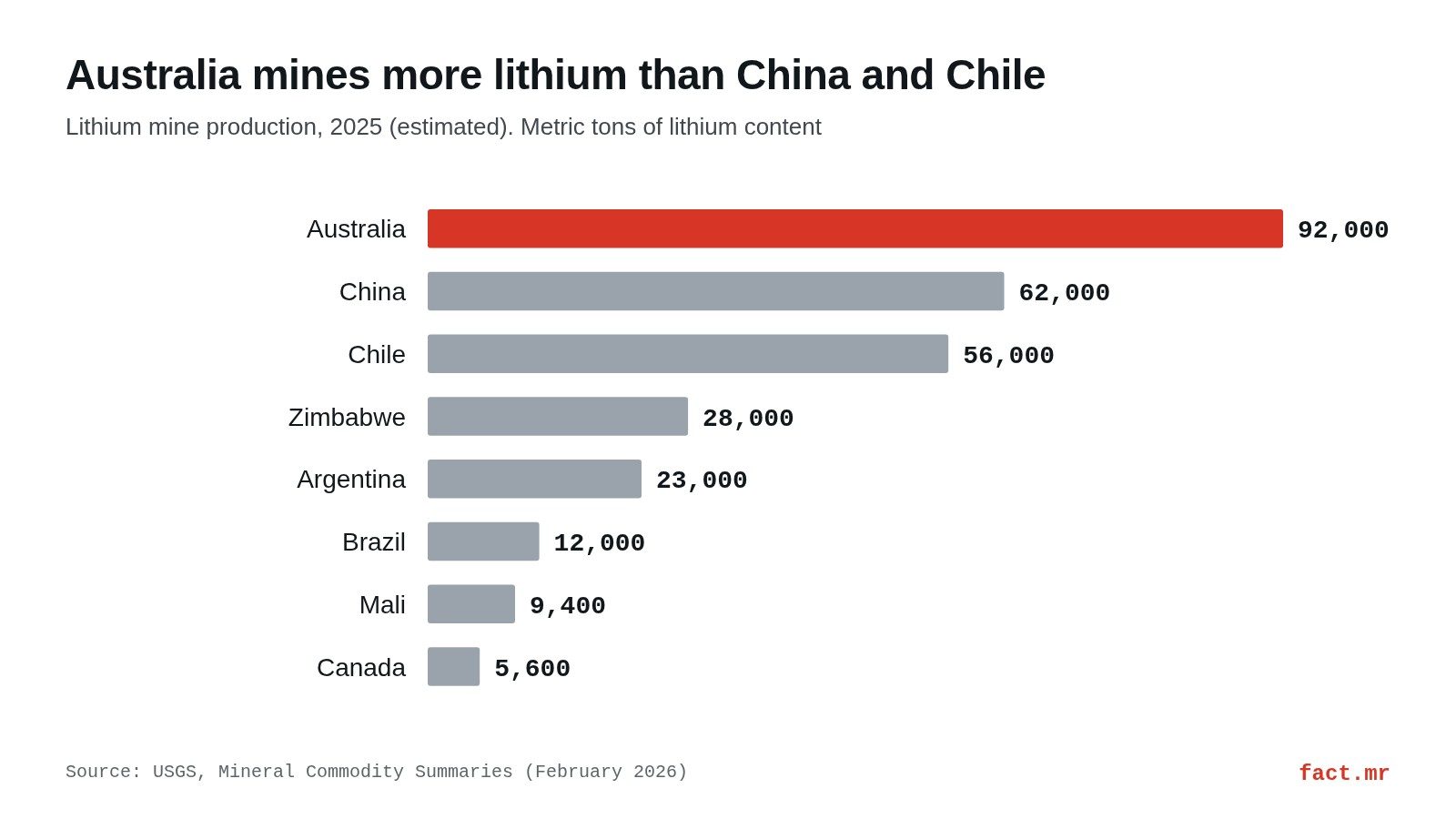
- Australia (92,000 t), China (62,000 t) and Chile (56,000 t) together accounted for 72.4% of 2025 world mine production, a USGS total that leaves out the United States.
- Batteries take 88% of the lithium consumed worldwide, according to the 2026 USGS edition.
- The real average price of battery-grade carbonate went from $63,700 per metric ton in 2022 to an estimated $9,000 in 2025, according to the USGS.
How carbonate and hydroxide show up in the data
The USGS tracks a separate China spot price for each compound. Both end up in batteries, but Cochilco assigns them to different cell chemistries. Chile, whose USGS-listed operations are brine operations, exported 77% of its lithium as carbonate in 2023, 13% as hydroxide and 10% as sulfate, according to Cochilco.
The units change from source to source. Cochilco reports output and demand in tons of lithium carbonate equivalent (LCE), and it put 2023 world demand at 920 thousand tons of LCE, 27% more than in 2022, while the USGS reports metric tons of lithium content. So Cochilco's 270,947 tons of LCE for Chile in 2023 and the USGS estimate of 56,000 tons of lithium for Chile in 2025 can't be compared directly, because both the unit and the year differ.
Lithium carbonate vs lithium hydroxide: which battery uses each
Cochilco ties each compound to a battery chemistry.
| Compound | Battery that mainly uses it (Cochilco) | Share of Chile's lithium exports, 2023 (Cochilco) | China spot price, November 2025 (USGS) |
|---|---|---|---|
| Lithium carbonate | LFP | 77% | About $10,300 per ton (c.i.f.) |
| Lithium hydroxide | NMC | 13% | About $11,200 per ton (f.o.b.) |
How much of the world's carbonate goes into LFP cells, and how much into other uses? The Cochilco figures used here cover Chile's exports, and the USGS end-use shares are for lithium as a whole, so neither gives that split. One measure of battery demand is known, though: the International Energy Agency's Global EV Outlook 2026 reports that EV battery deployment reached 1.2 TWh in 2025, almost 30% more than in 2024.
Country-level supply data for another metal is in the nickel guide.
Where lithium comes from
The USGS sorts producing operations into two kinds: brine and mineral. Lithium clay is a third source, still in development or exploration in Mexico and the United States. The operations the USGS names as the source of most world output include two brine operations in Chile, nine mineral and six brine operations in China, and two mineral operations in Mali.
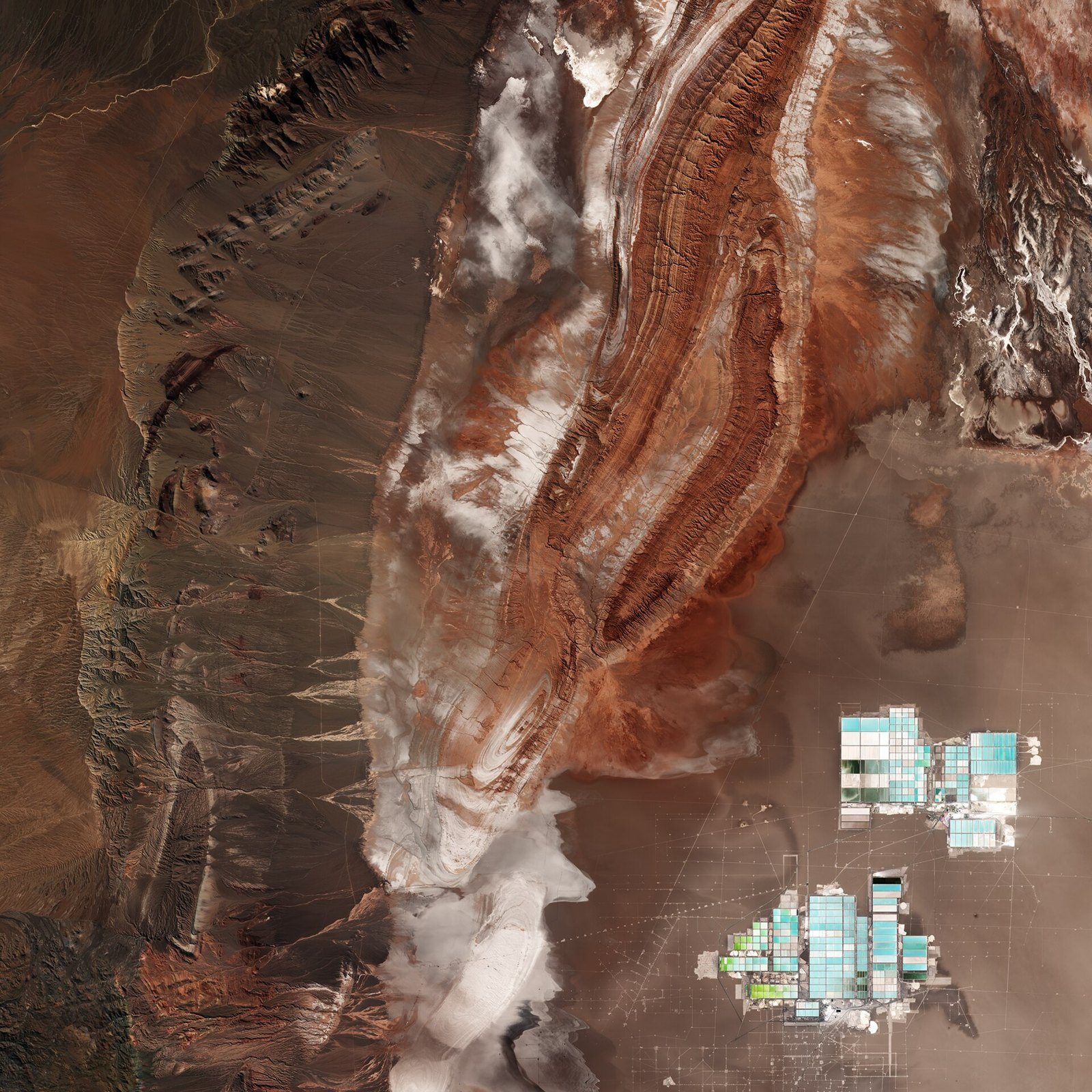
For Australia, the USGS tracks the price of spodumene (6% lithium oxide), f.o.b. In the United States, commercial-scale production came from a single continental brine operation in Nevada. Namibia was temporarily removed from the 2025 mine production table because of legal uncertainties.
Which countries produce the most lithium
Australia tops the USGS table with 31.7% of the estimated 2025 total, and China follows with 21.4%. In the table, "e" marks estimates and "W" marks figures withheld to avoid disclosing company proprietary data. "n.a." marks 2024 figures that the USGS publishes but this table does not reproduce.
| Country | 2024 (t of lithium) | 2025e (t of lithium) |
|---|---|---|
| Australia | 82,700 | 92,000 |
| China | 41,400 | 62,000 |
| Chile | n.a. | 56,000 |
| Zimbabwe | 20,000 | 28,000 |
| Argentina | n.a. | 23,000 |
| Brazil | 10,200 | 12,000 |
| Mali | 770 | 9,400 |
| Canada | n.a. | 5,600 |
| Portugal | n.a. | 380 |
| United States | W | W |
| World total (excluding the U.S.) | 222,000 | 290,000 |
Mali went from 770 to 9,400 tons. The USGS significantly revised its 2024 figure after two new operations started that year, and it also revised Argentina's 2024 output based on company reports. The world total for 2024 also differs between editions: the 2025 edition had about 240,000 tons for 2024, up 18% from 204,000 in 2023, while the 2026 edition puts the same year at 222,000 tons.
The straight calculation from 222,000 to 290,000 gives 30.6%, which the USGS rounds to 31%. Each edition of the Mineral Commodity Summaries carries the same kind of country table for other minerals, rare earth elements among them. For how lithium fits among the other commodity groups, see raw materials: what they are and types.
What lithium is used for
Batteries take most of it. The USGS breaks down the rest like this:
| End use | World share (USGS, 2026 edition) |
|---|---|
| Batteries | 88% |
| Ceramics and glass | 4% |
| Lubricating greases | 2% |
| Air treatment | 1% |
| Continuous casting mold flux powders | 1% |
| Medical | 1% |
| Other uses | 3% |
In the 2025 edition, batteries were 87% and ceramics and glass 5%. The USGS also notes that lithium minerals are used directly as mineral concentrates in ceramics and glass applications.
World consumption was an estimated 263,000 tons in 2025, up 20% from 220,000 tons in 2024, according to the USGS. The IEA's Global Critical Minerals Outlook 2025 recorded demand growth of nearly 30% in 2024, against 10% a year in the 2010s.
The U.S. case: imports, tariff and resources
The United States imports more lithium than it exports, and since 2023 it has relied on imports for more than half of its apparent consumption. From 2021 to 2024, 54% of those imports came from Chile and 43% from Argentina. Two U.S. companies make a wide range of downstream compounds from domestic or imported lithium carbonate, lithium chloride and lithium hydroxide.
| Year | Imports for consumption (t) | Exports (t) | Net import reliance |
|---|---|---|---|
| 2021 | 2,640 | 1,870 | >25% |
| 2022 | 3,260 | 2,440 | >25% |
| 2023 | 3,390 | 1,960 | >50% |
| 2024 | 3,020 | 1,690 | >50% |
| 2025e | 3,800 | 2,000 | >50% |
As of December 31, 2025, the U.S. Normal Trade Relations tariff on lithium carbonate under subheading 2836.91.0050 ("other") was 3.7% ad valorem. U.S. measured and indicated resources total 30 million tons. Mexico has resources of 1.7 million tons, and both countries have lithium clay projects in development or exploration.
Lithium carbonate price
Battery-grade carbonate is the price benchmark the USGS publishes, based on spot and long-term contract assessments from Benchmark Mineral Intelligence.
| Year | Real annual average price, battery-grade carbonate (dollars per metric ton) |
|---|---|
| 2021 | 11,700 |
| 2022 | 63,700 |
| 2023 | 39,000 |
| 2024 | 11,800 |
| 2025e | 9,000 |
Why does the 2024 price depend on which report you open? The 2025 USGS edition gave $14,000 per ton for 2024, down 66% from 2023, while the 2026 edition's real-price series shows $11,800. Cochilco placed carbonate in Asia near $70,000 per ton at the end of 2022, and the IEA's Global Critical Minerals Outlook 2025 put the whole cycle in one line: lithium prices rose eightfold in 2021-22 and then fell by over 80% from 2023.
| Product (USGS) | January 2025 (dollars per ton) | November 2025 (dollars per ton) |
|---|---|---|
| Lithium carbonate, China spot (c.i.f.) | About 9,300 | About 10,300 |
| Lithium hydroxide, China spot (f.o.b.) | About 10,300 | About 11,200 |
| Spodumene 6% lithium oxide, Australia (f.o.b.) | About 800 | About 970 |
Hydroxide was priced above carbonate in both months. But one figure is c.i.f. and the other f.o.b., so the gap isn't a clean comparison. At the end of July 2024, Cochilco recorded $12,000 per ton for carbonate and $12,100 for hydroxide (a gap close to rounding error).
According to the USGS, concern about a short-term oversupply kept prices low in the first half of 2025, and EV sales in China and Europe plus demand for energy storage lifted them in the second half. The latest reading comes from the IEA's Global EV Outlook 2026: at the start of 2026, lithium prices were more than twice as high as in the same period of 2025, yet still around 70% below the 2022 peak.
Can lithium run out?
Measured and indicated resources have grown substantially and total about 150 million tons, according to the USGS. The United States (30 million), Argentina (28), Bolivia (23), Chile (13), Australia (10) and China (10) hold most of it, and Chile's 13 million tons equal 8.7% of the world figure. And a different measure gives a different number: Cochilco credits Chile with 34% of world reserves in 2023, and reserves are a separate category from resources.
The USGS considers substitution possible for lithium compounds in batteries, ceramics, greases and manufactured glass. In its Global Critical Minerals Outlook 2025, the IEA described a well-supplied market in the short term and expected fast-growing demand to push it into deficit by the 2030s.
Because the USGS withholds U.S. output, the 290,000-ton world total leaves out the country with the largest measured and indicated resources on its list.
Frequently asked questions
What is the difference between lithium carbonate and lithium hydroxide?
They are two lithium compounds that go into different batteries. According to Cochilco, LFP batteries mainly use carbonate and NMC batteries use hydroxide. In November 2025, the USGS recorded about $10,300 per ton for carbonate spot in China and about $11,200 for hydroxide, on different delivery terms (c.i.f. and f.o.b.).
Which is more expensive, lithium carbonate or lithium hydroxide?
In the USGS China spot figures, hydroxide was higher in both January and November 2025, though the two prices use different delivery terms. In Cochilco's end-of-July 2024 reading, the two were almost level: $12,000 per ton for carbonate and $12,100 for hydroxide.
Which country produces the most lithium?
Australia, with about 92,000 tons of lithium content in 2025, or 31.7% of the world total the USGS estimates. China follows with 62,000 tons and Chile with 56,000. The USGS withholds the U.S. figure to avoid disclosing company proprietary data.
How much does lithium carbonate cost?
The USGS estimates a real annual average of $9,000 per metric ton for battery-grade carbonate in 2025, against $63,700 in 2022. In China, the spot price rose from about $9,300 in January 2025 to about $10,300 in November.
Sources
- U.S. Geological Survey, "Mineral Commodity Summaries 2026: Lithium" (February 2026). Production by country and world total, consumption, end uses, operations, U.S. imports and exports, tariff, prices, resources and substitutes. pubs.usgs.gov. Accessed Nov 25, 2026.
- U.S. Geological Survey, "Mineral Commodity Summaries 2025: Lithium" (2025 edition). World production for 2023 and 2024, end uses and the 2024 carbonate price as reported in that edition. pubs.usgs.gov. Accessed Nov 25, 2026.
- U.S. Geological Survey, "Mineral Commodity Summaries 2026" (data.gov, last updated February 6, 2026). Description of the data release and last update date. catalog.data.gov. Accessed Nov 25, 2026.
- Comisión Chilena del Cobre (Cochilco), "Informe de mercado del litio: proyección 2024-2025" (lithium market report, in Spanish). Batteries that use carbonate and hydroxide, demand in LCE, Chile's production, exports and reserves, and 2022 and 2024 prices. cochilco.cl. Accessed Nov 25, 2026.
- International Energy Agency, "Global Critical Minerals Outlook 2025: Executive summary" (2025). Lithium demand growth in 2024, price cycle and market outlook. iea.org. Accessed Nov 25, 2026.
- International Energy Agency, "Global EV Outlook 2026: Electric vehicle batteries" (2026). EV battery deployment in 2025 and lithium prices at the start of 2026. iea.org. Accessed Nov 25, 2026.
Chart: our own, with data from USGS, Mineral Commodity Summaries (February 2026) (source 1).
Photo: European Space Agency (CC BY-SA 3.0 IGO, Wikimedia Commons).
fact.mr is not affiliated with consulting firms with similar names.
Found an error? Write to us at [email protected].
Related
Galvanized steel: what it is, how zinc protects it, how long it lasts and corrosion rates
Platinum-group metals: what they are, what platinum is used for, where it is mined and figures