Galvanized steel: what it is, how zinc protects it, how long it lasts and corrosion rates
A typical minimum of 100 µm of zinc on structural steel gives 47 to 143 years to first maintenance in ISO C3 air, per the American Galvanizers Association.
In this article
Galvanized steel is steel covered with a zinc coating. In the hot-dip version, that coating forms when the steel reacts with a bath of molten zinc at approximately 450 °C. The zinc wears away instead of the steel: the American Galvanizers Association (AGA) says a 100 µm coating on structural steel in an ISO 9223 C3 atmosphere could go 47 to 143 years before its first maintenance1.
Key points
- Hot-dip galvanizing dips a steel part into a kettle of molten zinc at approximately 450 °C. The coating bonds to the steel as three iron-zinc intermetallic layers topped by pure zinc.
- Under ISO 9223:2012, zinc loses less than 0.1 µm per year in category C1 and 8.4 to 25 µm per year in category CX.
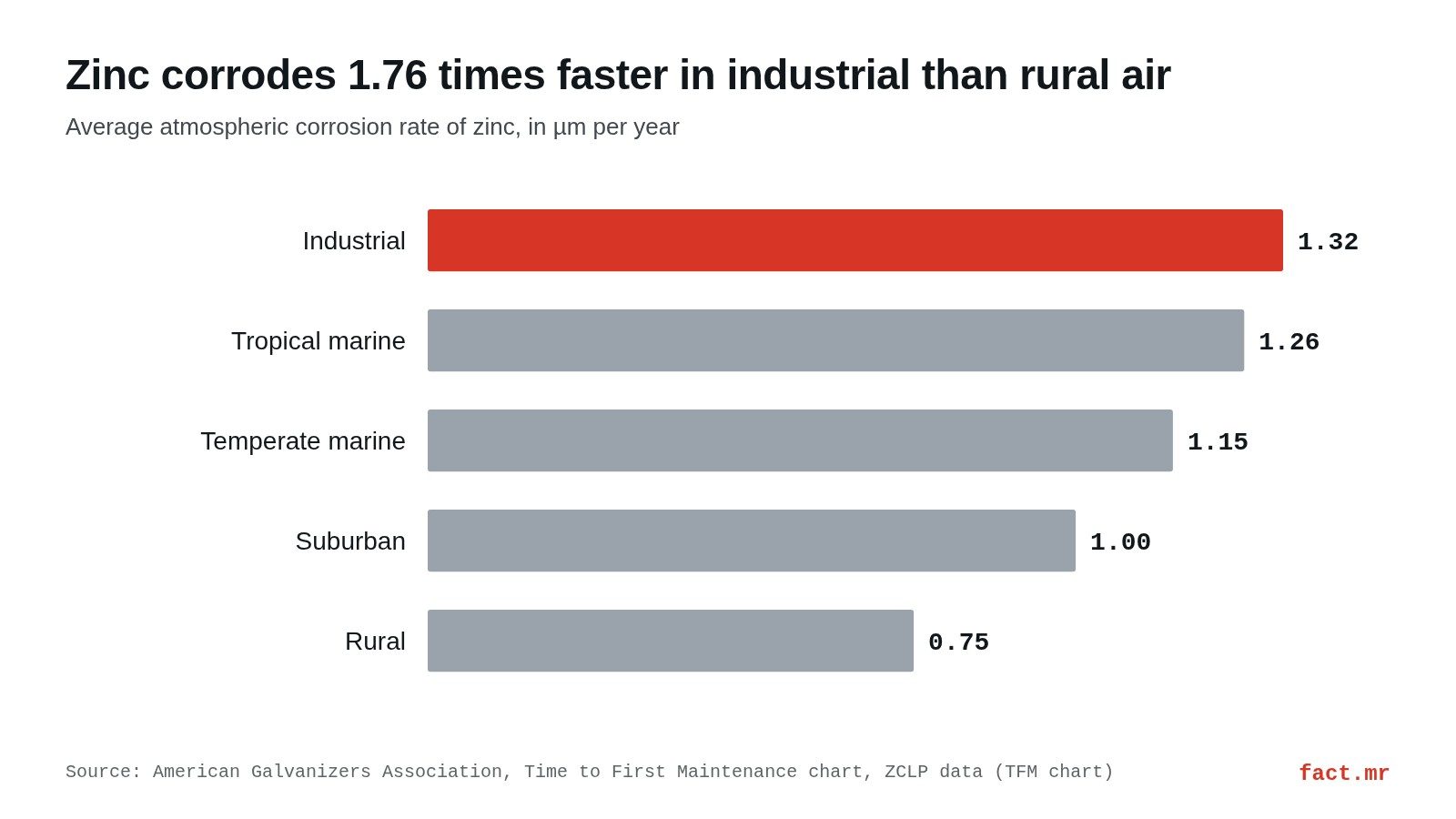
- In the AGA's Time to First Maintenance (TFM) chart, average zinc loss runs from 0.75 µm per year in rural air to 1.32 µm in industrial air, 1.76 times as much.
- For buried steel, the AGA estimates 35 to 50 years of service in the harshest soil and 75 years or more in the least corrosive soil.
- High-strength steels can lose properties in the zinc bath: one peer-reviewed study measured drops of up to 18% in yield strength and up to 55% in hardness.
What galvanized steel is
A peer-reviewed article in PubMed Central defines hot-dip galvanizing as a metallurgical process where the coating comes from a reaction between the base steel and the molten zinc of a bath4. The zinc becomes part of the surface instead of sitting on it like a coat of paint. That difference shows up in adhesion: the AGA puts the bond strength of a galvanized coating at approximately 3,600 psi, against roughly 300-600 psi for other coatings3.
Because the part goes fully under the zinc, the coating reaches places a brush or spray gun misses. The AGA notes that it covers the threads of fasteners and the inside of hollow structures.
Hot-dip versus electrogalvanized
"Galvanized" on a label can mean two different products. Hot-dip galvanized steel is dipped in molten zinc; electrogalvanized steel is coated by a different process. Every lifetime and corrosion figure below comes from sources that describe hot-dip coatings (the AGA's material covers after-fabrication hot-dip galvanized steel), so none of them should be read as a figure for electrogalvanized sheet.
How zinc protects steel from rust
Zinc protects steel in three ways. Each one does a different job.
Barrier
The coating physically separates the steel from air and water. As long as the zinc is intact, oxygen and moisture never touch the iron.
Cathodic protection
Zinc is more reactive than iron. Where the coating gets scratched or cut, the zinc around the damage corrodes first and shields the small patch of exposed steel, so the zinc works as a sacrificial metal.
Zinc patina
The zinc surface reacts with the atmosphere in steps. According to the AGA, zinc oxide forms first, then zinc hydroxide, and finally zinc carbonate2. The carbonate gives the long-term protection: its particles form a tightly adherent and relatively insoluble layer that slows any further attack.
The layers inside a galvanized coating
Under a microscope, a hot-dip coating is a stack of alloys. The iron content drops as you move from the steel toward the surface. The AGA describes three intermetallic layers (gamma, delta and zeta) under a top layer of pure zinc called eta3. The PMC article gives the iron content of each one4.
| Layer (phase) | Position | Iron content (wt.% Fe) |
|---|---|---|
| Eta | Surface, pure zinc | Less than 0.03 |
| Zeta | Intermetallic | 5.8 to 6.7 |
| Delta | Intermetallic | 7 to 11.5 |
| Gamma | Intermetallic, next to the steel | 21 to 28 |
Zinc corrosion rates by ISO 9223 category
How long galvanized steel lasts depends on the air around it. ISO 9223:2012 sorts atmospheres into corrosivity categories from C1 to CX according to how much metal they eat in the first year of exposure. The AGA lists these rates for zinc1:
| ISO 9223 category | Corrosivity | Zinc loss (µm per year) | Zinc loss (mils per year) |
|---|---|---|---|
| C1 | Very low | Less than 0.1 | Less than 0.004 |
| C2 | Low | 0.1 to 0.7 | 0.004 to 0.028 |
| C3 | Medium | 0.7 to 2.1 | 0.028 to 0.083 |
| C4 | High | 2.1 to 4.2 | 0.082 to 0.165 |
| C5 | Very high | 4.2 to 8.4 | 0.165 to 0.331 |
| CX | Extreme | 8.4 to 25 | 0.331 to 0.984 |
The AGA's own figures don't line up perfectly: its table gives 0.083 mils as the top of C3 and 0.082 mils as the bottom of C4. In a separate 2012 article, the association said observed atmospheric rates for galvanized coatings rarely exceed 0.3 mils per year2.
Zinc versus bare steel
The same ISO categories also rate bare low-carbon steel, and the gap is wide. The PMC article reproduces the first-year losses for both metals4:
| Category | Low-carbon steel, mass (g/m²) | Low-carbon steel, thickness (µm) | Zinc, mass (g/m²) | Zinc, thickness (µm) |
|---|---|---|---|---|
| C3 (medium) | >200 to ≤400 | >25 to ≤50 | >5 to ≤15 | >0.7 to ≤2.1 |
| C5 (very high) | >650 to ≤1,500 | >80 to ≤200 | >30 to ≤60 | >4.2 to ≤8.4 |
How long galvanized steel lasts
According to the PMC article, the lifetime of a zinc coating is inversely proportional to its corrosion rate: twice the loss per year means half the years. The article also cites long-term experience of protection lasting up to 50 years. The AGA's numbers go much higher, and they depend on coating thickness, which for most structural steel is at least 3.9 to 5 mils2 (the typical minimum is 100 µm, or 3.9 mils)1.
So why does a single category like C3 get a range as wide as 47 to 143 years? Because C3 itself covers zinc losses from 0.7 to 2.1 µm per year, so a mild C3 site and a harsh one can be decades apart.
The AGA's Time to First Maintenance chart narrows that down with average rates for typical environments, based on data from the ZCLP. The AGA describes it as a quick visual reference for atmospheric corrosion rates in North America1.
| Environment (TFM chart) | Average zinc loss (µm per year) | Mils per year | Equivalent ISO category |
|---|---|---|---|
| Rural | 0.75 | 0.030 | C2/C3 |
| Suburban | 1.00 | 0.040 | C3 |
| Temperate marine | 1.15 | 0.045 | C3 |
| Tropical marine | 1.26 | 0.050 | C3 |
| Industrial | 1.32 | 0.052 | C3 |
Example: a 100 µm coating losing 1.00 µm per year, the suburban average, would last 100 years at that rate. It's a straight-line illustration and says nothing about a specific site.
All five environments fall in or near C3, so the chart doesn't tell you much about atmospheres in C4 or C5. And the AGA built it to represent atmospheric corrosion rates in North America.
In soil and in water
For buried steel, the AGA estimates a service life of 35 to 50 years in the harshest soil and 75 years or more in the least corrosive one2. In chemical solutions, galvanizing performs well between pH 4.0 and pH 12.5. Hard water is much less corrosive to zinc than soft water (an unusual case where mineral-heavy tap water helps).
When galvanizing changes the steel
For ordinary carbon steel, the bath is harmless: the PMC article reports that strength stays the same or may rise slightly. But steels classed as high-strength, with a yield strength above 460 MPa, react differently at galvanizing temperature. In an experiment with three types of steel between 460 and 1,250 MPa, yield strength fell by up to 18%, tensile strength by up to 13% and hardness by up to 55%4.
| Steel (brand grade) | Hardness drop after galvanizing (HV10) |
|---|---|
| DOMEX 460 | 60 HV |
| DOMEX 700 | 80 HV |
| HARDOX 500 | 220 HV |
| ARMOX 500 | 230 HV |
| HARDOX 600 | 240 HV |
HARDOX 600 lost 4 times as much hardness as DOMEX 460. Steels with a yield strength above 1,000 MPa may lose up to 25% of their strength at bath temperature, and the authors set the upper limit for steel suited to galvanizing at Rp0.2 = 700 MPa.
The zinc behind the coating
Galvanizing is the main use of zinc metal. The U.S. Geological Survey (USGS) reports that about three-fourths of the zinc used is consumed as metal, mainly as a coating that protects iron and steel from corrosion. The remaining one-fourth goes into zinc compounds for the rubber, chemical, paint and agricultural industries5.
Zinc is the 23rd most abundant element in the earth's crust and ranks fourth in world production tonnage, behind only iron, aluminum and copper. Its main ore is sphalerite, a zinc sulfide. The USGS also published a fact sheet on the subject, "Zinc - The Key to Preventing Corrosion" (Fact Sheet 2011-3016). Its Data Series 140, whose 2022 zinc update was published in 2024, holds historical statistics on about 90 mineral commodities, with data back to 1900 for many of them6. Related fact.mr guides: nickel production and uses and types of raw materials.
The ISO 9223 tables are based on first-year exposures, so they don't show how a coating behaves after its patina has matured.
Frequently asked questions
How many years does galvanized steel last?
That depends on the atmosphere and the zinc thickness. The AGA estimates 47 to 143 years to first maintenance for a 100 µm coating in an ISO 9223 C3 environment. Buried in soil, its estimate is 35 to 50 years in the harshest soil and 75 years or more in the least corrosive.
Does galvanized steel rust?
The zinc corrodes first, and slowly. The steel underneath starts to rust only once the coating is gone. The AGA reports observed atmospheric rates rarely above 0.3 mils per year, and in its TFM chart average zinc losses range from 0.75 µm per year in rural areas to 1.32 µm in industrial ones.
Can high-strength steel be hot-dip galvanized?
Only up to a point. A peer-reviewed study found high-strength steels lost up to 18% of their yield strength and up to 55% of their hardness after galvanizing. The authors set the upper yield-strength limit for steel suited to galvanizing at Rp0.2 = 700 MPa. Carbon steels keep their strength.
Can galvanized steel be used in water or chemical solutions?
According to the AGA, galvanizing performs well in solutions with a pH above 4.0 and below 12.5. In fresh water, hardness matters: hard water is much less corrosive to zinc than soft water. The lifetimes quoted above are for air and soil, not for immersion.
Sources
- American Galvanizers Association, "HDG Corrosion Rates for ISO Categories C1-C5/X" (web article). Zinc corrosion rates by ISO 9223:2012 category, Time to First Maintenance chart averages (ZCLP data), typical minimum coating thickness and C3 time to first maintenance. galvanizeit.org. Accessed Nov 19, 2026.
- American Galvanizers Association, "Performance of Galvanized Steel in Different Environments" (2012). Zinc patina, observed atmospheric rates, service life in soil, pH range and water hardness. galvanizeit.org. Accessed Nov 19, 2026.
- American Galvanizers Association, "Durability" (web page). Coating layers, bond strength and coverage of threads and hollow parts. galvanizeit.org. Accessed Nov 19, 2026.
- PubMed Central, "The Influence of Hot-Dip Galvanizing on the Mechanical Properties of High-Strength Steels" (PMC8467660). Process definition, bath temperature, iron content of the phases, ISO 9223 losses for steel and zinc, and mechanical property changes. pmc.ncbi.nlm.nih.gov. Accessed Nov 19, 2026.
- U.S. Geological Survey, "Zinc Statistics and Information" (web page). Zinc uses, abundance, production rank, main ore and Fact Sheet 2011-3016. usgs.gov. Accessed Nov 19, 2026.
- U.S. Geological Survey, "Zinc - Historical Statistics (Data Series 140)" (2024). Coverage and time span of the historical series. usgs.gov. Accessed Nov 19, 2026.
Chart: our own, with data from American Galvanizers Association, Time to First Maintenance chart, ZCLP data (source 1).
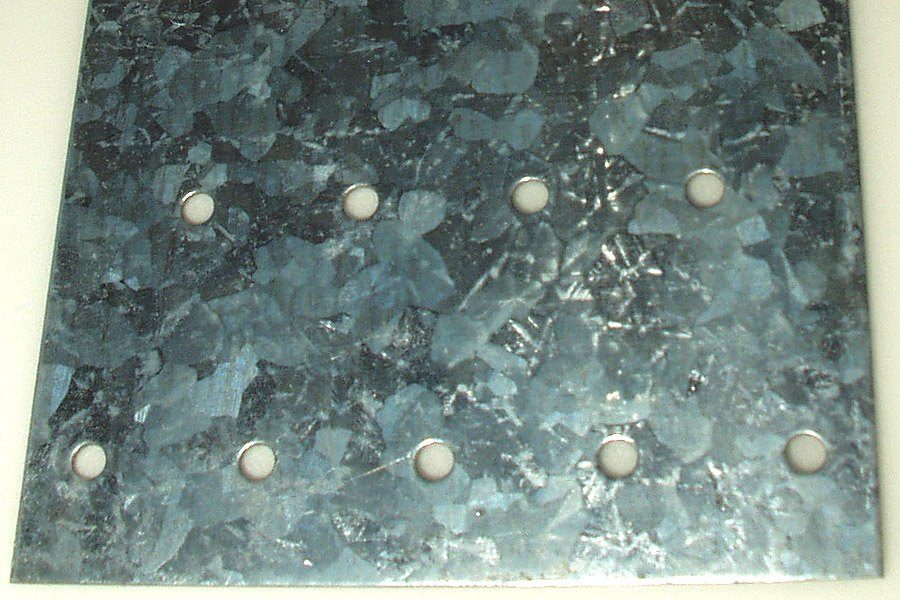
Photo: The original uploader was Splarka at English Wikipedia . (Public domain, Wikimedia Commons).
fact.mr is not affiliated with consulting firms with similar names.
Found an error? Write to us at [email protected].
Related
Platinum-group metals: what they are, what platinum is used for, where it is mined and figures
US salt industry: what it is, which states produce it, what it is used for and figures