Agile methodology: what it is, agile vs. Scrum and waterfall, and adoption figures
Agile methodology explained from the 2001 Agile Manifesto and the 2020 Scrum Guide, plus adoption data: 42% of State of Agile respondents use a hybrid model.
In this article
Agile methodology is a way of building products in small increments that are checked and adjusted as the work moves forward. The term takes its meaning from the four values of the Manifesto for Agile Software Development, published in 20012. Scrum is one framework built on the same idea: the November 2020 Scrum Guide defines it as a lightweight framework with set roles, events and artifacts1.
Key points
- The Agile Manifesto (2001) states four values, each built as a preference: the item on the left matters more than the item on the right.
- Scrum, according to the November 2020 Scrum Guide, has one Scrum Master, one Product Owner and Developers, typically 10 or fewer people, plus five events and three formal artifacts.
- A Sprint lasts one month or less, and the Daily Scrum is a 15-minute event.
- In Digital.ai's 17th State of Agile Report (788 respondents, 2023), 42% said their organization uses a hybrid model that includes Agile, DevOps or other choices.
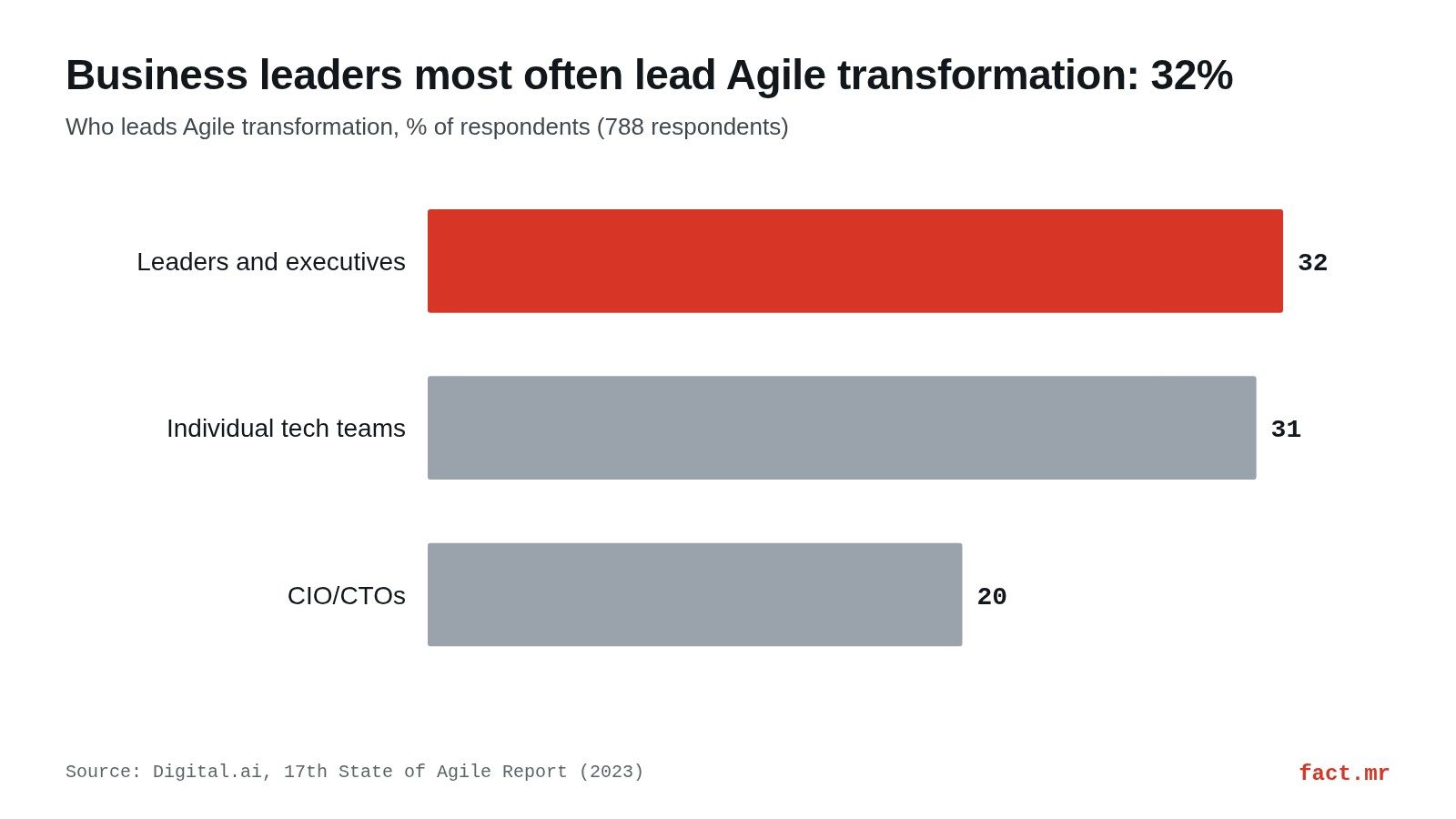
- The same survey found business leaders and executives leading Agile transformation in 32% of cases, ahead of individual technical teams (31%) and CIO/CTOs (20%).
What agile methodology is and where it comes from
The text behind the word fits on a single web page. The site agilemanifesto.org shows four value statements, copyrighted in 2001 by their authors, and a closing line that tells you how to read them: "while there is value in the items on the right, we value the items on the left more"2.
| Valued more (left) | Valued less (right) |
|---|---|
| Individuals and interactions | Processes and tools |
| Working software | Comprehensive documentation |
| Customer collaboration | Contract negotiation |
| Responding to change | Following a plan |
"Methodology" does not appear in the text (the four values never use the word). And the four values name no roles, meetings or deliverables. It sets priorities and leaves the mechanics to whoever adopts it.
The U.S. Government Accountability Office gives a plainer definition in its Agile Assessment Guide (GAO-20-590G), published on Sep 28, 2020: agile is "an approach to software development in which software is developed incrementally and is continuously evaluated" for functionality, quality and customer satisfaction6. The GAO places the guide next to the federal IT acquisition reform law of 2014, known as FITARA, and notes that the federal government planned to spend at least $90 billion on major IT investments in FY 2021. The guide went out as an exposure draft, open for comments from Sep 28, 2020 through Sep 27, 2021.
Agile vs. Scrum: values versus a framework
Agile tells you what to prefer, while Scrum tells you who does what, when and with which outputs. The Scrum Guide says Scrum rests on empiricism and lean thinking, with three empirical pillars: transparency, inspection and adaptation1.
| Aspect | Agile (Manifesto, 2001) | Scrum (Scrum Guide, November 2020) |
|---|---|---|
| What it is | Four values for developing software | A lightweight framework for complex problems |
| Roles | None defined | One Scrum Master, one Product Owner and Developers |
| Cadence | None defined | Five events; Sprints of one month or less |
| Outputs | Working software, as a value | Three formal artifacts |
| Values | The four statements above | Commitment, focus, openness, respect and courage |
| Room to change it | Open to interpretation | Immutable; implementing only parts of it is not Scrum |
Roles, events and artifacts in Scrum
The Scrum Team is typically 10 or fewer people. The Product Owner is "one person, not a committee," and only the Product Owner can cancel a Sprint1. Among the three artifacts, the Guide ties the Product Backlog to the Product Goal and the Increment to the Definition of Done.
Where Scrum came from
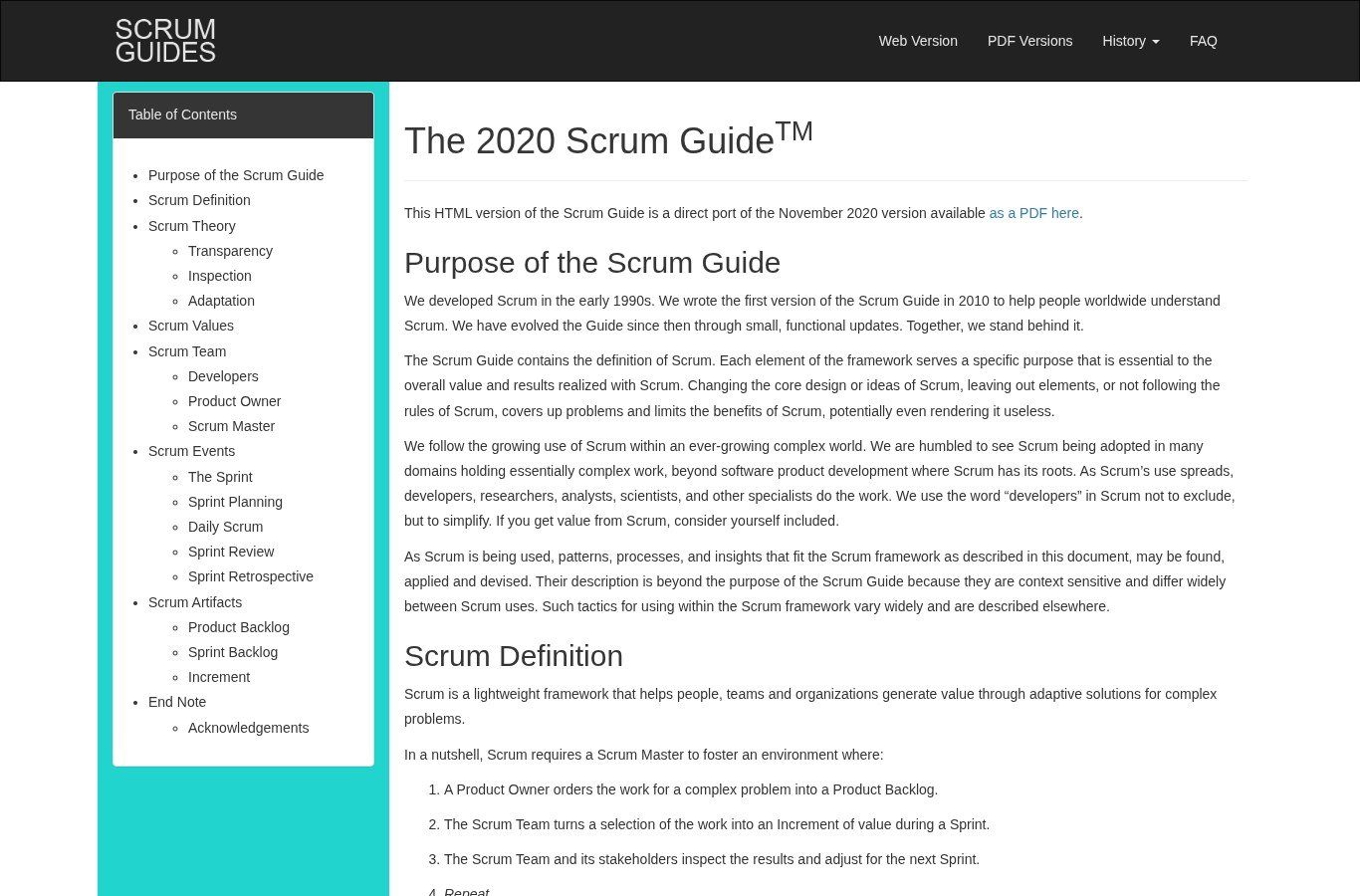
Jeff Sutherland and Ken Schwaber write that they developed Scrum in the early 1990s and first co-presented it at the OOPSLA Conference in 1995. They wrote the first Scrum Guide in 2010, and the current HTML page is a direct port of the November 2020 version, released under a Creative Commons Attribution Share-Alike license1. The Guide describes the framework as developed and sustained for 30-plus years.
Agile vs. waterfall
"Waterfall" is the usual shorthand for plan-driven delivery in sequential stages, where requirements, design, build and testing each close before the next one opens. The Manifesto names that contrast in its fourth value: responding to change over following a plan2.
| Aspect | Agile | Waterfall |
|---|---|---|
| Delivery | Incremental, evaluated continuously (GAO definition) | One delivery at the end of the sequence |
| Change | Expected and absorbed | Handled against the original plan |
| Documentation | Valued less than working software | Central to each stage gate |
| Customer role | Ongoing collaboration | Mostly defined by contract up front |
Phases still exist in agile practice. The UK government's Service Manual, in its "Agile delivery" section on principles, tools and governance, splits an agile project into discovery, alpha, beta, live and retirement7.
How a Scrum Sprint runs, step by step
- The Product Owner orders the Product Backlog toward the Product Goal.
- Sprint Planning opens the Sprint, with a maximum of 8 hours for a one-month Sprint. Developers break Product Backlog items into smaller work items of one day or less.
- The Developers meet each working day for the Daily Scrum, a 15-minute event.
- The Sprint Review inspects the outcome, with a maximum of 4 hours for a one-month Sprint.
- The Sprint Retrospective closes the Sprint, with a maximum of 3 hours for a one-month Sprint.
Every Sprint has a fixed length of one month or less, and the Increment has to meet the Definition of Done1.
Worked example: the time box of a one-month Sprint
Example: take the maximums the Scrum Guide sets for a one-month Sprint. Planning, review and retrospective add up to 8 + 4 + 3 = 15 hours at most, before counting the Daily Scrum. In a month with 20 working days (a round number chosen for the example), the Daily Scrum adds 15 minutes × 20 = 300 minutes, or 5 hours.
| Event | Maximum for a one-month Sprint |
|---|---|
| Sprint Planning | 8 hours |
| Sprint Review | 4 hours |
| Sprint Retrospective | 3 hours |
| Subtotal of the three | 15 hours |
| Daily Scrum (example: 20 working days × 15 minutes) | 300 minutes = 5 hours |
These numbers are ceilings. They are not targets.
Do companies actually use agile? What the surveys show
A long-running public survey is the State of Agile Report, which its site says has been published for 18 years as a benchmark for Agile maturity, trends and transformation4. The latest edition shown on the official page is the 18th, titled "The Adaptation Era," and its headline finding is that "adoption remains widespread, but many organizations are rebuilding from the ground up to focus on measurable outcomes."
The detailed public figures come from the 17th edition, published by Digital.ai with answers from 788 respondents about Agile in 20235.
| Who leads the Agile transformation (17th State of Agile, 2023) | Share of respondents |
|---|---|
| Business leaders and executives | 32% |
| Individual technical teams | 31% |
| CIO/CTOs | 20% |
| Those three together | 83% |
Executives and engineering teams sit almost level, which matters for anyone weighing who should sponsor a change in how teams work (fact.mr's guide to leadership styles and what Gallup data says about managers covers the management side). On methods, 42% of respondents said their organization uses a hybrid model that includes Agile, DevOps or other choices. Hybrid use reached 49% in larger organizations and 45% in medium-sized companies, a gap of 4 percentage points.
But how many of those teams run Scrum specifically? The public summary of the 17th edition doesn't break that out, and the 18th edition's landing page gives no comparable percentages. A vendor survey with a self-selected sample also calls for the usual caution, covered in how to read industry reports without getting manipulated.
When agile helps and when it does not
The Scrum Guide aims Scrum at complex problems and says it has been adopted in many domains of complex work beyond software product development1. The 17th State of Agile adds that small, nimble organizations continue to report Agile as a powerful productivity and organizational framework5.
The texts offer far less for work whose steps are known in advance and rarely change. Even the Manifesto's authors concede that "there is value in the items on the right," so plans, contracts and documentation keep a place in agile work. A hybrid model is also no sign of failure: it is the arrangement 42% of State of Agile respondents described for their own organizations.
Common confusions
- Agile and Scrum as synonyms. Agile is the set of values from 2001; Scrum is one framework, with its own rules, that applies them.
- Scrum "à la carte." The Guide calls the framework immutable and says implementing only parts of it is not Scrum.
- A Product Owner committee. The Guide says the role is one person.
- A daily meeting of any length. The Daily Scrum is a 15-minute event for the Developers.
- Translated versions as separate texts. The Spanish version of the Manifesto, translated by Ángel Medinilla, Andrés Giné and Esther Gómez, sits on the same site and keeps the same closing line3.
Neither official text puts a number on how many organizations use agile; the only figures come from the State of Agile survey and its 788 respondents in 2023.
Frequently asked questions
Is Scrum the same as agile methodology?
No. Agile refers to the four values of the Agile Manifesto, published in 2001. Scrum is a framework defined in the November 2020 Scrum Guide, with one Scrum Master, one Product Owner, Developers, five events and three formal artifacts. A team can work in an agile way without using Scrum.
How long is a Sprint in Scrum?
The Scrum Guide sets Sprints as fixed-length events of one month or less. For a one-month Sprint, planning takes up to 8 hours, the review up to 4 hours and the retrospective up to 3 hours, and the Daily Scrum lasts 15 minutes.
How many people are on a Scrum team?
According to the Scrum Guide, a Scrum Team is typically 10 or fewer people: one Scrum Master, one Product Owner and the Developers. The Product Owner is one person, not a committee, and is the only one who can cancel a Sprint.
How many companies use agile?
None of the official texts cited here gives a figure. In Digital.ai's 17th State of Agile Report, based on 788 respondents in 2023, 42% said their organization uses a hybrid model that includes Agile, DevOps or other choices, rising to 49% in larger organizations and 45% in medium-sized companies.
Sources
- Ken Schwaber and Jeff Sutherland, "The Scrum Guide" (November 2020 version). Definition of Scrum, history, team, events, timeboxes, artifacts and license. scrumguides.org. Accessed Oct 21, 2026.
- Agile Manifesto authors, "Manifesto for Agile Software Development" (2001). The four values and how to read them. agilemanifesto.org. Accessed Oct 21, 2026.
- Agile Manifesto authors, "Manifiesto por el Desarrollo Ágil de Software" (Spanish version). Translators and closing line. agilemanifesto.org. Accessed Oct 21, 2026.
- State of Agile, "State of Agile" (18th edition, "The Adaptation Era"). Years of publication, scope and headline finding. stateofagile.com. Accessed Oct 21, 2026.
- Digital.ai, "17th State of Agile Report" (2023). Sample, who leads Agile transformation, hybrid models by company size and findings on small organizations. digital.ai. Accessed Oct 21, 2026.
- U.S. Government Accountability Office, "Agile Assessment Guide: Best Practices for Agile Adoption and Implementation" (GAO-20-590G, 2020). Definition of agile, federal IT spending, FITARA and comment period. gao.gov. Accessed Oct 21, 2026.
- GOV.UK, "Agile delivery - Service Manual". Phases of an agile project and scope of the section. gov.uk. Accessed Oct 21, 2026.
Chart: our own, with data from Digital.ai, 17th State of Agile Report (source 5).
Photo: our own screenshot of scrumguides.org, Oct 21, 2026.
fact.mr is not affiliated with consulting firms with similar names.
Found an error? Write to us at [email protected].