Kaizen: what it is, how Toyota uses it and how to run a kaizen event
Kaizen means continuous improvement. How Toyota built it into its suggestion system from 1951, and how the EPA describes a kaizen event of one to seven days.
In this article
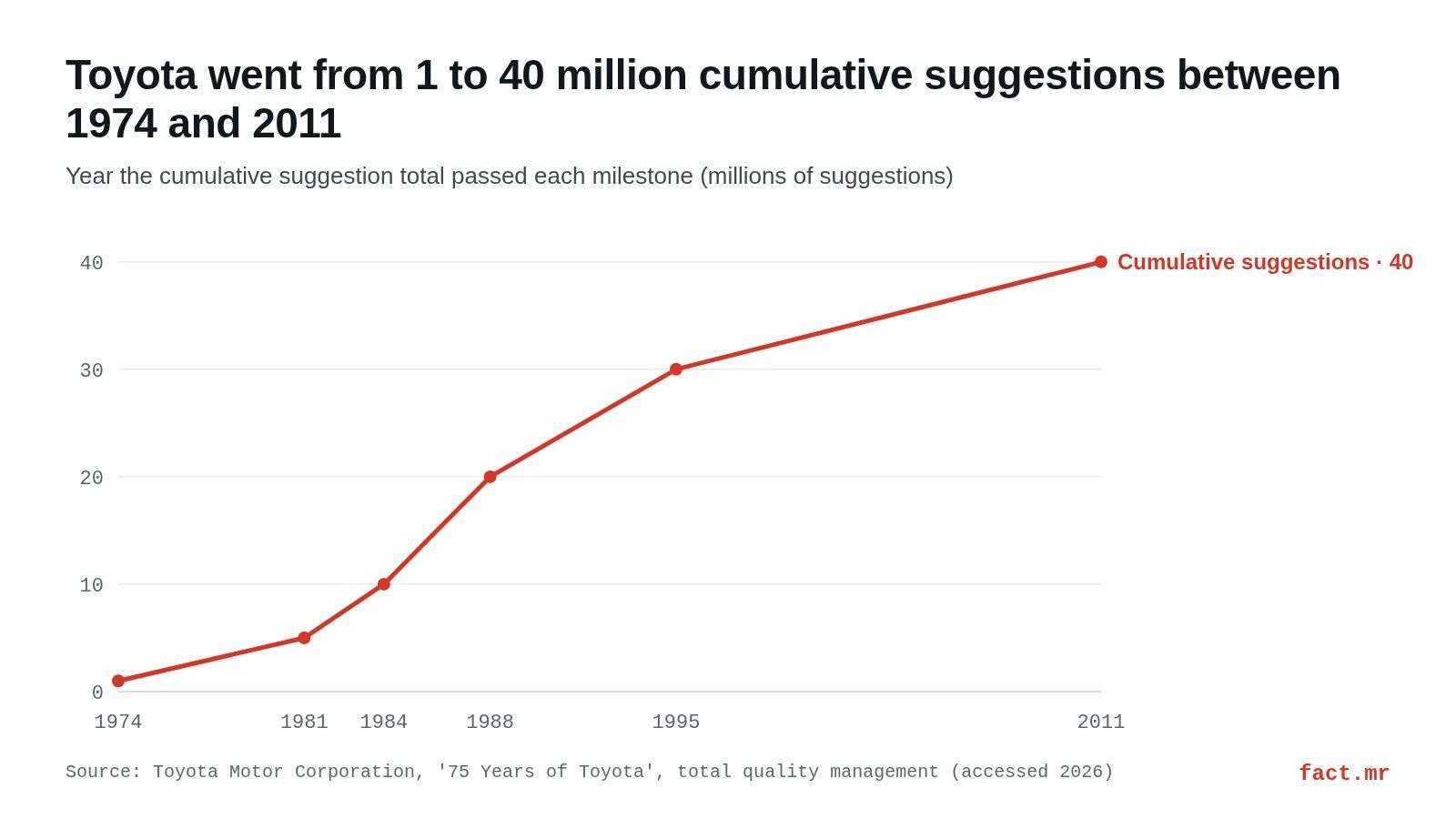
Kaizen means continuous improvement: the people who do the daily work note its problems and propose the fixes. Toyota lists kaizen among the principles of its total quality management, next to "customer first" and "total participation." Its suggestion system, launched in 1951, passed 40 million cumulative ideas in August 2011, according to Toyota Motor Corporation's corporate history2.
Key points
- Toyota UK defines it in four words: "Kaizen means continuous improvement"5.
- Toyota introduced statistical quality control in 1949 and launched its Creative Idea Suggestion System in 1951, modeled on the suggestion system at Ford2.
- Cumulative suggestions went from more than 1 million in May 1974 to more than 40 million in August 20112. Toyota Times puts the total at 50 million over seven decades3.
- Employees submitted some 810,000 suggestions in 2023, an average of 14.4 per person among plant technical staff3.
- The U.S. Environmental Protection Agency (EPA) describes kaizen events lasting one to seven days, with improvements often in place within 72 hours6.
What kaizen is and where it comes from
In lean manufacturing, the term points back to one carmaker. Toyota says the objective of the Toyota Production System (TPS) is to thoroughly eliminate waste and shorten lead times, so that it can deliver vehicles quickly, at low cost and with high quality1.
The TPS rests on two pillars: jidoka and Just-in-Time. Just-in-Time means synchronizing production processes and making only what is needed, when it is needed and in the amount needed. Toyota credits that concept to Kiichiro Toyoda, founder of Toyota Motor Corporation, and traces the system's roots to the automatic loom invented by Sakichi Toyoda, founder of the Toyota Group1.
A car is made up of more than 30,000 parts, the same Toyota page notes.
Outside Toyota, a U.S. federal agency describes the method too. The EPA published a kaizen guide in 2016 that frames the method as eliminating waste, improving productivity and achieving sustained continual improvement in targeted activities and processes6.
Kaizen inside Toyota's total quality management
Toyota's corporate history names kaizen as one of the three principles of its total quality management (TQM), together with "customer first" and "total participation"2. The timeline it publishes is short: statistical quality control (SQC) in 1949, the suggestion system in 1951, the Deming Application Prize in 1965 and the Japan Quality Control Award in 1970. Sixteen years separate SQC from the Deming Prize.
The Toyota Way 2001
In April 2001 Toyota published The Toyota Way 20014. The same history notes that TMC's consolidated headcount had exceeded 200,000 employees in fiscal 1999.
How to run a kaizen event, step by step
Public sources describe two formats that run side by side. One is daily and almost invisible: each person writes down problems and proposes changes. The other is intensive, with a date, a team and a chosen area.
The kaizen event, according to the EPA
| Stage | What happens | EPA detail |
|---|---|---|
| Planning and preparation | The team picks the target area for the event | Phase 1 of the guide |
| Event | The team studies the process and looks for the root cause | Lasts between one day and seven days |
| Implementation | Agreed changes go into effect | Often within 72 hours of starting the event |
| Follow-up | The team checks whether the gain holds | Sometimes at 30 and 90 days after the initial event |
To find the root cause, the EPA points to a practice it credits to Toyota: asking "why" five times6.
Bringing it to a small business
A machine shop, a warehouse or a restaurant kitchen can borrow pieces of both formats without copying an automaker's structure:
- Make a habit of noting problems from daily work. That is step 1 of Toyota's eight-step suggestion system3.
- Pick one narrow area (a pick line, a packing station, the end-of-day close), as the EPA's planning phase asks.
- Ask "why" until the chosen problem reaches its root cause.
- Make the change fast: the EPA says implementation often happens within 72 hours.
- Have a supervisor review the result. At Toyota, step 7 is a supervisor's genchi-genbutsu review to determine the reward amount3.
- Return to the area at 30 and 90 days to see whether the improvement is still there.
Worked example: Toyota's suggestion system
Toyota documents its own case with numbers. Its corporate history lists cumulative suggestion milestones since the system launched in 19512:
| Date | Cumulative suggestions |
|---|---|
| May 1974 | More than 1 million |
| June 1981 | More than 5 million |
| April 1984 | More than 10 million |
| 1988 | More than 20 million |
| August 1995 | More than 30 million |
| August 2011 | More than 40 million |
The corporate series stops in 2011. Toyota Times, the company's own outlet, gives a later figure: 50 million suggestions over seven decades3. Both are cumulative totals, counted up to different dates.
What does one recent year look like? In 2023 employees submitted some 810,000 suggestions, an average of 14.4 per person per year among plant technical staff3. Dividing 810,000 by twelve months gives 67,500 a month, which Toyota Times rounds to 67,000.
First- and second-year employees can earn the Rookie Award by reaching at least 36 suggestions in a year, or three a month. That target is 2.5 times the 14.4 average, with a big caveat: the two figures describe different groups of workers, so the comparison is only a rough guide. The top prize, The Best Award, pays 10,000 to 200,000 yen, and submissions are evenly split between paper and digital3.
But the data has a gap: none of these sources say what share of the suggestions were put into practice or how much money each one saved.
When kaizen fits and when it doesn't
The EPA's wording sets the boundary: targeted activities and processes. Repeating work like picking orders, handling returns or setting up a production shift gives a team enough material for a one- to seven-day event and a 30- and 90-day follow-up.
Outside that boundary, the method has little to grip. Setting the strategy for a new company calls for a different tool, such as a business plan. And a suggestion system costs management time: at Toyota, a supervisor reviews suggestions to determine the reward (a suggestion box nobody opens is just a box).
Common confusions
Kaizen vs. the Toyota Production System
The TPS is the whole production system, built on jidoka and Just-in-Time1. Kaizen appears in Toyota's history as a principle of its total quality management2.
Kaizen vs. a kaizen event
Kaizen is the ongoing habit. A kaizen event is a short, intensive format with a fixed length, which the EPA describes for teams working on an area chosen in advance.
Kaizen, lean, six sigma and agile
Toyota uses the word lean too: Toyota Manufacturing UK offers Lean Approach Seminars for team leaders from other companies5. Six sigma and agile and Scrum are separate methods with their own guides.
The clearest limit of the method sits in the EPA guide itself. Follow-ups are scheduled at 30 and 90 days only "sometimes," and without that check nobody can tell whether the improvement held.
Frequently asked questions
What does kaizen mean?
Toyota UK, in an article published on May 14, 2026, defines it as continuous improvement. In Toyota's corporate history, kaizen is one of the three principles of its total quality management, along with "customer first" and "total participation," and its suggestion system dates to 1951.
How long does a kaizen event last?
The EPA's public guide says kaizen events generally last between one day and seven days. Improvements are often implemented within 72 hours of starting the event, and follow-up events are sometimes scheduled at 30 and 90 days.
How many suggestions does Toyota get each year?
Toyota Times reports some 810,000 suggestions in 2023, about 67,000 a month, with an average of 14.4 per person among plant technical staff. Its all-time total is 50 million over seven decades. Toyota's corporate history recorded more than 40 million in August 2011.
Does kaizen work for a small business?
None of the definitions cited here limit it to large companies. The EPA frames it around targeted activities and processes, and step 1 of Toyota's system is noting problems from daily work. A small business can start with one narrow area, use the five whys to find the root cause and check the result at 30 and 90 days.
Sources
- Toyota Motor Corporation, "Toyota Production System" (undated). TPS objective, its two pillars (jidoka and Just-in-Time), origin in Sakichi Toyoda's loom, Kiichiro Toyoda's role and number of parts in a car. global.toyota. Accessed Nov 18, 2026.
- Toyota Motor Corporation, "Total Quality Management (TQM): Changes and Innovations," 75 Years of Toyota (undated). TQM principles, introduction of SQC, the suggestion system and its Ford model, quality awards and cumulative suggestion milestones. toyota-global.com. Accessed Nov 18, 2026.
- Toyota Times, "Making Work More Fun and Fruitful: Toyota's Creative Idea Suggestion System" (2024). Suggestions in 2023, per-person average, Rookie Award, rewards in yen, system steps, submission format and all-time total. toyotatimes.jp. Accessed Nov 18, 2026.
- Toyota Motor Corporation, "Human Resources Development," 75 Years of Toyota (undated). Publication of The Toyota Way 2001 and TMC consolidated employees. toyota-global.com. Accessed Nov 18, 2026.
- Toyota UK, "What is kaizen and how does Toyota use it?" (May 14, 2026). Definition of kaizen and Toyota Manufacturing UK's Lean Approach Seminars. mag.toyota.co.uk. Accessed Nov 18, 2026.
- U.S. Environmental Protection Agency (EPA), "Lean Thinking and Methods - Kaizen" (Nov 16, 2016). Kaizen focus, event length and phases, implementation timing, follow-ups and the five whys. epa.gov. Accessed Nov 18, 2026.
Chart: our own, with data from Toyota Motor Corporation (source 2).
fact.mr is not affiliated with consulting firms with similar names.
Found an error? Write to us at [email protected].
Related
Six sigma: what 3.4 defects per million means, how to read the sigma table and the DMAIC steps
Business plan: what it is, the sections the SBA lists, and traditional vs. lean format