Unemployment rate: what it is, how it is calculated and figures for the US, Mexico and Spain
The US unemployment rate was 4.1% in October 2026, per the BLS. The official definition, the formula, and how Mexico (2.8%) and Spain compare.
In this article
The unemployment rate is the share of the labor force that has no job, has looked for one and is available to work. In the United States, the Bureau of Labor Statistics (BLS) put it at 4.1% in October 2026, with 7.1 million people unemployed, in the Employment Situation report released on Friday, November 6, 20262.
Key points
- The BLS reported an unemployment rate of 4.1% for October 2026, compared with 4.2% in September. Since March the rate has stayed between 4.1% and 4.3%.
- The BLS, Mexico's INEGI and Eurostat all use the same formula: unemployed people divided by the labor force (employed plus unemployed), times 100.
- Mexico's open unemployment rate was 2.8% in September 2026 (1.8 million people), according to INEGI's ENOE survey. Labor informality covered 54.3% of employed people in the same month.
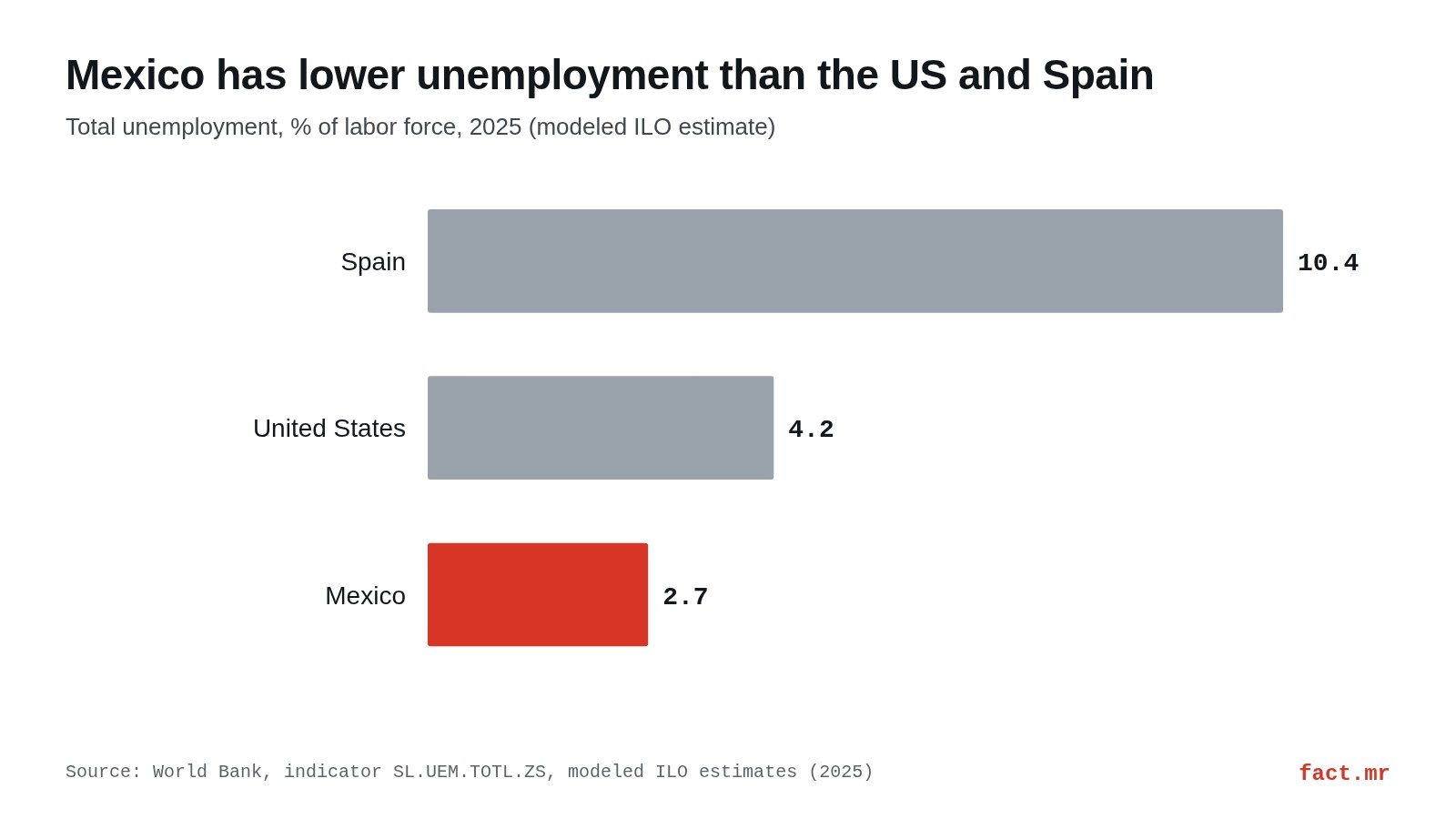
- The World Bank publishes modeled ILO estimates. For 2025 they give Spain 10.376% unemployment, the US 4.198% and Mexico 2.673%.
- Eurostat reported 6.5% for the euro area and 6.2% for the EU as a whole in September 2026.
What the unemployment rate measures
The BLS states that there is only one official definition of unemployment: people who are jobless, looking for a job and available for work. To be counted, a person must have no job, must have actively looked for work in the prior 4 weeks and must be available to work now4. The Current Population Survey (CPS) is the household survey behind the number, and it counts every person age 16 and over, with no upper age limit.
The bar for being employed is low. Any work at all for pay or profit during the survey reference week counts4.
The ILO definition used in Europe
Eurostat follows the guidelines of the International Labour Organization (ILO). Under them, an unemployed person is someone aged 15 to 74 who had no work in the reference week, actively sought work in the last 4 weeks and can start within the next 2 weeks5. Eurostat defines the rate the same way the BLS does, as unemployed people as a percentage of the labor force.
How Mexico defines it
Mexico's national statistics institute, INEGI, calls the figure the tasa de desocupación (open unemployment rate). It counts as unemployed the population that "did not work even one hour during the survey reference week, but expressed willingness to do so"1. The data come from the ENOE (National Survey of Occupation and Employment), which INEGI calls the main source of information on the Mexican labor market. Fieldwork for the survey began in January 2005.
One hour is enough.
A street vendor who worked a few paid hours during the survey week counts as employed in the ENOE, whether the job is formal or not.
How to calculate the unemployment rate
The rate needs two counts. Add employed and unemployed people together to get the labor force. Then divide the unemployed by that total and multiply by 100.
Unemployment rate = unemployed ÷ (employed + unemployed) × 100
Example with round numbers, not data from any country: an economy with 5 million unemployed and 95 million employed has a labor force of 100 million and an unemployment rate of 5%.
With the BLS figures for October 2026, the calculation works like this. Divide 7,068 thousand unemployed by a civilian labor force of 170,683 thousand and you get 4.14%, which the BLS publishes as 4.1%3. In Mexico, INEGI reports 1.8 million unemployed, equal to 2.8% of a labor force of 61.7 million1.
How precise is a monthly number? The BLS says that, with a confidence level of 90 out of 100, its monthly unemployment estimate falls within about 300,000 people of what a full census would find. The CPS has run every month since 1940, and its sample is 60,000 eligible households4.
United States: the latest BLS report
Total nonfarm payroll employment rose by 165,000 in October 2026. The unemployment rate was 4.1%, after 4.2% in September3, and the BLS said it changed little. It has stayed in a narrow range of 4.1% to 4.3% since March2.
There were 2.0 million long-term unemployed (jobless for 27 weeks or more), or 27.6% of all unemployed people. Labor force participation was 61.9% and the employment-population ratio was 59.3%. By group, the rate was 3.9% for adult men, 3.6% for adult women, 13.9% for teenagers, 6.6% for Black workers and 4.7% for Hispanic or Latino workers2.
Average hourly earnings for all private nonfarm employees rose 14 cents, or 0.4%, to $38.00, and were up 3.1% over 12 months. The average workweek stayed at 34.4 hours2.
| Year | Annual unemployment rate (BLS, CPS) | Unemployed (thousands) |
|---|---|---|
| 2021 | 5.3% | 8,623 |
| 2022 | 3.6% | 5,996 |
| 2023 | 3.6% | 6,080 |
| 2024 | 4.0% | 6,761 |
| 2025 | 4.3% | 7,314 |
The 2025 figure comes with fine print. It is an 11-month average that leaves out October, because October 2025 data were not collected during the federal government shutdown, and the BLS warns that it is not strictly comparable with other years3.
Mexico: a low rate next to high informality
INEGI published its September figures on October 22, 2026. Employment reached 60.0 million people and the participation rate was 58.5%1.
| Indicator (ENOE, INEGI) | September 2025 | September 2026 |
|---|---|---|
| Open unemployment rate (% of labor force) | 3.0% | 2.8% |
| Participation rate | 59.6% | 58.5% |
| Labor informality rate TIL1 (% of employed) | 54.9% | 54.3% |
| Critical employment conditions rate | 37.3% | 37.5% |
The rate was 2.7% among women and 2.9% among men, a gap of 0.2 percentage points. People aged 25 to 44 made up 46.8% of the unemployed, and those aged 15 to 24 made up 30.5%. And 40.0% had been out of work for a month or less1.

A US reader should read the 2.8% alongside a second figure: 54.3%. That was INEGI's labor informality rate (TIL1) in September 2026. It covers 32.6 million employed people, and it was 42.4% in urban areas1.
Under the one-hour rule, all of those workers count as employed, so none of them show up in the 2.8%. The cited sources don't say how many of them a survey with a different design would count as unemployed.
By sector, services employed 27.0 million people (44.9%), commerce 11.9 million (19.8%) and manufacturing 9.4 million (15.7%). Agriculture, livestock, forestry, hunting and fishing employed 6.3 million (10.6%) and construction 4.6 million (7.6%). Subordinate paid workers, Mexico's category for people who work for an employer and receive pay, totaled 41.0 million, or 68.4% of the employed1.
The guide to the org chart and its types shows how those jobs are arranged inside a company.
Spain and the euro area
Spain's official figure comes from the Encuesta de Población Activa (EPA, Spain's quarterly labor force survey), run by the INE, the national statistics institute. Since the first quarter of 2026, the EPA's activity tables have been coded under CNAE 2025, Spain's national classification of economic activities, with double coding under CNAE 2025 and CNAE 2009 for all four quarters of 20266. In Eurostat's monthly series, Spain appears with quarterly data up to the third quarter of 20265.
On October 30, 2026, Eurostat reported a September rate of 6.2% for the EU and 6.5% for the euro area, up from 6.0% and 6.3% a year earlier. Since January 2026, the euro area has been calculated with 21 countries. It was 0.3 percentage points above the EU, and the number of unemployed people rose by 471 000 in the EU and by 420 000 in the euro area over the year5.
Youth unemployment (under 25) was 15.5% in the EU and 15.4% in the euro area5.
Comparing countries on one scale
National surveys use similar definitions, but their age limits and job-search rules differ: the CPS counts people 16 and over, while Eurostat counts people 15 to 74. The World Bank indicator SL.UEM.TOTL.ZS uses modeled ILO estimates to put all three countries in one series7.
| Country | 2023 | 2024 | 2025 |
|---|---|---|---|
| Spain | 12.179% | 11.4% | 10.376% |
| United States | 3.638% | 4.022% | 4.198% |
| Mexico | 2.765% | 2.678% | 2.673% |
In 2025, the US estimate was 1.525 percentage points higher than Mexico's. Mexico's estimate fell 1.767 points between 2020, when it stood at 4.44%, and 20257.
The two sources disagree on the US for 2025. The BLS gives 4.3% (an 11-month average), while the modeled ILO estimate is 4.198% (if you cite one, say which one). The guide to comparative advantage also compares economies on a common base.
Common confusions
Unemployed versus out of the labor force
People who stop looking for work leave the labor force and stop counting as unemployed. The BLS counted 448,000 discouraged workers in October 20262. INEGI defines participation as the percentage of the population that has a job, or has none but is actively looking for one, and in Mexico it fell from 59.6% to 58.5% between September 2025 and September 20261.
But a falling unemployment rate can hide people who gave up. Labor figures like these usually go in the economic block of a PESTEL analysis.
Unemployment versus underemployment
Underemployment is measured among people who already have a job. Mexico's underemployment rate was 6.7% of the employed population in September 20261. The closest US measure counts people employed part time for economic reasons, a group that grew by 339,000 to 4.8 million in October2.
A small monthly change versus a real change
The monthly BLS estimate carries a sampling margin of about 300,000 people. The source doesn't say how much of a small monthly change falls within that margin4.
Frequently asked questions
What is the current US unemployment rate?
The BLS put it at 4.1% for October 2026 in the Employment Situation report released on November 6, 2026. That was 7.1 million unemployed people, compared with a rate of 4.2% in September.
How is the unemployment rate calculated?
Divide the number of unemployed people by the labor force (employed plus unemployed) and multiply by 100. For October 2026, 7,068 thousand unemployed divided by a labor force of 170,683 thousand gives 4.14%, which the BLS publishes as 4.1%.
Why is Mexico's unemployment rate lower than the US and Spain?
The World Bank's modeled ILO estimates for 2025 are 2.673% for Mexico, 4.198% for the US and 10.376% for Spain, but the cited sources don't explain the gap. The ENOE does show that 54.3% of employed Mexicans work informally, and anyone with an informal job counts as employed, not unemployed.
When is the next unemployment report released?
The BLS will publish the Employment Situation for November on Friday, December 4, 2026. INEGI's next ENOE release is scheduled for November 26, 2026. In Spain, the INE publishes the EPA every quarter.
Sources
- INEGI, "Indicadores de ocupación y empleo" (October 22, 2026, September 2026 data). Open unemployment rate, labor force, employment, participation, underemployment, informality, employment by sector and ENOE definitions. inegi.org.mx. Accessed Nov 11, 2026.
- U.S. Bureau of Labor Statistics, "Employment Situation Summary" (October 2026). Unemployment rate, payroll employment, unemployment by group, earnings, hours, part time for economic reasons and discouraged workers. bls.gov. Accessed Nov 11, 2026.
- U.S. Bureau of Labor Statistics, "A-1. Employment status of the civilian noninstitutional population 16 years and over, prior years to date" (2026). Annual rates for 2021 to 2025, the note on 2025, and the labor force in September and October 2026. bls.gov. Accessed Nov 11, 2026.
- U.S. Bureau of Labor Statistics, "How the Government Measures Unemployment". Official definitions, sample and margin of error of the CPS. bls.gov. Accessed Nov 11, 2026.
- Eurostat, "Unemployment statistics" (October 30, 2026). EU and euro area rates, youth unemployment, Spain's data coverage and the ILO definition. ec.europa.eu. Accessed Nov 11, 2026.
- INE, "Encuesta de población activa: últimos datos" (2026). Notice on CNAE 2025 coding. ine.es. Accessed Nov 11, 2026.
- World Bank, "SL.UEM.TOTL.ZS: Unemployment, total (% of total labor force) (modeled ILO estimate)" (2025). Modeled ILO estimates for Mexico, the United States and Spain. worldbank.org. Accessed Nov 11, 2026.
Chart: our own, with data from World Bank (source 7).
Photo: Luisalvaz (CC BY-SA 4.0, Wikimedia Commons).
fact.mr is not affiliated with consulting firms with similar names.
Found an error? Write to us at [email protected].
Related
PESTEL analysis: what it is, the six factors, a template and a copper example
Comparative advantage: what it is, how it differs from absolute advantage, examples and figures