Btu: what it is, how many Btu are in a kWh, conversion factors and figures
One kilowatt-hour equals 3,412 Btu and one therm 100,000 Btu, per the EIA. Conversion factors for electricity, natural gas, oil, propane and wood.
In this article
A British thermal unit (Btu) is the amount of heat needed to raise the temperature of one pound of water by 1°F. The U.S. Energy Information Administration (EIA) uses it as the standard unit for comparing fuels. Its factor for electricity is 1 kWh = 3,412 Btu, which puts a power bill and a gas or heating oil bill on the same scale.1
Key points
- EIA factors: 1 kWh = 3,412 Btu, 1 therm = 100,000 Btu and 1 cubic foot of natural gas = 1,036 Btu.
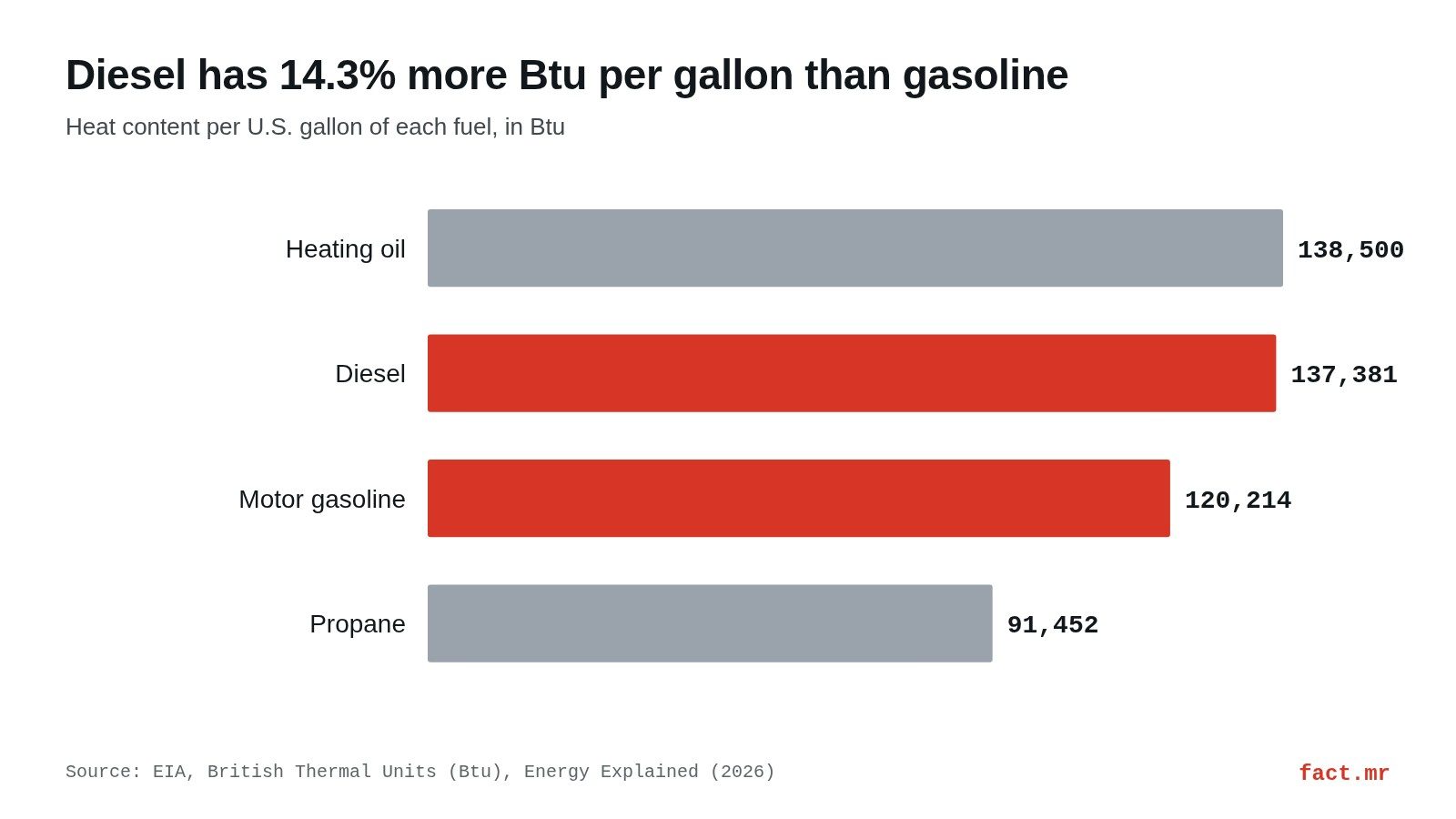
- Based on those EIA factors, a gallon of diesel holds 14.3% more Btu than a gallon of motor gasoline, and a gallon of propane holds 76.1% of the Btu in a gallon of gasoline.
- NIST puts 1 Btu IT at 1,055.056 joules and 1 kWh at 3.6 MJ.
- In 2025, the heat content of natural gas delivered to consumers ranged from 917 Btu per cubic foot in Hawaii to 1,096 in Washington.
- In an EIA cost example, natural gas came out at $13.18 per million Btu and heating oil at $29.90.
What a Btu measures
The EIA describes the Btu as a measure of the heat content of fuels or energy sources. For a sense of scale, the EIA says 1 Btu is about the energy released by burning a match.1
The unit matters because each fuel is sold in its own physical unit. Gasoline, diesel, jet fuel and biofuels come in barrels or gallons, natural gas in cubic feet, coal in short tons and electricity in kilowatt-hours. A barrel of crude oil or petroleum products holds 42 U.S. gallons.2
In the United States, the Btu is the most common unit for comparing energy sources or fuels, according to the EIA.2
Three Btu definitions in the NIST guide
The National Institute of Standards and Technology (NIST) lists more than one Btu in its Guide to the SI, Appendix B.8. The Btu IT equals 1,055.056 joules, the thermochemical Btu (Btu th) 1,054.350 J and the 59°F Btu 1,054.80 J.5 For household bills the gap between them is too small to matter (it shows up only after the first three digits).
Conversion factors: Btu, kWh, therm, cubic foot and gallon
The EIA recalculates its factors every year to reflect changes in the quality and composition of fuels. The current set is in Appendix A of its Monthly Energy Review, and the agency's conversion factors page was last updated on November 2, 2026.2,3
| Energy source | Physical unit | Btu per unit (EIA) |
|---|---|---|
| Electricity | 1 kilowatt-hour | 3,412 |
| Natural gas | 1 cubic foot | 1,036 |
| Natural gas | 1 therm | 100,000 |
| Motor gasoline | 1 gallon | 120,214 |
| Diesel fuel | 1 gallon | 137,381 |
| Heating oil | 1 gallon | 138,500 |
| Propane | 1 gallon | 91,452 |
| Wood | 1 cord | 20,000,000 |
To compare these with metric energy units, the NIST factors give the value of each unit in joules:
| Unit | Joules (NIST) |
|---|---|
| Btu IT | 1,055.056 J |
| Btu th (thermochemical) | 1,054.350 J |
| Btu (59°F) | 1,054.80 J |
| Kilowatt-hour | 3.6 × 10^6 J (3.6 MJ) |
| Therm (U.S.) | 1.054 804 × 10^8 J |
| Quad (10^15 Btu IT) | 1.055056 × 10^18 J |
How to convert between Btu and kWh, therms and cubic feet
Every conversion is a multiplication or a division by the factor in the table:
- Btu = kWh × 3,412, and kWh = Btu ÷ 3,412.
- Btu = cubic feet of natural gas × 1,036.
- Therms = Btu ÷ 100,000.
- Btu = gallons × the Btu per gallon of that fuel.
Example: a round figure of 10,000 kWh of electricity is 10,000 × 3,412 = 34,120,000 Btu. Divide 34,120,000 by 3,412 and you get back to 10,000 kWh.
The EIA works through a heating example on its units page. A home that burns 67,000 cubic feet of natural gas gets 67,000 × 1,036 = 69,412,000 Btu, while a neighbor's home with 500 gallons of heating oil, at 137,381 Btu per gallon, gets 68,690,476 Btu in the EIA's calculation.2 But the two EIA pages don't match on heating oil: the worked example uses 137,381 Btu per gallon, which is the diesel factor, while the factor table lists heating oil at 138,500.1,2
The conversion factors page has more examples. Ten barrels of asphalt, at 6.636 million Btu per barrel, hold about 66.36 million Btu. In two other examples, 10 barrels equal 420 U.S. gallons, and 500 short tons multiplied by 0.9071847 give 453.6 metric tons.3
Btu per gallon: diesel, gasoline, heating oil and propane
The chart above ranks the four liquid fuels by heat per gallon in the EIA table: heating oil at 138,500 Btu, diesel at 137,381, motor gasoline at 120,214 and propane at 91,452.1 Using those factors, a gallon of diesel carries 14.3% more Btu than a gallon of gasoline. Propane reaches 76.1% of gasoline's figure.
These factors are the EIA's figures for the United States. The EIA says the Btu content of fuels varies slightly from country to country because the fuels come from different places, so a U.S. factor may not fit fuel sold in another country exactly.2
Natural gas: Btu per cubic foot varies by state
Natural gas varies within the United States too. The EIA table on the heat content of gas delivered to consumers, released on October 30, 2026, shows a 2025 low of 917 Btu per cubic foot in Hawaii and a high of 1,096 in Washington.4 The table gives the values without giving reasons for the gap between states.
The EIA pages cited here measure natural gas in cubic feet, thousand cubic feet and therms. A therm is a fixed amount of energy, 100,000 Btu. A cubic foot is a volume, and its Btu content depends on the gas. For more on how the fuel is produced and used, see natural gas: what it is, where it comes from and how it is used.
Comparing heating costs per million Btu
Once each price is converted to dollars per million Btu, fuels sold in different units can be compared directly. In the EIA example, natural gas at a winter average (October to March) of $13.66 per thousand cubic feet works out to $13.18 per million Btu. Heating oil at $4.11 per gallon, divided by its Btu content, comes to $29.90 per million Btu.2
The EIA's conclusion is that, at those prices, natural gas cost less than half as much per million Btu as heating oil. Those prices are the EIA's example figures.
Quads: the Btu at national scale
National statistics use quads, short for a quadrillion Btu: 1,000,000,000,000,000 (a 1 followed by 15 zeros, as the EIA puts it).1 The EIA's Btu page converts U.S. consumption of three fossil fuels from physical units to quads.
| Fuel | Physical quantity | Quads |
|---|---|---|
| Petroleum | 7.40 billion barrels | 35.43 |
| Natural gas | 32.51 trillion cubic feet | 33.61 |
| Coal | 425.92 million short tons | 8.17 |
Together the three fuels add up to 77.21 quads. Petroleum makes up 45.9% of that total and natural gas 43.5%. Both shares cover only these three fuels, with no renewables or nuclear included.
Terms that get confused
Gross and net heat content
The EIA applies gross (higher) heat content rates in all the Btu calculations for its Monthly Energy Review. European energy calculations typically use net (lower) rates.3 The difference is the energy needed to vaporize the water formed during combustion. It generally ranges from 2% to 10%, depending on the fuel and its hydrogen content, and can exceed 40% for unseasoned wood.
Btu, quad and therm
All three measure the same thing at different sizes. A therm is 100,000 Btu and a quad is a quadrillion Btu. If a European and a U.S. figure for the same fuel don't match, check first whether one uses gross and the other net heat content.
Btu and the physical properties of a fuel
Btu per gallon describes how much heat a fuel releases. It says nothing about how the fuel flows or how it is handled, which are covered in viscosity: what it is and how it is measured and in the overview of raw materials and how their prices move.
One gap is left open. Air-conditioner and furnace ratings in Btu don't appear in any of the EIA or NIST pages cited here, and the EIA's table in quads doesn't say which year it covers.
Frequently asked questions
How many Btu are in a kWh?
According to the EIA, 1 kilowatt-hour equals 3,412 Btu. To convert, multiply kWh by 3,412 to get Btu, or divide Btu by 3,412 to get kWh. For example, a round 10,000 kWh equals 34,120,000 Btu. In metric terms, NIST puts 1 kWh at 3.6 MJ.
How many Btu are in a therm and in a cubic foot of natural gas?
The EIA puts a therm at 100,000 Btu and a cubic foot of natural gas at 1,036 Btu. The figure varies with the gas delivered: in 2025, the EIA recorded 917 Btu per cubic foot in Hawaii and 1,096 in Washington, the lowest and highest state values in its table.
How do I convert Btu to joules?
Use the NIST factor for the Btu you are working with. One Btu IT equals 1,055.056 joules, one thermochemical Btu equals 1,054.350 J, and one 59°F Btu equals 1,054.80 J. Multiply the number of Btu by the factor to get joules.
Why do sources list different Btu values for the same fuel?
The EIA pages cited here point to three reasons: the agency recalculates its factors every year, fuel composition varies by country, and some sources use net rather than gross heat content. The gap between gross and net is generally 2% to 10%, according to the EIA, and more than 40% for unseasoned wood.
Sources
- U.S. Energy Information Administration (EIA), "British thermal units (Btu)," Energy Explained (current edition). Definition of the Btu, conversion factors by fuel, quad definition and U.S. consumption of petroleum, natural gas and coal in quads. eia.gov. Accessed Nov 18, 2026.
- U.S. Energy Information Administration (EIA), "Energy units and calculators explained" (current edition). Physical units by fuel, gallons per barrel, country variation, Appendix A of the Monthly Energy Review, and the heating and price-per-million-Btu examples. eia.gov. Accessed Nov 18, 2026.
- U.S. Energy Information Administration (EIA), "British Thermal Unit and Other Conversion Factors" (updated Nov 2, 2026). Gross and net heat content and conversion examples for asphalt, barrels and short tons. eia.gov. Accessed Nov 18, 2026.
- U.S. Energy Information Administration (EIA), "Heat Content of Natural Gas Delivered to Consumers" (release of Oct 30, 2026). 2025 heat content by state, Hawaii and Washington. eia.gov. Accessed Nov 18, 2026.
- National Institute of Standards and Technology (NIST), "NIST Guide to the SI, Appendix B.8: Factors for Units Listed Alphabetically" (updated Aug 18, 2025). Btu IT, Btu th, Btu (59°F), kilowatt-hour, therm and quad in joules. nist.gov. Accessed Nov 18, 2026.
Chart: our own, with data from EIA, British Thermal Units (Btu), Energy Explained (source 1).
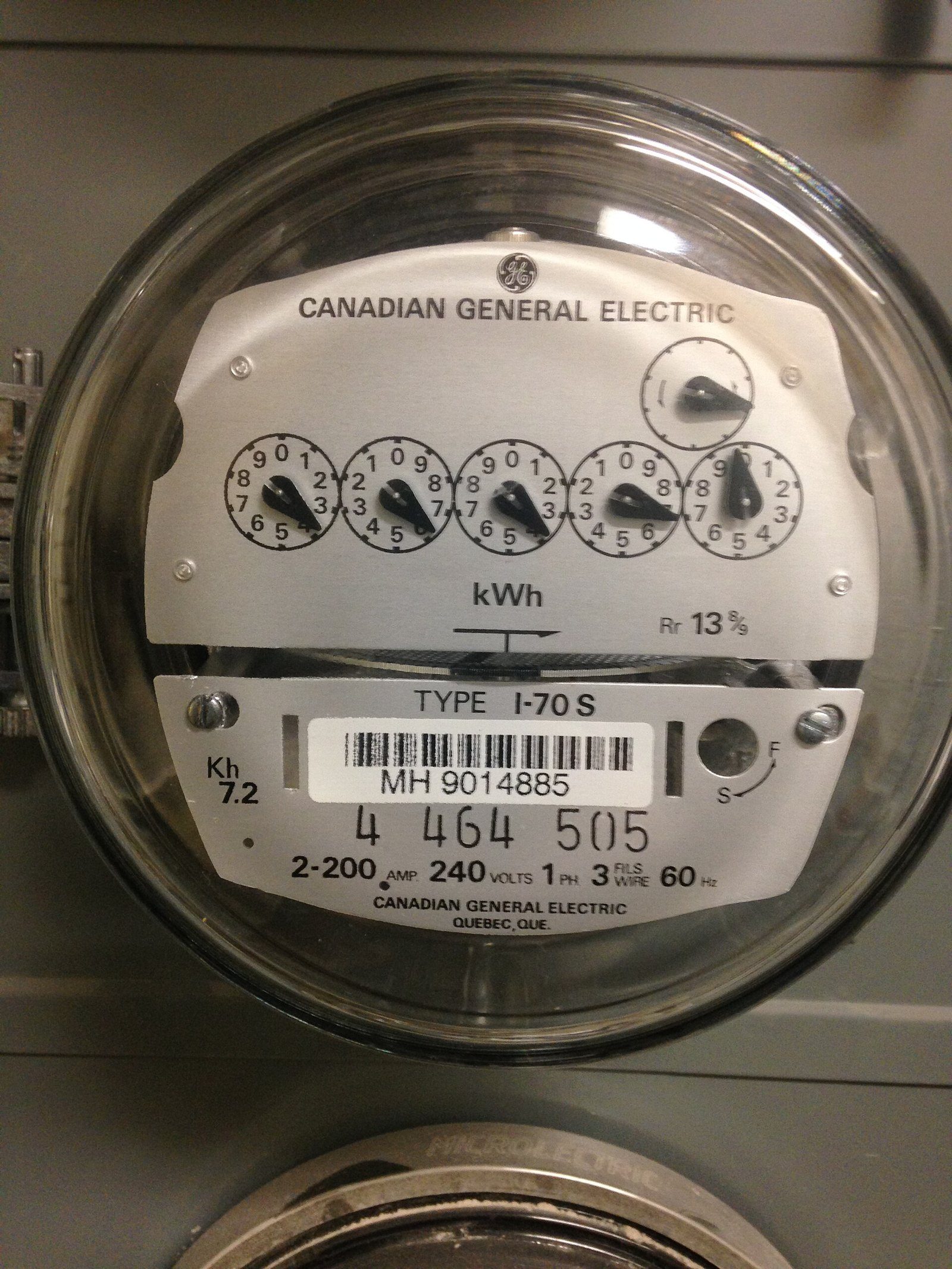
Photo: NellieBly (CC BY-SA 3.0, Wikimedia Commons).
fact.mr is not affiliated with consulting firms with similar names.
Found an error? Write to us at [email protected].