What is human resources: what HR does, its main functions, the jobs and what they pay
Human resources recruits, trains and pays the staff of an organization. O*NET definitions plus BLS pay data: HR managers earned a $149,280 median in May 2025.
In this article
Human resources (HR) is the part of an organization that deals with the people who work there: it recruits and selects staff, trains them, runs pay and benefits, keeps personnel records and reviews performance, in the description used by O*NET, the occupational database of the U.S. Department of Labor. Pay is highest at the management level. The Bureau of Labor Statistics (BLS) reports that the median annual wage for human resources managers was $149,280 in May 2025.
Key points
- O*NET describes HR work as recruiting, selecting and training applicants, keeping personnel records, running compensation and benefit programs and conducting performance reviews.
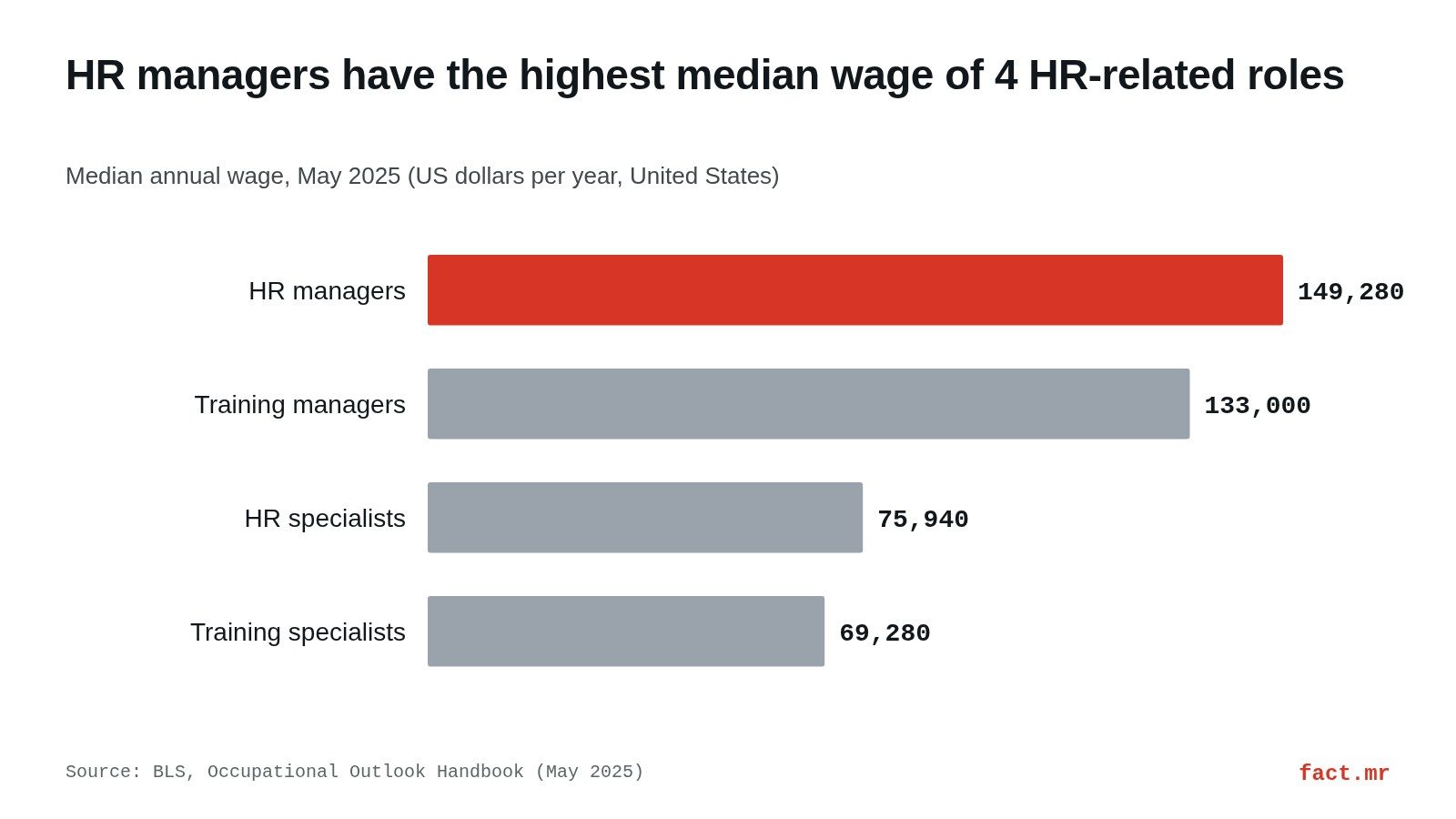
- Median annual wages in May 2025, according to the BLS: $149,280 for HR managers, $133,000 for training and development managers, $75,940 for HR specialists and $69,280 for training and development specialists.
- The median HR manager earns about 1.97 times what the median HR specialist earns (calculated from the two BLS medians).
- For 2025-2035, the BLS projects about 16,800 openings a year for HR managers and about 73,700 for HR specialists, or 90,500 combined.
- Training and development specialists have the fastest projected growth: 11%, against 6% for the other three roles.
The BLS definition and the O*NET definition
The BLS, the federal agency behind the Occupational Outlook Handbook, says human resources managers "plan, coordinate, and direct the administrative functions of an organization"1. O*NET's profile 11-3121.00 (Human Resources Managers) frames the job as planning, directing or coordinating "human resources activities and staff of an organization"5. The BLS wording stresses administration, while O*NET names the people.
Which companies have HR? The BLS says human resources managers are employed in nearly every industry1. Where the function sits, and who it reports to, shows up on each company's org chart. Neither source says at what headcount a business usually hires its first HR person.

The main functions of human resources
O*NET's task list for HR managers follows an employee from the open position to the exit interview5. The table matches each stage with the task as O*NET describes it.
| Function | What it covers, according to O*NET |
|---|---|
| Recruiting and hiring | Identify staff vacancies and recruit, interview and select applicants. |
| Onboarding | Plan and conduct new employee orientation to foster a positive attitude toward the organization's goals. |
| Training | Analyze training needs to design employee development, language training and health and safety programs. |
| Compensation and benefits | Analyze and modify pay and benefits policies to keep programs competitive and meet legal requirements. |
| Exits | Conduct exit interviews to find out why employees leave. |
The BLS adds employee relations to the duties a specialist may handle, alongside compensation and benefits and training2. But neither source says how much of the workweek each function takes, so the table shows what HR does without showing how the hours are split. How managers run their teams day to day is a separate subject, covered in leadership styles.
HR jobs and how much they pay
The BLS Occupational Outlook Handbook has a separate profile for each of the four roles below, with wages from May 2025 and employment projections for 2025-2035. The table puts the four side by side.
| Job | What it does, according to the BLS | Median annual wage (May 2025) | Projected job growth, 2025-2035 | Openings per year (2025-2035 average) |
|---|---|---|---|---|
| Human resources manager | Plans, coordinates and directs the administrative functions of an organization. | $149,280 | 6% | About 16,800 |
| Training and development manager | Plans, coordinates and directs skills- and knowledge-enhancement programs for staff. | $133,000 | 6% | About 4,100 |
| Human resources specialist | Recruits, screens and interviews applicants and places new hires in jobs. | $75,940 | 6% | About 73,700 |
| Training and development specialist | Plans and administers programs that improve employees' skills and knowledge. | $69,280 | 11% | About 46,000 |
The gap is wide. The median HR manager earned $73,340 more than the median HR specialist, or about 1.97 times as much (calculated from BLS data). In training and development, the gap between manager and specialist was $63,720.
The BLS projects 6% employment growth for three of the four roles, which is faster than the average for all occupations. For training and development specialists it projects 11%, much faster than average3. HR managers and specialists together account for about 90,500 projected openings a year, and 73,700 of them are specialist jobs (management has far fewer openings).
Candidates for manager jobs typically need several years of related work experience, the BLS says.
Education and hours
To start as a specialist, the BLS says the usual requirement is a bachelor's degree in human resources, business or a related field2. Manager positions usually require a bachelor's degree and some require a master's, and candidates generally need a combination of education and several years of related experience1. O*NET puts HR managers in Job Zone Four ("considerable preparation needed"), and in its survey 68% of these managers said their typical week runs more than 40 hours5.
How turnover is measured
Turnover has a public federal data series. The data come from the BLS Job Openings and Labor Turnover Survey (JOLTS), which produces monthly and annual estimates of job openings, hires and separations for the nation6. The quits rate is the total number of quits during the entire month as a percentage of employment.
Formula: quits rate = quits in the month ÷ employment × 100.
Example: a company with 1,000 employees and 20 quits in a month has a quits rate of 2.0%.
| JOLTS indicator (US) | Value | Month |
|---|---|---|
| Job openings | 7.5 million | September 2026 |
| Hires | 5.4 million | September 2026 |
| Total separations | 5.3 million | September 2026 |
| Quits | 3.4 million | September 2026 |
| Layoffs and discharges | 1.6 million | September 2026 |
| Nonfarm quits rate | 1.9% | August 2026 |
| Nonfarm quits rate | 2.0% | August 2025 |
In August 2026, the nonfarm quits rate was unchanged from the previous month and 0.1 percentage points below its August 2025 level. Over the past decade it peaked at 3.0%, in November 2021 and again in April 2022. The JOLTS page reports these changes without giving a cause for them.
The unemployment rate is a separate indicator and is not among the JOLTS figures in the table above.
Common mix-ups
HR manager vs. HR specialist
The BLS treats them as separate occupations. Specialists recruit, screen, interview and place new hires, while managers plan, coordinate and direct. The May 2025 medians show how far apart they are: $75,940 for specialists and $149,280 for managers.
Is training part of HR?
The answer depends on the source. O*NET lists analyzing training needs among the HR manager's tasks. The BLS gives training and development managers and specialists their own profiles, with medians of $133,000 and $69,280.
Reading US figures from another country
All four wages are US medians in dollars: in each job, half the workers earned more and half earned less. They do not tell you what an HR specialist earns in Mexico, Spain or Colombia, and converting them at the exchange rate will not give you that figure either. None of the sources used here cover wages in those countries.
Frequently asked questions
What does an HR department do?
According to O*NET, it recruits, selects and trains applicants, keeps personnel records, runs compensation and benefit programs and conducts performance reviews. It also handles orientation for new employees and holds exit interviews to find out why people leave. The BLS adds employee relations to the duties of HR specialists.
How much do HR jobs pay?
Pay depends on the role. In May 2025, the BLS reported median annual wages of $149,280 for HR managers, $133,000 for training and development managers, $75,940 for HR specialists and $69,280 for training and development specialists. These are US figures and do not apply to other countries.
What degree do you need to work in HR?
The BLS says specialists usually need a bachelor's degree in human resources, business or a related field. Manager roles usually ask for a bachelor's degree, sometimes a master's, plus several years of related experience. O*NET places HR managers in Job Zone Four, which means considerable preparation is needed.
Is HR a growing field?
For 2025-2035, the BLS projects about 73,700 openings a year for HR specialists and about 16,800 for HR managers, with 6% employment growth for both. It projects faster growth for training and development specialists: 11%, with about 46,000 openings a year.
Sources
- U.S. Bureau of Labor Statistics, "Human Resources Managers," Occupational Outlook Handbook (May 2025 data). Job definition, median wage, projected growth, annual openings, education and industries. bls.gov. Accessed Nov 23, 2026.
- U.S. Bureau of Labor Statistics, "Human Resources Specialists," Occupational Outlook Handbook (May 2025 data). Definition and duties, median wage, projected growth, annual openings and education. bls.gov. Accessed Nov 23, 2026.
- U.S. Bureau of Labor Statistics, "Training and Development Specialists," Occupational Outlook Handbook (May 2025 data). Definition, median wage, projected growth and annual openings. bls.gov. Accessed Nov 23, 2026.
- U.S. Bureau of Labor Statistics, "Training and Development Managers," Occupational Outlook Handbook (May 2025 data). Definition, median wage, projected growth and annual openings. bls.gov. Accessed Nov 23, 2026.
- O*NET OnLine, "11-3121.00 - Human Resources Managers" (online profile). Description of the occupation and the field, tasks, Job Zone and workweek. onetonline.org. Accessed Nov 23, 2026.
- U.S. Bureau of Labor Statistics, "JOLTS Home" (August and September 2026 data). Job openings, hires, separations, quits, layoffs and discharges, and quits rate. bls.gov. Accessed Nov 23, 2026.
Chart: our own, with data from the BLS, Occupational Outlook Handbook (sources 1, 2, 3 and 4).
Photo: Breather breather (CC0, Wikimedia Commons).
fact.mr is not affiliated with consulting firms with similar names.
Found an error? Write to us at [email protected].
Related
Remote work statistics: how many people work from home in the US and EU, and what Mexico's NOM-037 requires
Org chart: types, how to read one and real examples from DOL, OPM and Mexico's SAT