Remote work statistics: how many people work from home in the US and EU, and what Mexico's NOM-037 requires
In 2025, 35% of employed Americans did some work at home on days they worked (BLS ATUS). EU and ILO figures, plus what Mexico's NOM-037 telework standard requires.
In this article
In 2025, 35% of employed people in the United States did some or all of their work at home on days they worked, according to the American Time Use Survey (ATUS) of the Bureau of Labor Statistics (BLS). The European Union's most detailed snapshot is older: in 2019, before the pandemic, only 2.9% of employed people in the EU-27 worked mainly at home, per Eurostat. Mexico approaches the subject through regulation, with a telework standard, NOM-037-STPS-2023, that its Ministry of Economy lists as in force.
Key points
- In the US, 35% of employed people did some work at home on days they worked in 2025, compared with 33% in 2024 (BLS, ATUS).
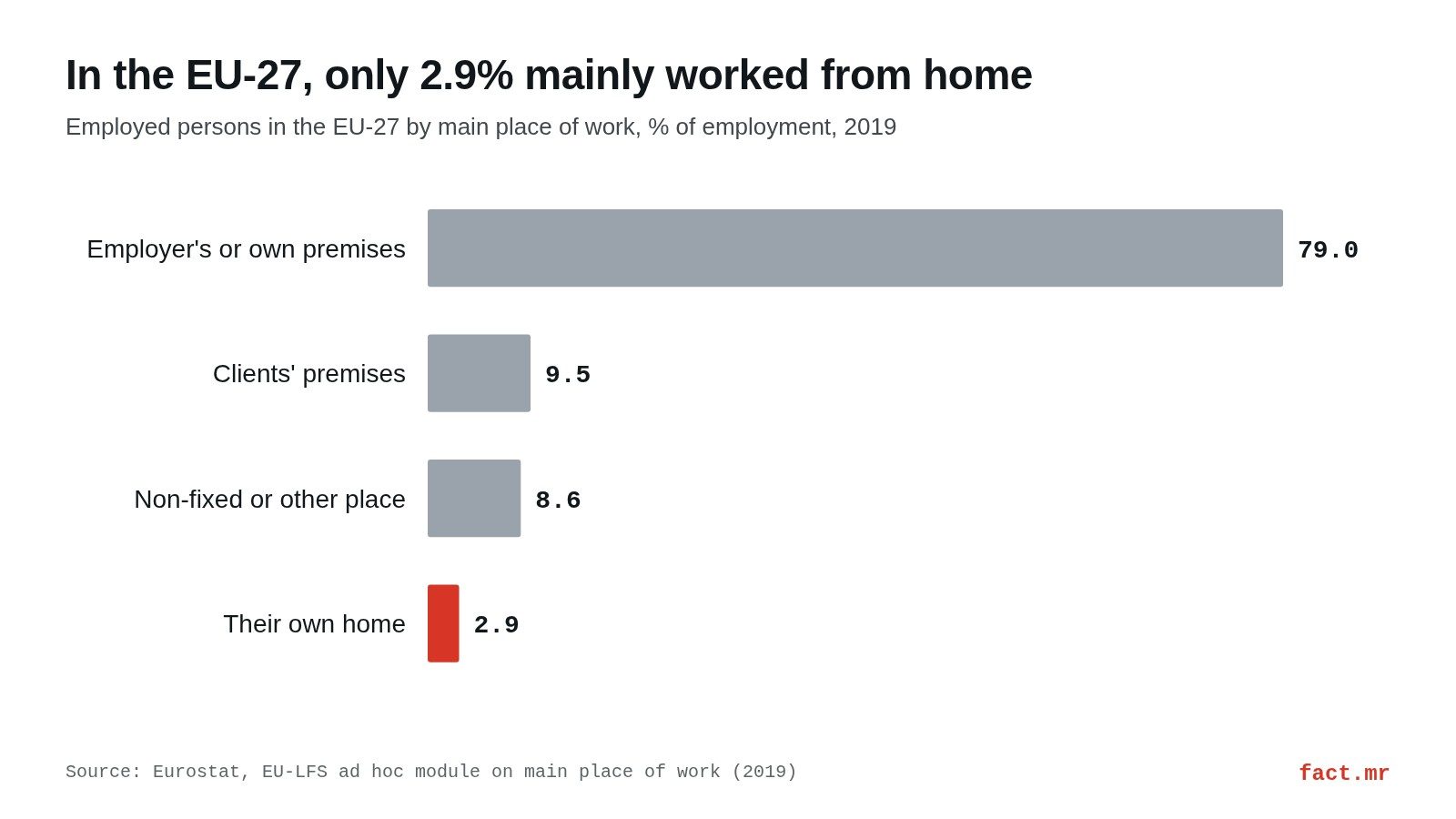
- In the EU-27, 2.9% of employed people worked mainly at home in 2019, while 79.0% worked mainly at their employer's or their own premises (Eurostat).
- The International Labour Organization (ILO) counted 260 million people working from home in a broad sense in 2019, 7.9% of global employment. That category includes self-employed people working in their own homes.
- Mexico's NOM-037-STPS-2023 requires employers to set a written telework policy and to respect the right to disconnect.
- Appendix 2 of the standard, which is informative and not mandatory, describes telework candidates as people working away from the workplace for more than 40% of their weekly working hours.
What counts as remote work depends on who is counting
No single definition exists. The BLS Current Population Survey (CPS) counts as a teleworker anyone who teleworked or worked at home for pay at any time during the reference week, which is generally the calendar week containing the 12th of the month4. Any amount counts.
Mexico's standard sets a far higher bar. Under Appendix 2 of NOM-037-STPS-2023, a candidate for telework is someone willing to work away from the workplace for more than 40% of their weekly working hours, and occasional or sporadic work below 40% is not considered telework9. But the appendices are informative and not mandatory (for what is binding, check the current text in the DOF or with the STPS).
Eurostat asks a different question: where people mainly work. Its ad hoc module of the EU Labour Force Survey (EU-LFS) counts someone as employed if they worked at least one hour for pay, profit or family gain in the reference week6. How a survey defines "employed" matters just as much when reading the unemployment rate.
How the telework rate and Mexico's 40% threshold are calculated
The BLS builds its telework rate from the CPS: the number of people who telework or work at home for pay, as a percentage of people employed and at work during the reference week4.
Telework rate = people who telework ÷ people employed and at work × 100
Example: in a fictional company where 20 of 100 employed people teleworked during the reference week, the telework rate is 20%.
Mexico's threshold works on hours rather than headcount. Example: with a fictional 40-hour workweek, 40% equals 16 hours, so under Appendix 2 someone working away from the workplace for more than 16 hours a week fits the telework profile, and someone who does it occasionally for less time does not.
Remote work statistics: the official figures
United States: two BLS surveys, two answers
The ATUS records any time spent working at home, even for people whose usual workplace is somewhere else2. Does answering email from the couch one evening count? For the ATUS, yes.
In 2025, 35% of employed people worked at home on days they worked, and 70% worked at their workplace. The two shares overlap, since each one includes anyone who did part or all of their work in that location1.
| Year | All employed | Women | Men |
|---|---|---|---|
| 2023 | 35% | 36% | 34% |
| 2024 | 33% | 36% | 29% |
| 2025 | 35% | 38% | 31% |
Share of employed people who did some work at home on days they worked. Source: BLS, ATUS13.
The gap between women and men in 2025 was 7 percentage points. The education gap was far wider: among employed people aged 25 and over, 51% of those with a bachelor's degree or higher did some work at home on days worked, compared with 19% of high school graduates with no college, a difference of 32 points1. And the 2025 series has a hole, because ATUS operations were suspended from October 1 through November 12, 2025, during the federal government shutdown, leaving no data for September 30 through November 11.
Full-time workers, defined by the BLS as those who usually work 35 or more hours a week, averaged 8.1 hours on days they worked, and 81% of employed people worked on an average weekday13. The ATUS covers people age 15 and over, while the CPS starts at 16.
The CPS, with its weekly definition, produces different numbers: one out of five workers teleworked in August 2023, and 37.9% of advanced degree holders did so in October 20234. The BLS added these questions in October 2022, so it has no February 2020 figure measured at the time; it asked about that month retrospectively from October 2022 to November 2023. Its Excel telework tables were discontinued after April 2025.
The BLS job flexibilities and work schedules module for 2024-2025 warns that its own work-at-home estimates differ from those in the annual ATUS release5.
European Union: main place of work in 2019
| Main place of work (EU-27, 2019) | % of employed people |
|---|---|
| Employer's or own premises | 79.0% |
| Clients' premises | 9.5% |
| Non-fixed or other places (a vehicle, for example) | 8.6% |
| Home | 2.9% |
Source: Eurostat, EU-LFS ad hoc module6.
Across member countries, the share working mainly at home ranged from 0.3% in Bulgaria to 6.3% in Slovenia. Older workers were the most likely to do it: 4.1% of those aged 50 to 74, against 2.8% of those aged 35 to 49 and 1.9% of those aged 15 to 34, a gap of 2.2 points between the oldest and youngest groups6.
The closest thing to hybrid work shows up in a separate question. Among people who worked at their employer's premises and changed location at least once a week, 31.8% sometimes worked from home, 10.7% usually did and 57.5% never did. Finland led that group in usual work from home with 31.9%, followed by Austria with 31.4%6.
The same module timed the commute: employed people in the EU averaged 25 minutes from home to work, and 61.3% traveled less than 30 minutes. The EU-LFS runs around 1.8 million interviews per quarter. For annual figures, Eurostat's lfsa_ehomp dataset publishes the annual share of employed people working from home, as a percentage of total employment, for the EU-27 and for Spain7.
Worldwide: homeworking according to the ILO
The ILO estimated that 260 million people worked from home in a broad sense in 2019, 7.9% of the employed population. Of them, 147 million were women: homeworking accounted for 11.5% of women's employment and 5.6% of men's8. Because the category includes self-employed people working in their own homes, it does not equal telework.
The ILO also estimated that approximately one in six occupations worldwide could be done from home, and just over one in four in advanced countries. That figure describes jobs that could move home and counts no actual workers.
What Mexico's NOM-037 requires, explained for US readers
A NOM, short for Norma Oficial Mexicana, is an official Mexican standard. NOM-037 falls under the Secretaría de Trabajo y Previsión Social (STPS), Mexico's labor ministry, and was published in 2023 in the Diario Oficial de la Federación (DOF), the federal government's official gazette10.
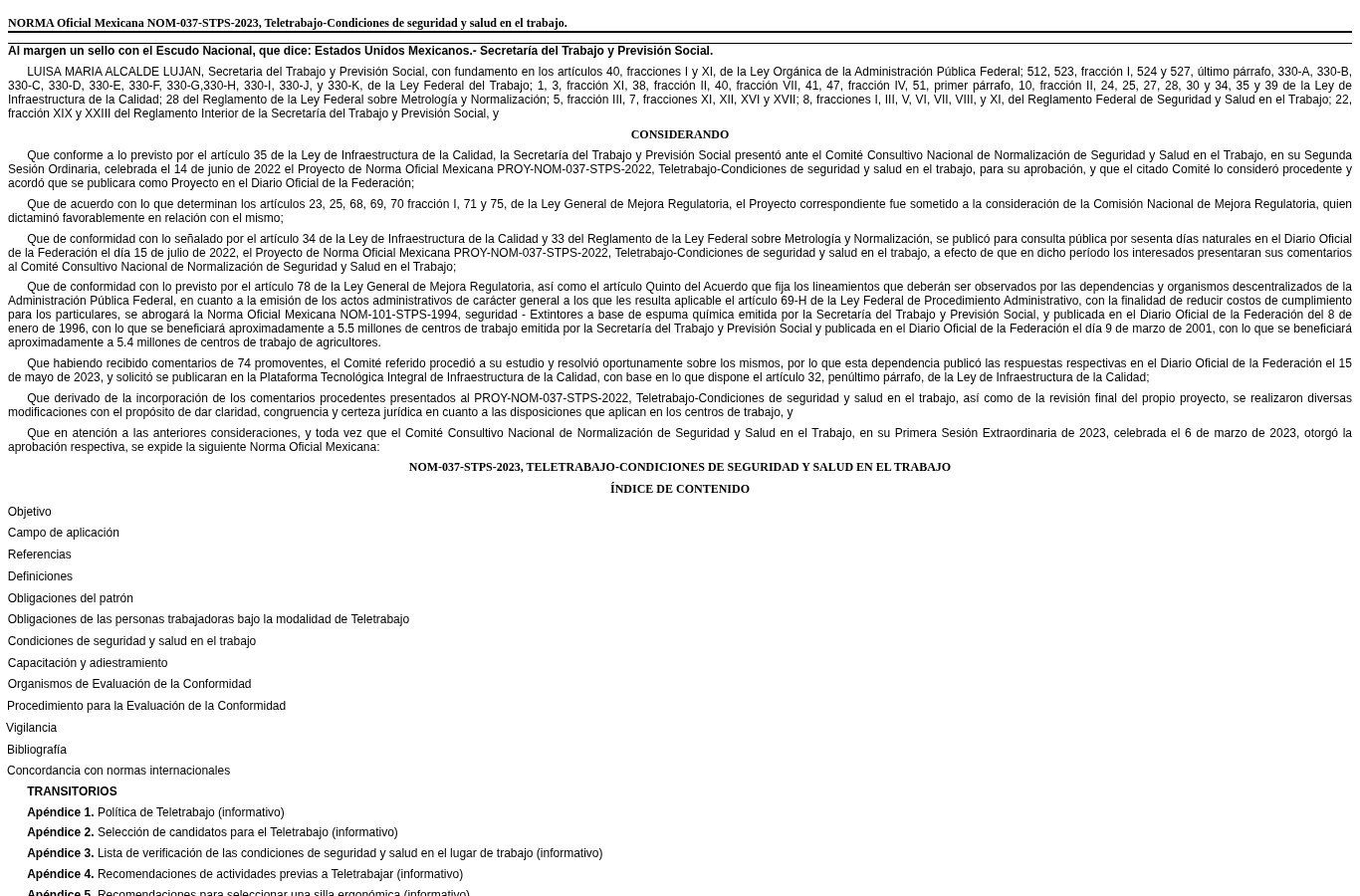
The official title is "NOM-037-STPS-2023, Teletrabajo-Condiciones de seguridad y salud en el trabajo" (telework: safety and health conditions at work). It was developed by the National Consultative Committee for Standardization on Occupational Safety and Health, which approved it at its First Extraordinary Session of 2023, held on March 6, 20239.
The draft (PROY-NOM-037-STPS-2022) had been published for public comment on July 15, 2022. The standard's bibliography cites the decree that amended article 311 and added chapter XII Bis on telework to the Ley Federal del Trabajo (LFT), Mexico's federal labor law, published in the DOF on January 11, 2021. The Ministry of Economy lists NOM-037 as not equivalent to any international standard, since none existed when it was drafted10.
| Provision | What it requires |
|---|---|
| Section 5 (LFT articles 330-C, 330-D and 330-E) | A written Telework Policy set by the employer at the workplace |
| Section 7.3, item d) | Adequate breaks and rest periods |
| Section 7.3, item e) | Right to disconnect, including from digital tools, at the end of the workday, during breaks, outside working hours, on vacation, and during leave |
| Breastfeeding (LFT article 170) | For up to six months: two extra half-hour breaks per day, or a workday one hour shorter |
| Section 8 | Training for people working under telework |
| Appendix 2 (informative) | Checklist item: a work surface of at least 2 square meters and a height of at least 2.5 meters |
The standard says teleworkers' rights cannot be lower than those of people working on site, and it asks employers to set up communication channels to prevent teleworkers' social isolation. None of this is legal advice: check the current text in the DOF or with the STPS. An org chart helps pin down who inside a company answers for each obligation.
The BLS pages cited here measure telework and say nothing about rules for it, so this table has no US counterpart in these sources.
Terms that get mixed up
- Telework vs. remote work: the BLS pages cited here do not separate the two. Its surveys use "telework" and "work at home."
- Home office: the title of Mexico's standard does not use this phrase; it uses "teletrabajo."
- Hybrid work: none of the sources cited here defines it. The nearest proxy is Eurostat's group that sometimes worked from home (31.8% in 2019).
- Homeworking (ILO): includes self-employed people working in their own homes, so its 260 million cannot be read as teleworkers.
- Flexible schedule: for the BLS, being able to vary the times you start and stop working. A worker can have one without ever working from home.
No series cited here counts Mexico's teleworkers: NOM-037 regulates the arrangement but publishes no figures. And Eurostat foresees no update of the 2019 module, whose data were extracted in September 2020.
Frequently asked questions
What percentage of Americans work from home?
According to the BLS American Time Use Survey, 35% of employed people did some or all of their work at home on days they worked in 2025, compared with 33% in 2024. The CPS, which uses a weekly definition, found that one out of five workers teleworked in August 2023.
How many Europeans worked from home before the pandemic?
Eurostat's EU-LFS ad hoc module found that in 2019 only 2.9% of employed people in the EU-27 worked mainly at home, ranging from 0.3% in Bulgaria to 6.3% in Slovenia. Another 79.0% worked mainly at their employer's or their own premises.
What counts as telework under Mexico's NOM-037?
Appendix 2 of NOM-037-STPS-2023 describes a telework candidate as someone working away from the workplace for more than 40% of their weekly working hours, and it excludes occasional or sporadic work below that level. The appendix is informative and not mandatory.
Does Mexico have a right to disconnect?
Section 7.3, item e) of NOM-037-STPS-2023 requires respecting teleworkers' right to disconnect, including from digital tools, at the end of the workday, during breaks, outside working hours, on vacation and during leave. For a specific case, check the current text in the DOF or with the STPS.
Sources
- U.S. Bureau of Labor Statistics, "American Time Use Survey Summary" (2025 results). Work at home by sex and education, hours worked, weekday work and shutdown notice. bls.gov. Accessed Nov 17, 2026.
- U.S. Bureau of Labor Statistics, "Table 6. Employed persons working at home, workplace, and time spent working at each location" (2025). Definition of working at home. bls.gov. Accessed Nov 17, 2026.
- U.S. Bureau of Labor Statistics, "American Time Use Survey News Release" (2024 results). Work at home in 2023 and 2024 by sex, full-time definition and reference population. bls.gov. Accessed Nov 17, 2026.
- U.S. Bureau of Labor Statistics, "Telework or work at home for pay" (CPS). Definitions, telework rate, reference week and August and October 2023 figures. bls.gov. Accessed Nov 17, 2026.
- U.S. Bureau of Labor Statistics, "Job Flexibilities and Work Schedules News Release" (2024-2025). Flexible schedule definition and difference from the annual ATUS. bls.gov. Accessed Nov 17, 2026.
- Eurostat, "Main place of work and commuting time - statistics" (Statistics Explained, 2019 data). Main place of work, age groups, countries, commuting time and survey size. ec.europa.eu. Accessed Nov 17, 2026.
- Eurostat, "lfsa_ehomp" (annual series). Employed persons working from home as a percentage of total employment, EU-27 and Spain. ec.europa.eu. Accessed Nov 17, 2026.
- International Labour Organization, "Working from home". Homeworking in 2019 and occupations that could be done from home. ilo.org. Accessed Nov 17, 2026.
- Diario Oficial de la Federación, "NOM-037-STPS-2023, Teletrabajo-Condiciones de seguridad y salud en el trabajo" (2023). Text of the standard: Telework Policy, disconnection, breaks, breastfeeding, training and Appendix 2. dof.gob.mx. Accessed Nov 17, 2026.
- Secretaría de Economía (Mexico), "NOM-037-STPS-2023 – Normalización" (Mexican Catalog of Standards). Status in force, responsible ministry, committee, 2022 draft, LFT amendment and international concordance. platiica.economia.gob.mx. Accessed Nov 17, 2026.
Chart: our own, with data from Eurostat, EU-LFS ad hoc module on main place of work (source 6).
Photo: our own screenshot of dof.gob.mx, Nov 17, 2026.
fact.mr is not affiliated with consulting firms with similar names.
Found an error? Write to us at [email protected].