Market report
Fluorspar: what it is, acid and metallurgical grades, who supplies it and official data
Fluorspar (calcium fluoride) explained: grades, uses and trade. US imports were 436,000 t in 2025, per the USGS, with Mexico supplying 59% of acid grade.
Fluorspar is the name the mining trade and the U.S. Geological Survey (USGS) use for fluorite, the mineral form of calcium fluoride (CaF2). The USGS says it goes directly or indirectly into aluminum, gasoline, insulating foams, refrigerants, steel and uranium fuel. The United States has no domestic production, so its supply comes from imports: 436,000 metric tons in 2025, according to the USGS Mineral Industry Surveys for the fourth quarter of 20254.
Key points
- Fluorspar is calcium fluoride (CaF2). The USGS splits it into acid grade (more than 97% calcium fluoride) and metallurgical grade (not more than 97%).
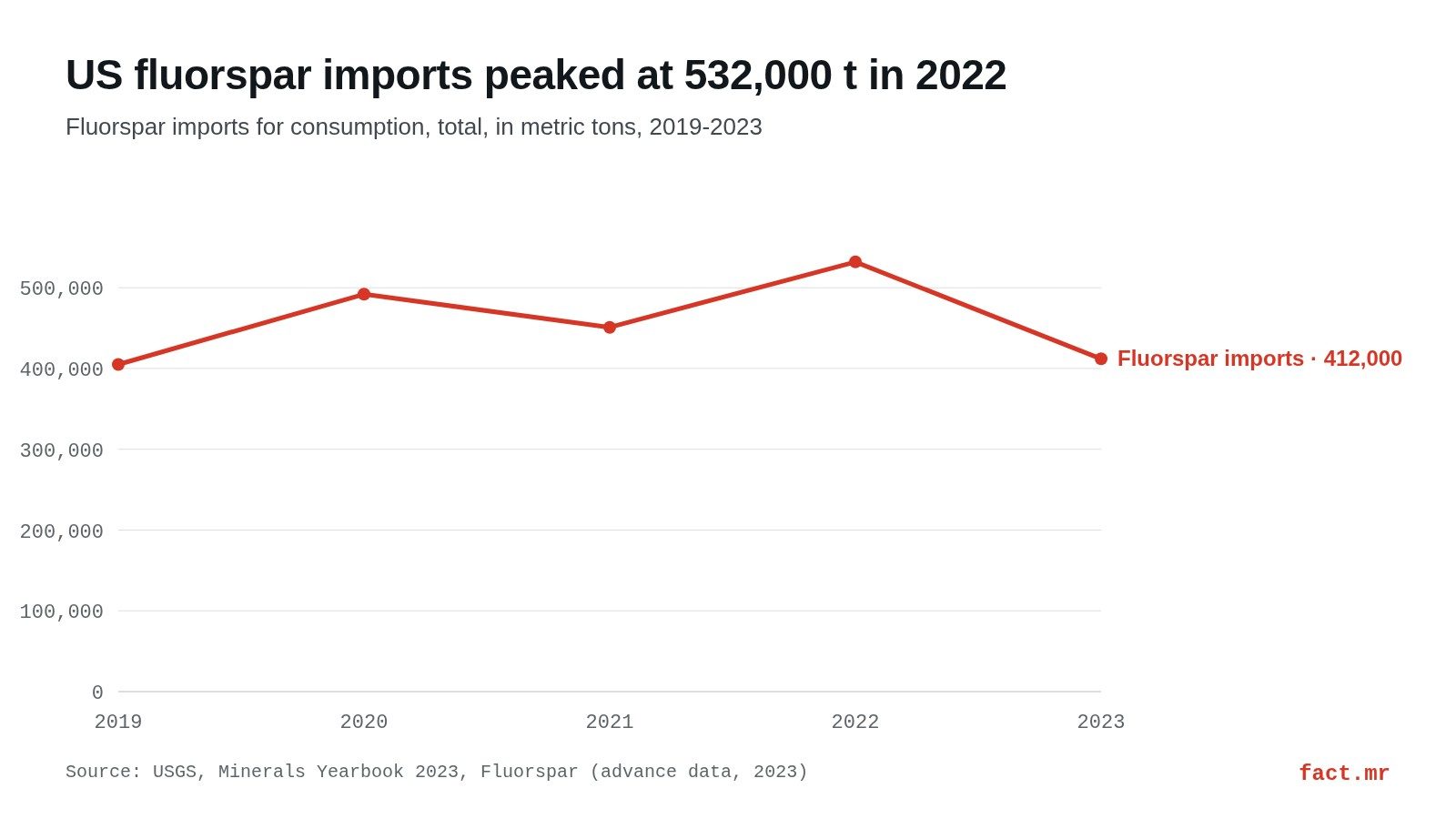
- The United States mines none. It imported 412,000 t in 2023 and 436,000 t in 2025, and 414,000 t of the 2025 total was acid grade.
- Mexico supplied 59% of US acid-grade imports by volume in 2025, and 240,000 t of the acid grade bought in 2023.
- Both lists include fluorspar: the US final 2025 List of Critical Minerals (60 minerals) and the EU 2023 list of critical raw materials (34 materials).
- The average unit value of US acid-grade imports was $304 per metric ton in 2019 and $469 in 2025.
What fluorspar is
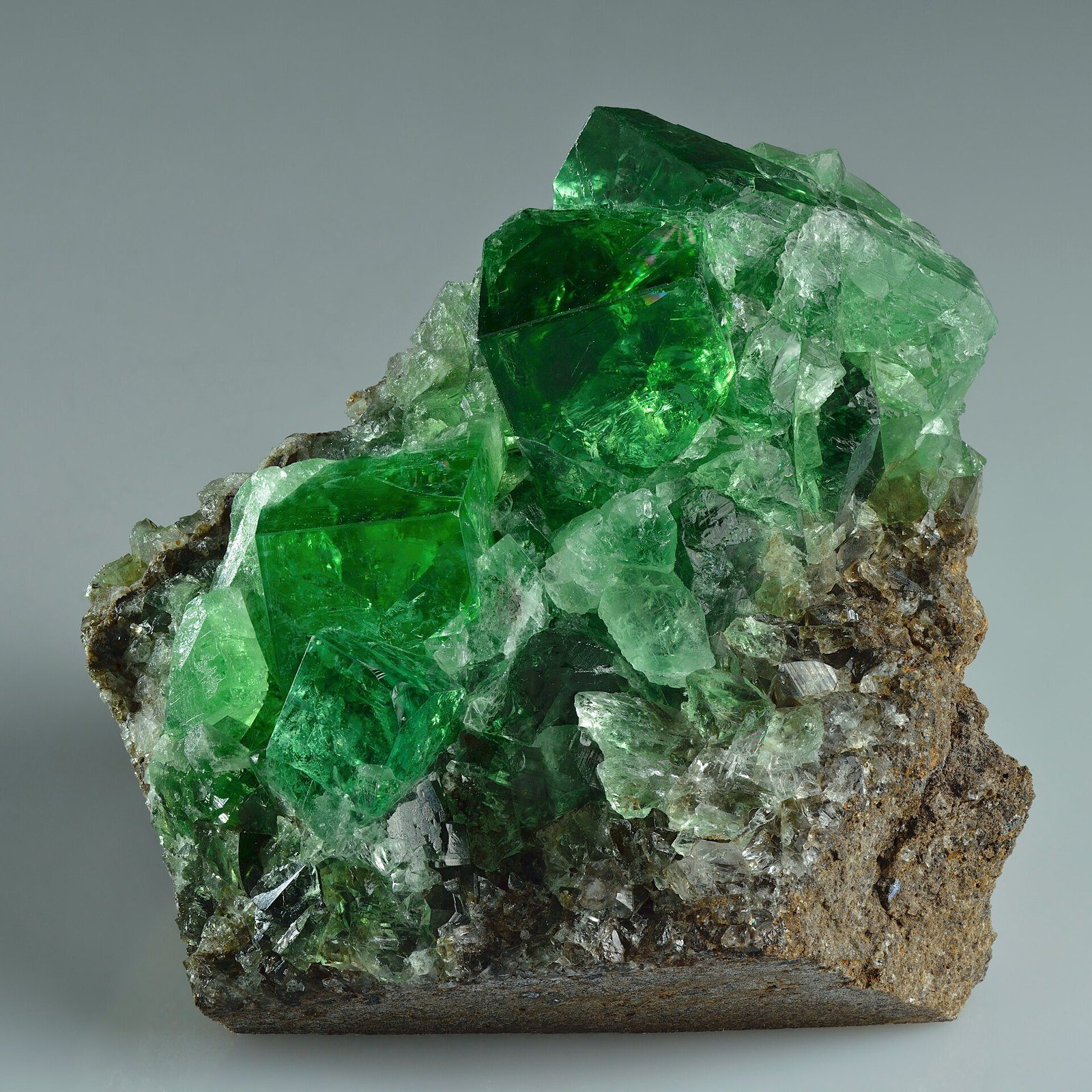
In chemistry the compound is written CaF2, with calcium bound to fluorine. On its fluorspar statistics page the USGS shows a photo of fluorite and labels it calcium fluoride1. Collectors know fluorite from crystals like the green specimen below, but industry buys it as ore concentrate and sorts it by chemistry rather than looks.
The test that matters is purity.
Acid grade and metallurgical grade
The USGS draws the line at 97% calcium fluoride. Material above that mark is recorded as acid grade, and anything at or below it is metallurgical grade3.
| Grade | USGS definition | Mexican quoted price, f.o.b. Tampico, 2023 (US$ per metric ton; Fastmarkets IM range reprinted by the USGS) |
|---|---|---|
| Acid grade | More than 97% calcium fluoride | 400-430 (filtercake) |
| Metallurgical grade | Not more than 97% calcium fluoride | 340-370 |
The two grades are far from equal in US trade. Acid grade made up 92.5% of US fluorspar imports in 2023 (381,000 of 412,000 metric tons), a share calculated from the USGS Minerals Yearbook tables3. Metallurgical grade was the smaller stream in 2025 too, with 22,000 t out of 436,000 t4.
What fluorspar is used for
The USGS lists the end uses in different words on different pages. Read together, the lists cover metals, fuels, building materials and chemistry.
| USGS publication | Products and sectors named |
|---|---|
| Fluorspar Statistics and Information (National Minerals Information Center) | Aluminum, gasoline, insulating foams, refrigerants, steel, uranium fuel |
| Release on the final 2025 List of Critical Minerals | Synthetic materials and plastics, iron and steel, ceramics, glass, refineries |
Some of the trade happens a step further down the chain. In the fourth quarter of 2025 the United States imported 16,900 t of hydrofluoric acid, 3,070 t of aluminum fluoride and 4,990 t of cryolite, which the USGS groups as fluorine materials produced directly from fluorspar4. On October 30, 2025, Solstice Advanced Materials Inc. of Morris Plains, New Jersey, split off from Honeywell International Inc. as part of the conglomerate's planned breakup, and the USGS noted that Solstice's largest businesses depend on fluorine chemistry4.
The United States also has a domestic source of fluorine that never shows up as fluorspar. Some phosphoric acid producers recover fluorosilicic acid as a byproduct (an estimated 43,200 t in 2023), and the USGS keeps it out of its fluorspar production and consumption figures13. The yearbook also leaves out byproduct and synthetic fluorspar.
Who produces fluorspar
World mine output reached 9,530,000 metric tons in 2023, according to the USGS Minerals Yearbook. The agency warns that the world totals may include estimates3.
| Year | World fluorspar production (metric tons) | Note |
|---|---|---|
| 2020 | 8,580,000 | May include estimates |
| 2021 | 8,590,000 | Revised |
| 2022 | 9,110,000 | Revised |
| 2023 | 9,530,000 | May include estimates |
The figures change after release. The 2021 and 2022 totals are marked "r" for revised, so a number quoted from an older edition may no longer match the current table.
And the United States is missing from the producer side altogether: the USGS states plainly that there is no domestic production4.
Where US imports come from
So where does American fluorspar come from? For acid grade in 2023, the yearbook gives this breakdown by country of origin3:
| Origin | Acid-grade imports, 2023 (metric tons) |
|---|---|
| Mexico | 240,000 |
| South Africa | 51,700 |
| Vietnam | 49,600 (estimated) |
| China | 29,900 |
| Spain | 9,030 |
| Total acid grade | 381,000 |
Mexico supplied 63.0% of US acid-grade imports in 2023, a share calculated from that table. For 2025 the USGS put Mexico at 59%, Vietnam at 19% and South Africa at 13% of acid-grade import volume4. Thailand appeared in the fourth quarter of 2025 with 11%, behind Mexico (52%) and Vietnam (17%) and just ahead of South Africa (10%).
Metallurgical grade has a different supplier mix: Mexico 42%, China 41%, Mongolia 11% and Pakistan 6% in 2025. Mexico also leads one step down the chain. It shipped 74,400 t of the 86,800 t of hydrofluoric acid the United States imported in 2023, and it accounted for 71% of US hydrofluoric acid imports in the fourth quarter of 202534.
Import shares describe the US supply chain, which is a different thing from a ranking of the world's largest producers. For a mineral where the country ranking is the main story, see rare earth elements and how much each country produces.
US imports and apparent consumption
The USGS measures US use as apparent consumption, defined as imports minus exports. Reported consumption is withheld, marked W, in every year from 2019 to 2023 so that company data stay confidential (a column of Ws, which tells a reader very little)3.
| Year | Imports for consumption (metric tons) | Apparent consumption (metric tons) |
|---|---|---|
| 2019 | 405,000 | 398,000 |
| 2020 | 492,000 | 483,000 |
| 2021 | 451,000 | 436,000 |
| 2022 | 532,000 (revised) | 508,000 (revised) |
| 2023 | 412,000 | 392,000 |
Imports peaked at 532,000 t in 2022 and were 412,000 t in 2023. Apparent consumption ended the period 1.5% below its 2019 level. Exports were 20,200 t in 2023, based on Census Bureau data, and the USGS says US fluorspar exports are probably re-exports because there is no domestic production34.
The latest annual figure comes from the quarterly survey. Imports totaled 436,000 t in 2025, 5.8% more than in 2023, with acid-grade imports up 11% from 2024 and metallurgical-grade imports down 30%4. The fourth quarter alone brought in 125,000 t: 119,000 t of acid grade and 6,200 t of metallurgical grade.
The longer history is in the USGS Data Series 140, which covers about 90 mineral commodities, many of them with data back to 1900, including production, imports, exports, stocks, consumption and unit value. The current fluorspar file is a 2020 update in XLSX format, posted on June 4, 2024, and it is in the public domain2. Series like this are the baseline to check before you trust any figure in a private report, a habit covered in how to read industry reports.
Fluorspar prices in official data
The USGS does not publish a single world price. It reports the average unit value of US imports in current dollars per metric ton, which is a CIF value in the yearbook series.
| Period | Acid grade (US$ per metric ton) | Metallurgical grade (US$ per metric ton) |
|---|---|---|
| 2019 | 304 | n/a |
| 2023 | 429 | n/a |
| 2024 | 464 | n/a |
| 2025 | 469 (up 1% from 2024) | 400 (up 19% from 2024) |
| Fourth quarter of 2025 | 458 | n/a |
From 2019 to 2023 the acid-grade unit value rose 41.1% in current dollars, based on the yearbook figures3. The rise was much smaller after that, at $464 in 2024 and $469 in 20254.
Quoted prices by origin
The yearbook also reprints price ranges published by Fastmarkets IM. These are quoted ranges, a different measure from the import unit values above. "f.o.b." means free on board at the named port.
| Fluorspar quoted (US$ per metric ton) | 2022 | 2023 |
|---|---|---|
| Acid grade, Chinese, f.o.b. China, wet filtercake | 460-500 | 520-560 |
| Acid grade, Mexican, f.o.b. Tampico, filtercake | 340-400 | 400-430 |
| Acid grade, South African, f.o.b. Durban, filtercake | 480-570 | 520-570 |
| Metallurgical grade, Mexican, f.o.b. Tampico | 330-360 | 340-370 |
In 2023, Mexican acid grade was quoted at $400-430, the lowest range for acid grade in the table. Chinese wet filtercake was quoted at $520-560 and South African material at $520-570. The USGS gives no reason for the gap, and these ranges cannot explain it either.
Fluorspar on the US and EU critical minerals lists
United States
The Department of the Interior and the USGS published the final 2025 List of Critical Minerals on November 6, 2025. It names 60 minerals, and fluorspar is one of them6. The notice ran in the Federal Register on November 7, 2025 (vol. 90, no. 214, FR Doc. 2025-19813, pages 50494-50497) and replaces the list published in 20225.
To build the list, the USGS used a supply chain disruption model that tested more than 1,200 disruption scenarios across 84 mineral commodities. Set beside the trade tables, the result covers a mineral the United States uses every year without mining any of it.
European Union
The European Commission published its first list of critical raw materials in 2011, and every revision since has been longer. Fluorspar is on the fifth list, published in 2023 in Annex II of the Regulation proposal COM(2023), alongside arsenic, magnesium and silicon metal7.
| EU list | Year | Critical raw materials |
|---|---|---|
| First | 2011 | 14 |
| Second | 2014 | 20 |
| Third | 2017 | 27 |
| Fourth | 2020 | 30 |
| Fifth | 2023 | 34 |
For how a commodity like this fits with metals, energy and farm inputs, see raw materials: types, examples and prices.
Terms that get confused
- Fluorite and fluorspar: the same mineral, calcium fluoride. "Fluorite" is the mineral name, and "fluorspar" is the name used for the commodity in USGS statistics.
- Acid grade and metallurgical grade: purity classes that the USGS splits at 97% calcium fluoride. They are not separate minerals.
- Hydrofluoric acid: a chemical made from fluorspar. US imports of it are counted separately (86,800 t in 2023).
- Fluorosilicic acid: a byproduct of phosphoric acid production. It supplies fluorine but is left out of fluorspar production and consumption figures.
- Byproduct and synthetic fluorspar: not included in the USGS yearbook figures.
The most recent full-year detail in the USGS Minerals Yearbook covers 2023 and was released on April 15, 2025. The 2025 figures come from the quarterly Mineral Industry Surveys issued in April 2026.
Frequently asked questions
What is fluorspar used for?
According to the USGS, fluorspar is used directly or indirectly to make aluminum, gasoline, insulating foams, refrigerants, steel and uranium fuel. The USGS release on the 2025 critical minerals list adds synthetic materials and plastics, ceramics, glass and refineries. Part of it is first turned into hydrofluoric acid, aluminum fluoride or cryolite.
What is the difference between acid grade and metallurgical grade fluorspar?
In USGS statistics, acid grade contains more than 97% calcium fluoride and metallurgical grade contains no more than 97%. Acid grade made up 92.5% of US imports in 2023. In 2023, Mexican acid grade was quoted at $400-430 per ton f.o.b. Tampico, against $340-370 for Mexican metallurgical grade.
Does the United States mine fluorspar?
No. The USGS states that there is no domestic production, and it treats US exports as probable re-exports. Imports totaled 436,000 t in 2025. Mexico supplied 59% of acid-grade volume, followed by Vietnam with 19% and South Africa with 13%. Some fluorine also comes from byproduct fluorosilicic acid.
Is fluorspar a critical mineral?
Yes, on both sides of the Atlantic. Fluorspar is one of the 60 minerals on the final 2025 US List of Critical Minerals, published November 6, 2025. It is also on the European Union's fifth critical raw materials list, published in 2023 with 34 materials in Annex II of proposal COM(2023).
Sources
- U.S. Geological Survey, National Minerals Information Center, "Fluorspar Statistics and Information" (web page). What fluorspar is, its uses, and fluorosilicic acid as a domestic source of fluorine. usgs.gov. Accessed Nov 6, 2026.
- U.S. Geological Survey, "Fluorspar - Historical Statistics (Data Series 140)" (2020 update, posted June 4, 2024). What the historical series covers and how often it is updated. usgs.gov. Accessed Nov 6, 2026.
- U.S. Geological Survey, "Minerals Yearbook 2023, Fluorspar", advance data tables (XLSX, released April 15, 2025). Grade definitions, US imports by grade and origin, exports, apparent consumption, world production, unit values, Fastmarkets IM price ranges, hydrofluoric acid imports and fluorosilicic acid output. d9-wret.s3.us-west-2.amazonaws.com. Accessed Nov 6, 2026.
- U.S. Geological Survey, "Mineral Industry Surveys, Fluorspar, fourth quarter 2025" (April 2026). US imports for 2025 and the fourth quarter, supplier shares, unit values, imports of fluorine materials, the note on domestic production and the Solstice separation. d9-wret.s3.us-west-2.amazonaws.com. Accessed Nov 6, 2026.
- Federal Register, vol. 90, no. 214, Department of the Interior notice on the final 2025 List of Critical Minerals, FR Doc. 2025-19813 (November 7, 2025). The 60 listed minerals and the supply chain disruption model. govinfo.gov. Accessed Nov 6, 2026.
- U.S. Geological Survey, "Interior Department releases final 2025 List of Critical Minerals" (November 14, 2025). Publication date of the list and fluorspar uses. usgs.gov. Accessed Nov 6, 2026.
- European Commission, Internal Market, Industry, Entrepreneurship and SMEs, "Critical raw materials" (web page). The EU lists from 2011 to 2023 and fluorspar on the 2023 list. single-market-economy.ec.europa.eu. Accessed Nov 6, 2026.
Chart: our own, with data from USGS, Minerals Yearbook 2023, Fluorspar (source 3).
Photo: Ivar Leidus (CC BY-SA 4.0, Wikimedia Commons).
fact.mr is not affiliated with consulting firms with similar names.
Found an error? Write to us at [email protected].
Related reports
Automotive Remote Diagnostics Market Size, Share & Forecast 2026-2032
Automotive remote diagnostics market size is set for robust growth from 2026-2032, driven by connected vehicles, 5G adoption, and OEM telem…
Frozen Potato Market Size, Share & Forecast 2026-2032
The frozen potato market is projected to grow steadily through 2032, driven by QSR expansion, convenience food demand, and cold chain investments.
White Spirit Market Size, Share & Forecast 2026-2032
10.10 USD bn
Estimated market size in 2032
- 2026
- 7.40 USD bn
- Forecast period
- 2026–2032