What is an online marketplace: how it works, how it charges sellers and figures
An online marketplace lets many independent sellers reach buyers while the platform charges fees. How Amazon and MercadoLibre charge, plus Census Bureau and INEGI data.
In this article
An online marketplace is a website or app where many independent sellers list products for buyers. The operator handles the matching and charges the sellers, and at Amazon and Mercado Libre that charge includes a cut of each sale. Amazon and Mercado Libre (the marketplace run by MercadoLibre, Inc.) are the textbook examples, and the U.S. Census Bureau estimated that e-commerce made up 17.1% of total U.S. retail sales in the second quarter of 20261.
Key points
- For third-party sales, Amazon states in its 2025 Form 10-K that it is not the seller of record.
- According to its 10-K, Amazon charges sellers fixed fees, a percentage of sales, per-unit activity fees, interest or some combination of these.
- The Census Bureau estimated U.S. retail e-commerce at $340.2 billion in the second quarter of 2026, up 12.2% from a year earlier.
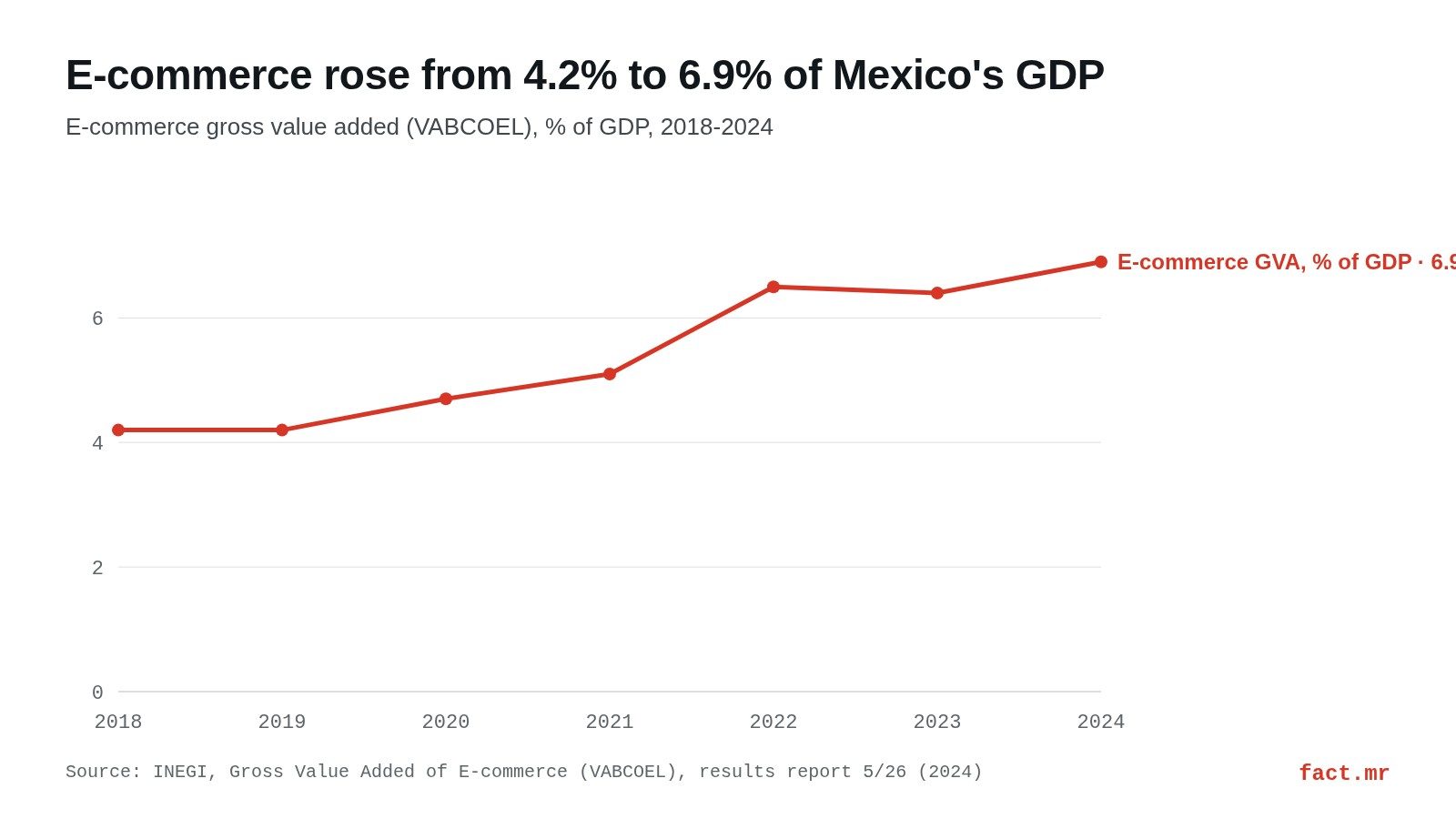
- In Mexico, e-commerce gross value added went from 4.2% of GDP in 2018 to 6.9% in 2024, a rise of 2.7 percentage points, according to INEGI, the national statistics agency.
- Neither official series cited here separates marketplace sales from other online sales.
What an online marketplace is
The platform provides the storefront and the checkout, and the seller provides the product and sets the price. In annual reports, what separates a marketplace from a retailer that buys stock and resells it is who appears as the seller. Amazon's 2025 Form 10-K says it plainly for third-party sales: "We are not the seller of record in these transactions"2.
INEGI defines e-commerce as the process of buying, selling or exchanging goods, services and information over computer networks, whether or not the payment happens online4. A marketplace is one form of that trade. A single-brand web store is another, and official statistics count both together.
It all comes down to who is selling.
How a marketplace makes money
Both 10-Ks name the types of fees but publish no rate card. Amazon's 10-K lists how it charges participants in its seller programs: "fixed fees, a percentage of sales, per-unit activity fees, interest, or some combination thereof"2. The percentage of sales is what most shoppers and sellers call the commission.
Amazon: service sales vs. product sales
In 2025, Amazon reported $420,658 million in net service sales and $296,266 million in net product sales, out of $716,924 million in total net sales2. That puts services at 58.7% of net sales. But the service line combines third-party seller fees (commissions plus the related fulfillment and shipping fees) with AWS, advertising, Prime memberships and digital content subscriptions, so the 58.7% covers far more than the marketplace.
Mercado Libre: final value fees
MercadoLibre's 2025 Form 10-K says its commerce services revenue comes mainly from Marketplace fees, which include final value fees that cover use of its payment solution3. The company processes payments on the Marketplace and does not charge sellers an added commission for that service. According to the same filing, Mercado Pago, its payments business, was originally designed to facilitate transactions on Mercado Libre.
Example (without figures, because neither 10-K publishes a rate card): a seller lists an item on Mercado Libre, and when it sells, the platform keeps its final value fee while the payment goes through Mercado Pago with no separate processing charge. MercadoLibre also sells merchandise from its own inventory, which it calls a first-party basis, and records it as product sales. And Mercado Shops was discontinued as of December 31, 2025.
How much the big operators sell, according to their 10-Ks
The figures below cover each company as a whole, across all of its businesses. They show how large the operators are, but they cannot isolate the marketplace.
| Company and line item | 2024 ($ million) | 2025 ($ million) | Reported change |
|---|---|---|---|
| Amazon, total net sales | 637,959 | 716,924 | 12% |
| Amazon, North America segment | 387,497 | 426,305 | 10% |
| Amazon, International segment | 142,906 | 161,894 | 13% |
| MercadoLibre, net revenues and financial income | 20,777 | 28,893 | 39.1% |
Amazon's total net sales were $574,785 million in 20232. The company reports 12% growth for 2025. Calculating directly from the net sales figures gives 12.4%, and the gap comes only from rounding.
How much do they spend to attract buyers? Amazon spent $47,129 million on sales and marketing in 2025, or 6.6% of net sales, compared with 6.9% in 20242. MercadoLibre increased the same line from $2,191 million to $3,219 million, a rise of 46.9%3.
Official e-commerce figures
United States: the Census Bureau's quarterly report
The Census Bureau of the U.S. Department of Commerce estimated retail e-commerce sales for the second quarter of 2026 at $340.2 billion, adjusted for seasonal variation but not for price changes1. That equals 17.1% of total retail sales, which came to $1,986.5 billion. Compared with the second quarter of 2025, e-commerce rose 12.2% (±0.9%) and total retail sales rose 6.7% (±0.5%).
| Second quarter of 2026 | Census Bureau estimate |
|---|---|
| Retail e-commerce, seasonally adjusted | $340.2 billion |
| Retail e-commerce, not seasonally adjusted | $329.5 billion |
| Total retail sales, seasonally adjusted | $1,986.5 billion |
| E-commerce share of total retail sales | 17.1% |
| E-commerce change from the first quarter of 2026 | +3.8% (±0.4%) |
Release CB26-133 came out on August 18, 2026. Since September 28, 2026, the Census page has carried a notice that it no longer contains the most up-to-date estimates, and revised figures are due with the third-quarter release on November 19, 2026. The biggest online shopping days have their own figures: see Black Friday sales numbers and Cyber Monday sales.
Mexico: INEGI's e-commerce value added (the chart)
Mexico uses a different measure. INEGI publishes e-commerce gross value added each year under the Spanish acronym VABCOEL, in a series that starts in 2013 and uses 2018 as its base year. Its latest results report, number 5/26, came out on February 18, 2026, and covers data through 20244.
In 2024, the VABCOEL totaled 2 308 458 million pesos at current prices and 1 796 594 million pesos at 2018 prices.
| Year | E-commerce gross value added as % of Mexico's GDP |
|---|---|
| 2018 | 4.2% |
| 2019 | 4.2% |
| 2020 | 4.7% |
| 2021 | 5.1% |
| 2022 | 6.5% |
| 2023 | 6.4% |
| 2024 | 6.9% |
At 2018 prices, VABCOEL growth slowed from 8.5% in 2023 to 7.1% in 2024, while GDP growth fell from 3.3% to 1.2% over the same period, according to INEGI. By activity, other services accounted for 51.3% of the 2024 total, retail trade for 29.1% and wholesale trade for 19.6%. If e-commerce were treated as one more of the 20 sectors that make up Mexico's economy, it would rank sixth.
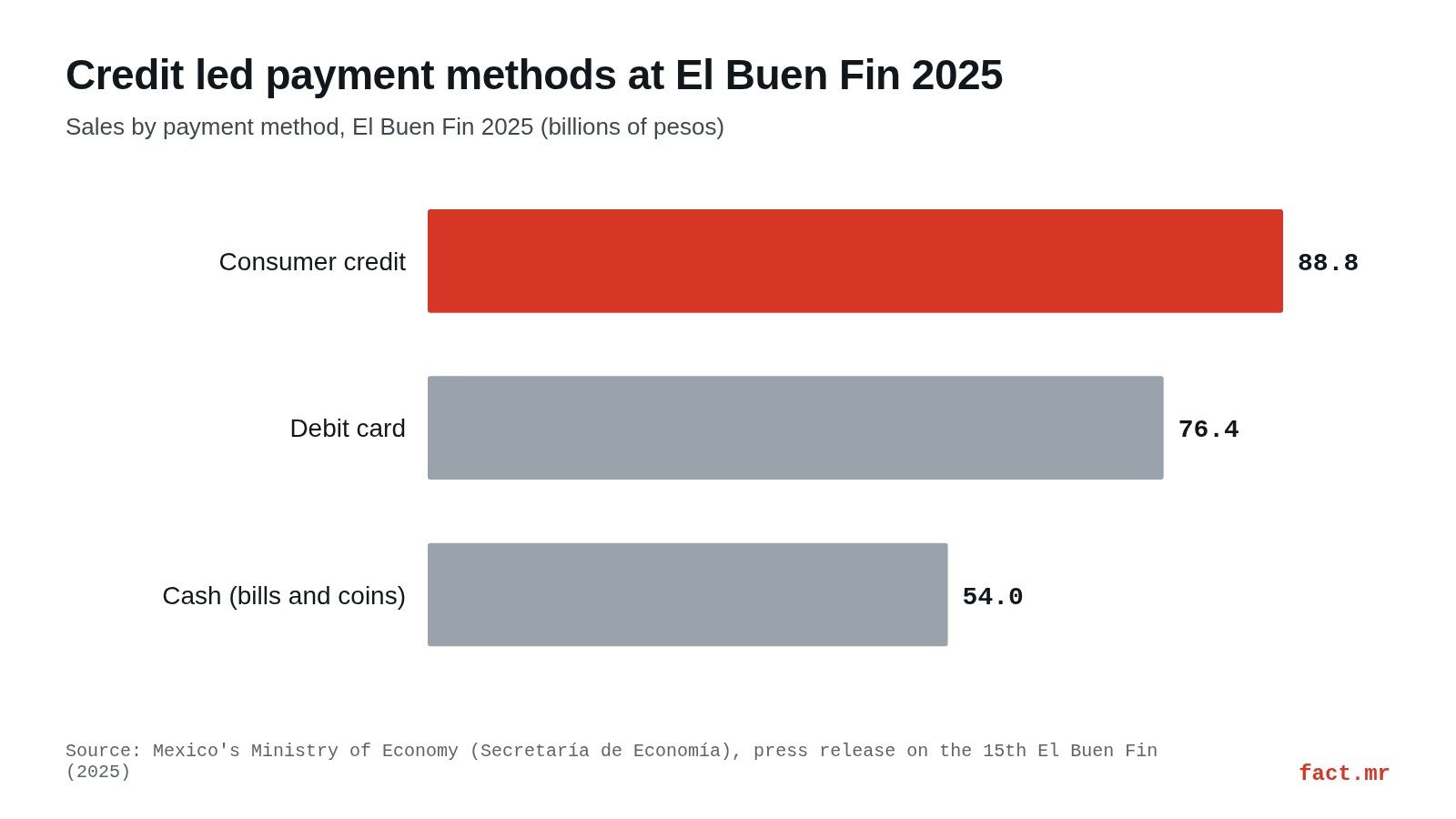
Mexico's November sales event has its own page: Buen Fin Mexico.
Common mix-ups
Marketplace vs. online store
An online store sells its own inventory, and a marketplace hosts other people's. The large platforms do both: Amazon's net product sales were $296,266 million in 2025, and MercadoLibre has its own first-party line. The name on the homepage doesn't tell you who is actually selling to you (the "sold by" line on the product page does).
Marketplace commission vs. affiliate payout
The seller pays a marketplace commission to the platform on each completed sale. In affiliate marketing, the money moves the other way: the brand pays an outside party for sending buyers.
Official e-commerce totals vs. marketplace sales
INEGI's figure is gross value added, not gross sales, and it covers all e-commerce in Mexico, from single-brand stores to digital services and wholesalers. The Census Bureau's figure covers all U.S. retail e-commerce. Neither report says how much of the total goes through Amazon, Mercado Libre or any other marketplace.
Frequently asked questions
What is an online marketplace, and what are some examples?
It is a website or app where independent sellers offer products to buyers, and the operator charges a fee for connecting them. Amazon and Mercado Libre are the usual examples. For third-party sales, Amazon states in its 2025 Form 10-K that it is not the seller of record.
How much does a marketplace charge sellers?
The annual reports describe the types of fees but do not give a single rate. Amazon charges fixed fees, a percentage of sales, per-unit activity fees or interest. MercadoLibre charges final value fees and, according to its 10-K, does not add a separate commission for processing payments on its Marketplace.
How big is U.S. e-commerce?
The Census Bureau estimated U.S. retail e-commerce sales at $340.2 billion in the second quarter of 2026, seasonally adjusted. That was 17.1% of total retail sales and 12.2% more than in the second quarter of 2025.
How much did Amazon and MercadoLibre sell in 2025?
According to its Form 10-K, Amazon reported net sales of $716,924 million in 2025, up 12% from 2024. MercadoLibre reported $28,893 million in net revenues and financial income, up 39.1%. Both figures cover the whole company, not only the marketplace.
Sources
- U.S. Census Bureau, "Quarterly Retail E-Commerce Sales Report" (second quarter of 2026). U.S. retail e-commerce and total retail sales, quarterly and annual changes, release date and revision notice. census.gov. Accessed Nov 9, 2026.
- Amazon.com, Inc., "Form 10-K" (fiscal year 2025). Total net sales, sales by segment, service and product sales, seller fee types, and sales and marketing expense. sec.gov. Accessed Nov 9, 2026.
- MercadoLibre, Inc., "Form 10-K" (fiscal year 2025). Net revenues and financial income, sales and marketing expense, Marketplace fees, Mercado Pago and Mercado Shops. sec.gov. Accessed Nov 9, 2026.
- INEGI, "Valor Agregado Bruto del Comercio Electrónico (VABCOEL) 2024, reporte de resultados 5/26" (February 18, 2026). Definition of e-commerce, VABCOEL at current and 2018 prices, growth, breakdown by activity and share of Mexico's GDP from 2018 to 2024. inegi.org.mx. Accessed Nov 9, 2026.
Chart: our own, with data from INEGI (source 4).
fact.mr is not affiliated with consulting firms with similar names.
Found an error? Write to us at [email protected].
Related
Affiliate marketing: what it is, how affiliates get paid and what the FTC says you must disclose
Black Friday sales numbers: what the day is, how sales are measured and official figures