Affiliate marketing: what it is, how affiliates get paid and what the FTC says you must disclose
Affiliate marketing explained: CPS and CPA pay models, Amazon Associates commission rates by category, the FTC disclosure rule and what Google calls thin affiliation.
In this article
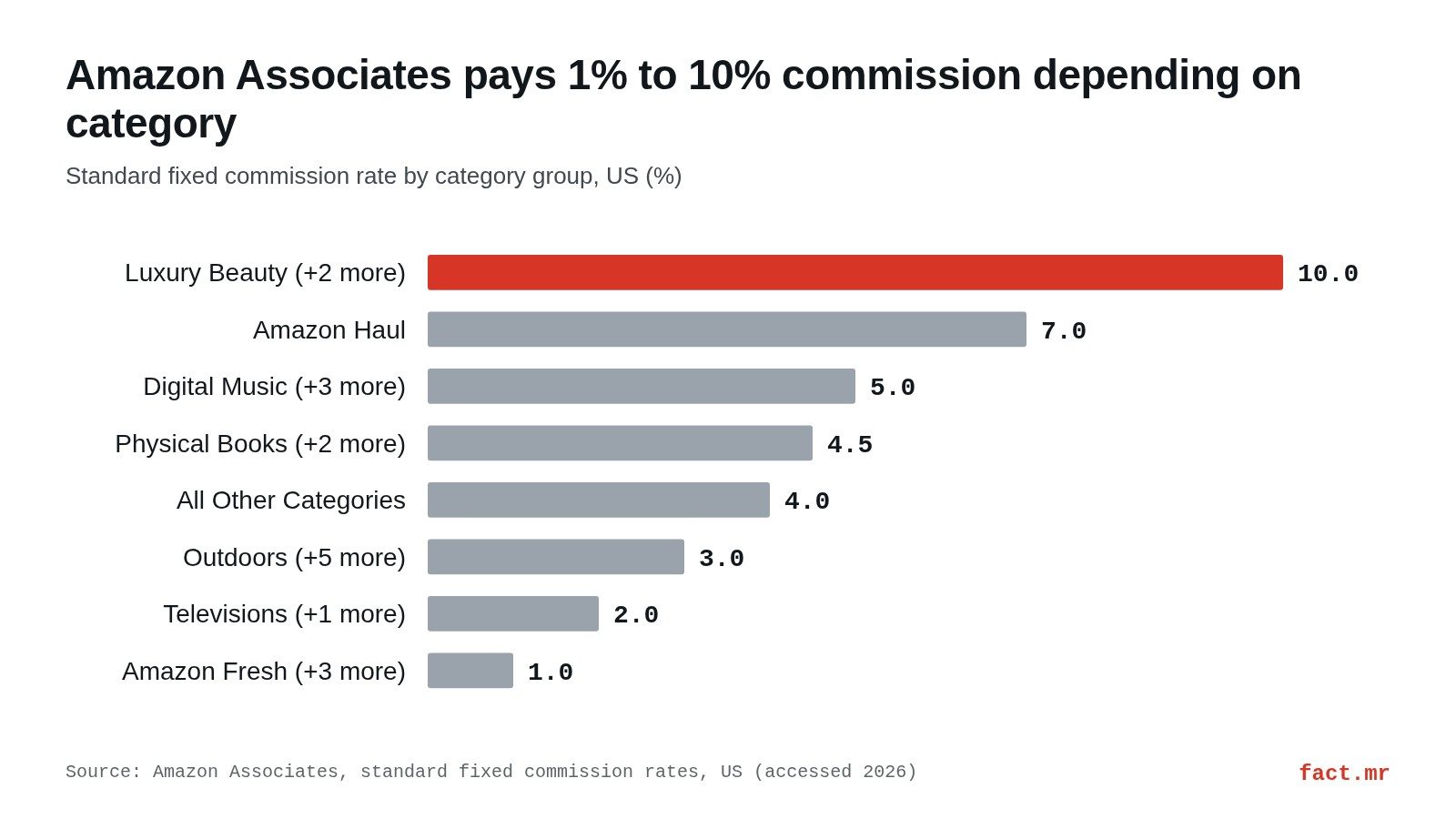
Affiliate marketing is a pay-for-results deal. A website, channel or creator recommends another company's products through a tracked link and earns money only when that link leads to a sale or to a specific customer action. In the US Amazon Associates program, the fixed standard commission runs from 10.00% (Luxury Beauty) down to 1.00% (Grocery and Amazon Fresh), according to Amazon's published rate table1.
Key points
- Affiliates are paid per result. The payout is either a percentage of the sale (CPS) or a flat amount per action (CPA). One example of a flat payout is the $3.00 Amazon Associates pays for each eligible Prime Free Trial sign-up.
- Amazon's US rates depend on the product category: 4.50% for Physical Books, Kitchen and Automotive, and 4.00% for "All Other Categories."
- The FTC expects affiliates to disclose their relationship with the retailer clearly and conspicuously. 16 CFR § 255.5 includes a worked example about a blog with affiliate links.
- Google does not treat every site with affiliate links as spam. Its spam policy targets thin affiliation, meaning pages that copy the merchant's descriptions and add nothing original.
- Outside the US, rules differ. Mexico's consumer agency, Profeco, published its own influencer advertising guide in 2023.
What affiliate marketing is
An affiliate deal has three parties: the merchant that sells, the affiliate that recommends and the customer who buys. The link carries an affiliate ID. When someone clicks it and later buys, the merchant knows which affiliate gets credit for the sale.
Google Search Central describes the setup in its guidance on writing product reviews. Reviews often use affiliate links, and if a reader follows the link and buys, the seller rewards the creator9. The Federal Trade Commission has its own term for that recommendation: an endorsement, defined as an advertising message that consumers are likely to believe reflects the opinions of someone other than the sponsoring advertiser2.
Under that definition, an affiliate's review counts as advertising even when someone outside the company writes it.
How affiliates get paid: CPS, CPA and, for comparison, CPC
Cost per sale (CPS)
The affiliate gets a share of the purchase. Amazon Associates applies its rate to the qualifying revenue from the sale, with a fixed percentage for each category group that ranges from 10.00% to 1.00%1. But the rate alone doesn't tell you what an affiliate earns, because earnings also depend on how many visitors end up buying, and no rate table publishes that number.
Cost per action (CPA)
Under CPA, the affiliate earns a flat amount when the customer completes a defined action, even if nothing is bought. Amazon's public example is the Prime Free Trial: $3.00 for each eligible customer who signs up1.
Cost per click (CPC)
CPC is a paid-search model, and it's included here for comparison. In its 10-K, Alphabet defines cost per click as click-driven revenue divided by total paid clicks. It also says it recognizes performance advertising revenue when a user engages with the ad10.
An advertiser pays for the click itself. An affiliate on CPS gets paid only when a sale happens.
For the cost side of paid clicks, see the piece on paid media cost inflation.
Amazon Associates commission rates in the US
Amazon publishes a table of fixed standard rates for its US program. These are the groups shown in the chart:
| Category group (Amazon's names) | Fixed standard rate |
|---|---|
| Luxury Beauty, Luxury Stores Beauty, Amazon Explore | 10.00% |
| Amazon Haul | 7.00% |
| Digital Music, Physical Music, Handmade, Digital Videos | 5.00% |
| Physical Books, Kitchen, Automotive | 4.50% |
| All Other Categories | 4.00% |
| Business & Industrial Supplies, Outdoors, Tools, Sports, Baby Products, Amazon Coins (with Toys, Furniture, Home and Beauty, among others) | 3.00% |
| Televisions, Digital Video Games | 2.00% |
| Amazon Fresh, Physical Video Games & Video Game Consoles, Grocery, Health & Personal Care | 1.00% |
"Beauty" shows up twice. Luxury Beauty pays 10.00%, while plain Beauty sits in the 3.00% group (so check the exact category before you run any numbers). Physical video games and consoles pay 1.00%, while digital video games pay 2.00%.
How a commission is calculated: worked example
The CPS formula multiplies qualifying revenue by the category rate.
Example with round numbers, not measured data: a purchase with $100 in qualifying revenue in Luxury Beauty, at 10.00%, earns the affiliate $10. The same formula applied to Grocery pays 1.00% of whatever is sold.
A CPC example, also with round numbers: if a search engine bills $500 for 250 paid clicks, the CPC is $2 per click. The money changes hands at the click, before anyone buys.
Getting started: what the FTC expects you to disclose
The FTC is explicit about this part: its FAQ says that if you recommend a retailer's products through affiliate links, you should disclose your relationship to the retailer clearly and conspicuously on your site2. The FTC suggests this wording: "I get commissions for purchases made through links in this post." It adds that the closer the disclosure is to the recommendation, the better.
The underlying rule is 16 CFR § 255.5. In the eCFR version dated October 1, 2026, a connection that could materially affect the weight or credibility of an endorsement, and that the audience would not reasonably expect, must be disclosed clearly and conspicuously. The test is whether a significant minority of the audience doesn't understand or expect that connection3.
Example 11 in section 255.5(b) covers exactly this case: an independent blog about coffee makers that includes affiliate links to sites where readers can buy the products, and that has to disclose the compensation clearly and conspicuously.
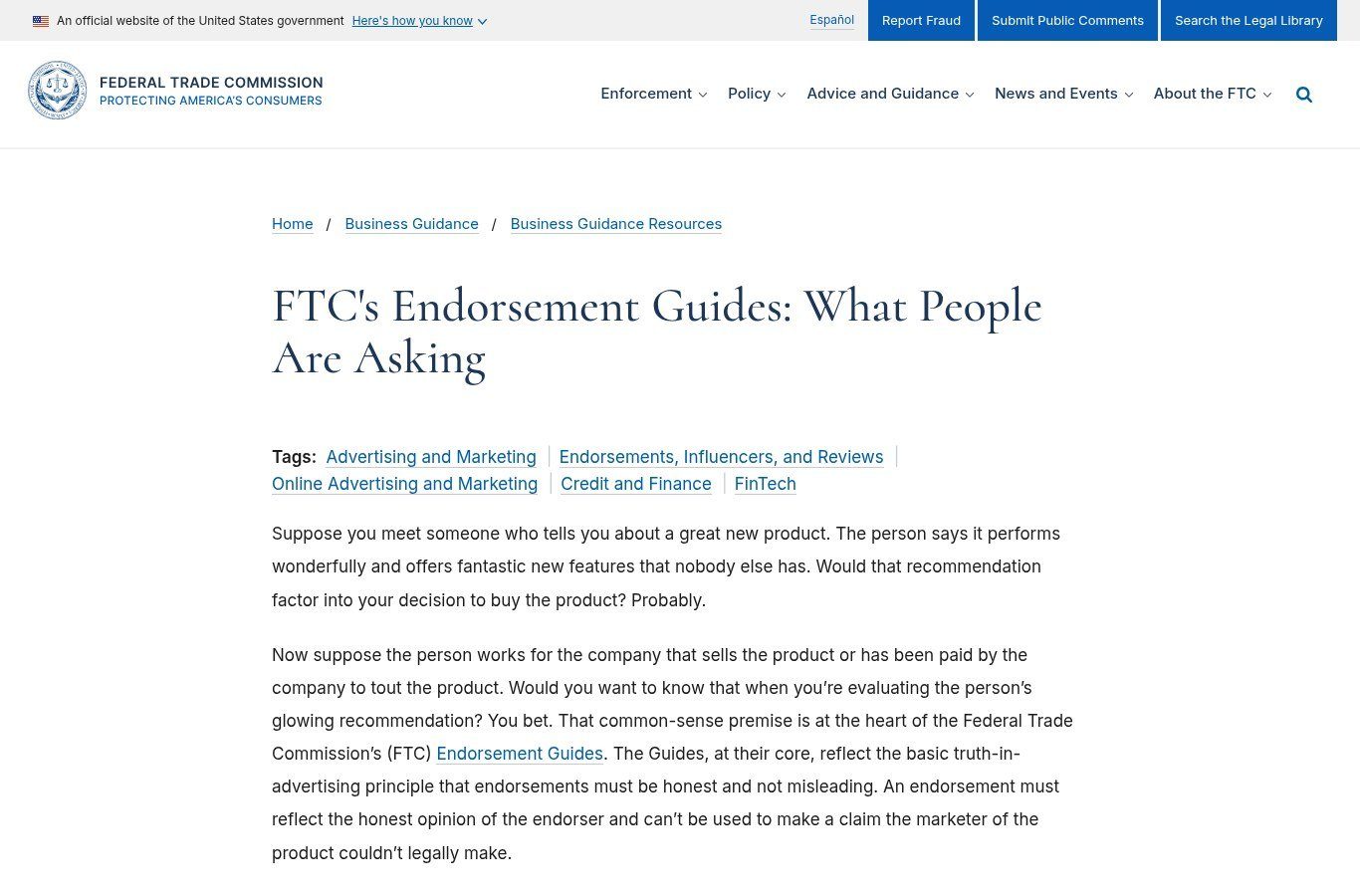
So are the Guides binding? The FTC says the Guides themselves don't have the force of law. Its cases rest on Section 5 of the FTC Act, which generally prohibits deceptive advertising, and the Guides were last revised in 20232.
The FTC's "Disclosures 101 for Social Media Influencers" puts the duty on the person making the recommendation. It also warns that a disclosure placed only on an "About me" or profile page is likely to be missed4.
Brands that pay creators can pair this with an influencer audit before signing.
What Google says about affiliate sites
Google Search Central defines spam as techniques used to deceive users or manipulate its Search systems. Sites that violate its policies may rank lower or not appear in results at all7. Thin affiliation is one of the named violations: affiliate pages whose product descriptions and reviews are copied from the original merchant, with no original content or added value.
The same page says that not every site in an affiliate program is a thin affiliate. Google describes good affiliate sites as ones that add value through useful features or content, such as extra pricing information, original product reviews, rigorous testing and ratings, navigation between products or categories, and product comparisons. Its site reputation abuse policy also lists affiliate links that are treated appropriately among the examples that don't violate it.
For marking paid links, Google prefers rel="sponsored", while nofollow remains acceptable. Links marked this way generally won't be followed8. For how search results look now, see SEO after Google's AI Overview.
If your audience is in Mexico: Profeco's guide
Mexico's Federal Consumer Protection Agency (Profeco) signed the agreement issuing its Guide to advertising for influencers on August 11, 20235. Profeco's press release of August 22, 2023, says the agreement was published in the Diario Oficial de la Federación, Mexico's official gazette, on Monday, August 216. It took effect the day after publication.
The agreement frames the guide as a reference tool for influencers, content creators and consumers. It applies the advertising provisions in Article 32 of Mexico's Federal Consumer Protection Law. Profeco recommends placing the ad label somewhere visible and available at all times, using plain tags such as #Publicidad ("advertising"), #PublicidadPagada ("paid advertising"), #Patrocinio ("sponsorship") or #OpinionesPersonales ("personal opinions").
| Point | FTC (United States) | Profeco (Mexico) |
|---|---|---|
| Document | Endorsement Guides (16 CFR part 255), revised in 2023 | Guide to advertising for influencers, published in the official gazette on August 21, 2023 |
| Legal status | No force of law on their own; cases rest on Section 5 of the FTC Act | Reference tool; applies Article 32 of the Federal Consumer Protection Law |
| Where the notice goes | Clear and conspicuous, as close to the recommendation as possible; not only on an "About me" page | Visible and available at all times |
| Sample wording | "I get commissions for purchases made through links in this post." | #Publicidad, #PublicidadPagada, #Patrocinio, #OpinionesPersonales |
Common mistakes
- Putting the disclosure only on a profile or "About me" page, the spot the FTC flags as easy to miss.
- Separating the disclosure from the recommendation, at the bottom of a long page.
- Copying the merchant's product copy and adding a link, the practice Google calls thin affiliation.
- Leaving paid links or ad placements without rel="sponsored" or nofollow, the attributes Google asks for on that kind of link.
- Applying one category's rate to a whole store, when at Amazon Associates Health & Personal Care pays 1.00% and Kitchen pays 4.50%.
Neither the FTC's sample sentence nor Profeco's hashtags is mandatory wording; what both agencies ask for is a notice the audience actually sees.
Frequently asked questions
How much does Amazon pay affiliates in the US?
Amazon's Associates rate table lists fixed standard commissions from 10.00% for Luxury Beauty, Luxury Stores Beauty and Amazon Explore down to 1.00% for Amazon Fresh, Grocery, Health & Personal Care and video game consoles. Products not in another group earn 4.00% ("All Other Categories"). An eligible Prime Free Trial sign-up pays $3.00.
What wording works for an affiliate disclosure?
The FTC suggests "I get commissions for purchases made through links in this post" and wants the disclosure clear and conspicuous, placed as close to the recommendation as possible. In Mexico, Profeco suggests tags such as #Publicidad or #PublicidadPagada, placed where they are visible at all times.
Are the FTC Endorsement Guides law?
Not by themselves. The FTC says the Guides don't have the force of law, but its enforcement cases rest on Section 5 of the FTC Act, which generally prohibits deceptive advertising. The disclosure rule sits in 16 CFR § 255.5.
Does Google penalize sites with affiliate links?
Having them is fine. Google Search Central says not every affiliate site is a thin affiliate, and that affiliate links treated appropriately don't violate its site reputation abuse policy. What it acts on is thin affiliation (copied descriptions with no added value), which can rank lower or drop out of results.
Sources
- Amazon, "Amazon.com Associates Central: Standard Commission Rates" (accessed 2026). Fixed standard commission rates by category and the Prime Free Trial sign-up payout. affiliate-program.amazon.com. Accessed Nov 4, 2026.
- Federal Trade Commission, "FTC's Endorsement Guides: What People Are Asking" (Guides revised in 2023). Definition of endorsement, affiliate disclosure, sample wording, disclosure placement and legal basis. ftc.gov. Accessed Nov 4, 2026.
- eCFR, "16 CFR § 255.5: Disclosure of material connections" (version of October 1, 2026). Material connection disclosure rule and Example 11 on affiliate links. ecfr.gov. Accessed Nov 4, 2026.
- Federal Trade Commission, "Disclosures 101 for Social Media Influencers" (online edition). Responsibility to disclose and placements where disclosures are likely to be missed. ftc.gov. Accessed Nov 4, 2026.
- Diario Oficial de la Federación, "Acuerdo por el que se da a conocer la Guía de publicidad para influencers de la Procuraduría Federal del Consumidor" (2023). Signing date, purpose, Article 32 of the Federal Consumer Protection Law and entry into force. sidof.segob.gob.mx. Accessed Nov 4, 2026.
- Procuraduría Federal del Consumidor, "Profeco emite Guía de Publicidad para Influencers" (August 22, 2023). Publication date in the official gazette, nature of the guide, label placement and suggested tags. gob.mx. Accessed Nov 4, 2026.
- Google Search Central, "Spam policies for Google web search" (online edition). Definition of spam, consequences, thin affiliation, examples of useful affiliate pages and site reputation abuse. developers.google.com. Accessed Nov 4, 2026.
- Google Search Central, "Qualify your outbound links to Google" (online edition). Use of rel="sponsored" and nofollow on paid links. developers.google.com. Accessed Nov 4, 2026.
- Google Search Central, "Write high quality reviews" (online edition). Relationship between product reviews and affiliate links. developers.google.com. Accessed Nov 4, 2026.
- Alphabet Inc., "Form 10-K" (fiscal year 2025). Definition of cost per click and recognition of performance advertising revenue. sec.gov. Accessed Nov 4, 2026.
Chart: our own, with data from Amazon Associates (source 1).
Photo: our own screenshot of ftc.gov, Nov 4, 2026.
fact.mr is not affiliated with consulting firms with similar names.
Found an error? Write to us at [email protected].
Related
Black Friday sales numbers: what the day is, how sales are measured and official figures
Buen Fin Mexico: what El Buen Fin is, how it compares with Black Friday and sales by edition