Pet Marketing: How Long to Run a Campaign, by Channel and Season
How long to run a pet marketing campaign on Meta, Google, TikTok and email: learning windows, when to cut or scale, and the seasonal dates of the pet business.
In this article
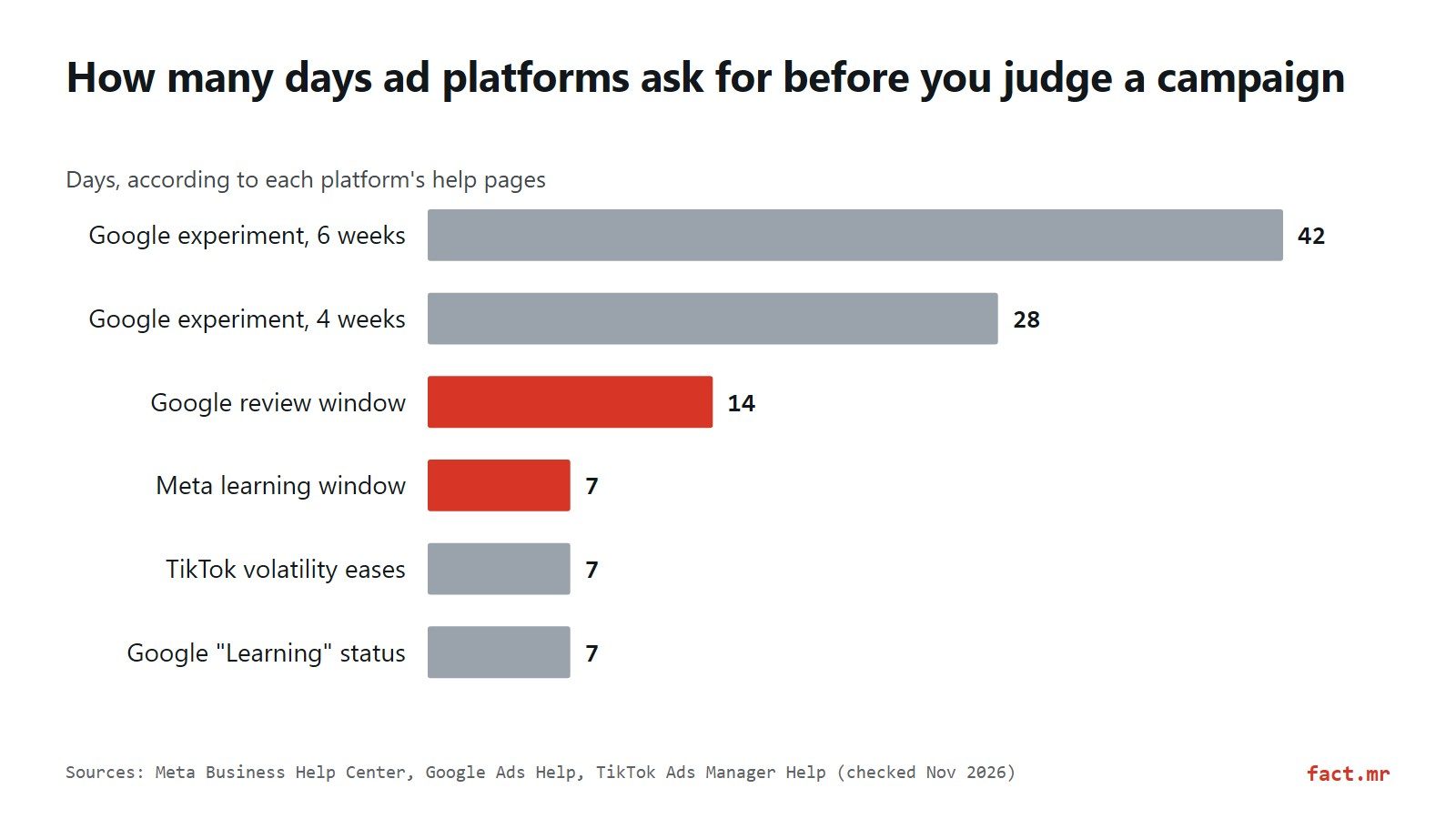
Give a paid pet marketing campaign at least three weeks before you decide whether it works. Google caps its "Learning" status at 7 days and then asks for a review over two conversion cycles or two weeks, whichever is longer, while Meta says ad sets usually need about 50 results in the week after their last significant edit.
Key points
- No ad platform publishes one correct length. The floor comes from its learning window and your conversion cycle; the ceiling comes from your results.
- Meta asks for about 50 results in a week. TikTok says volatility starts to ease after about 25 results or 7 days.
- Google Smart Bidding needs at least 21 days once you add the learning status to the review window, and Google recommends at least 4 to 6 weeks for experiments.
- Email has no learning phase. Mailchimp recommends waiting at least 4 hours before sending an A/B winner.
- Pet demand has fixed dates: the National Retail Federation counted a record 35% of consumers planning Valentine's Day gifts for their pets in 2026.
How long should you run a pet marketing campaign?
Two clocks decide it. One belongs to the ad platform, which needs a learning window before its results mean anything; the other belongs to your customer, who may take hours to buy a bag of treats or weeks to book a dental cleaning at a vet clinic. Offers with an end date add a third clock, the calendar.
| Goal and channel | Minimum before judging | What ends it |
|---|---|---|
| Always-on paid social (Meta) | About 50 results in the week after the last significant edit | Cost per result stays above your target after a full buying cycle |
| Paid social (TikTok) | About 25 results or 7 days before swings ease; 50 conversions in a week before scaling | Cost per action above target, or a creative that stops performing |
| Search (Google Smart Bidding) | Up to 7 days of "Learning", then two conversion cycles or two weeks, whichever is longer | Search demand is continuous, so results decide |
| A/B test of a Google campaign | At least 4 to 6 weeks; the first 7 days are discarded | The test end date |
| Email promotion | At least 4 hours before picking an A/B winner | The offer deadline, or a spam rate near Gmail's limit |
| Product launch | Start ads at least a week before the date that matters | The launch goal is met; winners move to always-on |
| Seasonal push | Start at least a week before the peak | The season ends |
These are floors. None of the help pages behind them says when a campaign has run too long, so the ceiling depends on your margin and on whether the cost per result still clears your target.
Learning windows, platform by platform
Meta (Facebook and Instagram)
Meta says an ad set leaves the learning phase "as soon as they can deliver stably," which "usually occurs after about 50 results in the week after the ad set's last significant edit." During that phase performance is less stable and cost per result usually runs higher (the marketer who tweaks a little every morning pays for the same lesson several times).
Significant edits include any change to targeting, ad creative, optimization event or bid strategy, adding a new ad, and pausing the ad set for 7 days or longer. Budget changes depend on size: Meta's own example says going from $100 to $101 is unlikely to restart learning, while going from $100 to $1,000 may.
Example: a pet supply shop targeting $15 per purchase needs roughly $750 a week per ad set to reach 50 purchases, about 7 a day. If the budget or audience can't deliver that, Delivery shows "Learning limited," and Meta suggests combining ad sets, expanding the audience, raising the budget or moving to a more frequent event, such as add to cart instead of purchase.
Google Ads
Google says the "Learning" status of Smart Bidding "never lasts more than 7 days," and that performance typically converges within 1 to 2 conversion cycles. After that, it advises evaluating "over 2 conversion cycles or a 2 week window (whichever is longer)." Add the 7 days and you reach the three-week minimum above, and a vet clinic whose clients book weeks after searching should plan on more.
Testing takes longer. Google's Experiments FAQ recommends at least 4 to 6 weeks and discards the first 7 days of data for ramp-up, while its page on monitoring experiments suggests 2 to 3 weeks to gather data. Both come from Google, and the longer one is the safer plan for a test that will move budget.
TikTok
TikTok says volatility typically starts to decline after about 25 campaign results or 7 days from when learning begins, and it warns against pausing during that phase. For scaling, conversion campaigns qualify when an ad group generates at least 50 conversions within a week and meets your metrics; for other campaigns it looks for 90-100% of budget spent with cost per action at or below target.
Email has no learning phase, so the clock runs in hours. Mailchimp recommends waiting at least 4 hours after sending an A/B test before sending the winner, and the winner should come from clicks or sales: Apple's Mail Privacy Protection "prevents senders from seeing if you've opened the email." A promotion ends with its offer; a reorder reminder for food or flea treatment has no end date.
Launches and seasonal pushes
Start ads at least a week before the date that matters so the learning window closes before demand peaks. For bid strategies, Google's seasonality adjustments are built for short events of 1 to 7 days and may not work as well beyond 14 days, so a two-day flash sale can use one and a months-long tick season can't.
When to cut a pet campaign and when to scale it
Cut or rebuild a campaign when one of these holds after the minimum window:
- Cost per result stays above target across a full conversion cycle.
- The ad set stays "Learning limited" and you can't raise the budget or broaden the audience.
- The seasonal date has passed. Keep it running and you are paying for a moment that's over.
- An email program's spam rate approaches Gmail's limit: Google asks senders to stay below 0.10% and never reach 0.30%.
Scale when the campaign has cleared the same window and sits at or above target. Raise budgets in steps, since a jump as large as Meta's $100-to-$1,000 example can restart learning, and avoid changing Google Smart Bidding targets several times within one conversion cycle, as Google advises.
Pausing is not free.
On Meta, an ad set paused for 7 days or longer goes back into learning when you turn it on again, and TikTok lists pausing among the actions to avoid during its learning phase. Meta also warns against testing by turning ad sets on and off by hand, which it says leads to inefficient delivery and unreliable results.
Seasonal dates in the pet business
Pet demand follows a calendar you can plan a year ahead, with a few dates that have public numbers behind them.
| Date | Public data | Who should plan for it |
|---|---|---|
| Valentine's Day (February 14) | A record 35% of US consumers planned gifts for pets in 2026, $2.1 billion, up from $1.7 billion in 2025 and from 19% of celebrants a decade ago (NRF) | Pet brands and stores: treats, toys, accessories |
| National Pet Dental Health Month (February) | Annual observance on the AVMA calendar | Vet clinics and dental products |
| National Pet Week (first full week of May; May 3-9 in 2026) | AVMA calendar | Vets, groomers, local stores |
| Tick season (April to September in the US) | CDC: ticks are most active in those months, though exposure happens year-round | Flea and tick products, groomers, vets |
| Halloween (October) | $0.92 billion on pet costumes in 2026; 23% of consumers plan to dress their pets, up from 17% in 2019; 49% start shopping in September or earlier (NRF) | Costume and accessory brands; pet stores |
| Year-end sales | Retail peak, see our Black Friday data | All: the learning window has to close before the sale starts |
One gap stays open: the federal spending series is annual, so it can't tell you which months sell. Your own store data and Google Trends for your product terms have to fill it in.
Who buys, and what each pet business should run
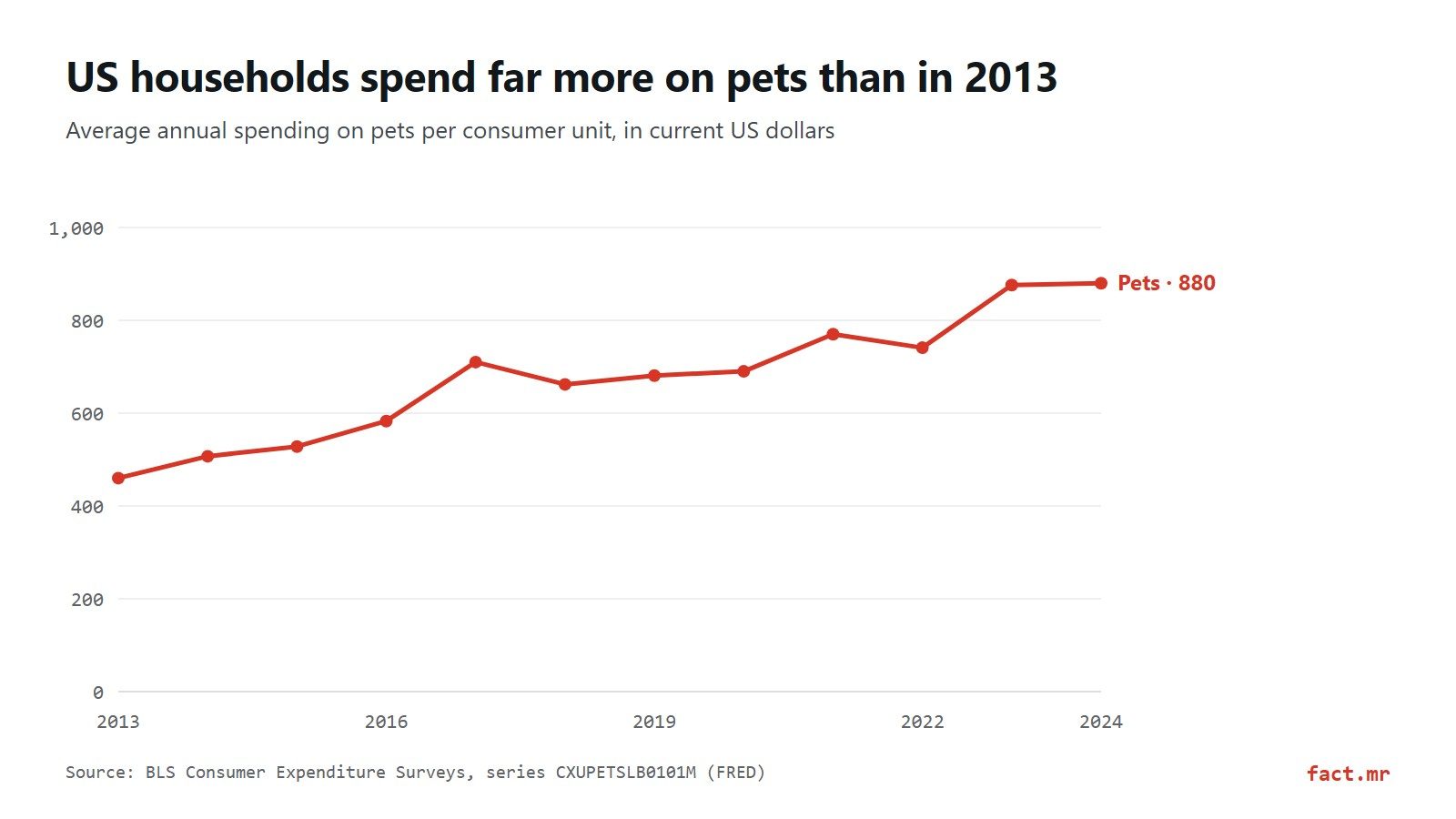
Average US spending on pets reached $880 per consumer unit in 2024, against $460 in 2013, in current dollars and across all households, according to the Bureau of Labor Statistics. AVMA preliminary figures for 2024 put dogs in 45.5% of households and cats in 32.1%, and 88.8% of dog owners and 84.7% of cat owners say their pet is a member of the family.
Segment before you buy media. A campaign for dog owners and one for cat owners need separate creative, and a shop selling premium food has little to say to someone searching for the cheapest litter.
| Business | Channels that fit | How long to plan |
|---|---|---|
| Pet brand (food, treats, toys) | Paid social, creators, email flows, marketplaces | Always-on, with launch and seasonal pushes on top |
| Pet store | Local search, email reminders, in-store events | Year-round; seasonal bursts around the dates above |
| Veterinary clinic | Search, Google Business Profile, reminders by email or text | Long windows, since clients book days or weeks after the first search |
| Groomer | Local search, rebooking reminders, referrals | Year-round, with extra capacity for tick season and year-end |
Before running creators, read our influencer vetting checklist. Before pushing email, check deliverability, because a promotion that lands in spam has no run time to measure.
Claims and disclosures that can sink a pet campaign
US rules reach pet ads too. The FTC says creators must disclose free or discounted products even if they weren't asked to mention them, and the disclosure has to sit with the endorsement itself, since it is likely to be missed on a profile page or at the end of a post.
Health claims carry a separate risk. The FDA says that if a product's intended use is to treat or prevent a disease, it is a drug, and it considers most complete diets marketed that way unapproved animal drugs. Rules differ in other countries, so a campaign that crosses borders needs each market's rules checked.
Frequently asked questions
How long should I run a Facebook ad before changing it?
Wait until the ad set exits the learning phase: Meta says that usually takes about 50 results in the week after the last significant edit. If you can't reach that volume, Meta's own fixes include combining ad sets or optimizing for a more frequent event.
How long do Google Ads take to work for a pet business?
Expect at least three weeks with Smart Bidding: up to 7 days of learning status, then two conversion cycles or two weeks, whichever is longer. Google recommends at least 4 to 6 weeks for formal experiments.
When should a seasonal pet campaign start?
At least a week before the peak, so the learning window closes before demand arrives. For Halloween, start earlier: NRF found 49% of consumers begin shopping in September or earlier.
How much budget does a pet campaign need?
Multiply your target cost per result by 50 to get the weekly floor for a Meta ad set. At $15 per purchase, that is $750 a week; if that is out of reach, combine ad sets or optimize for a more frequent event.
Sources
- Meta Business Help Center, "About the learning phase." About 50 results in the week after the last significant edit. facebook.com. Accessed Nov 9, 2026.
- Meta Business Help Center, "Significant edits and learning phase." Which edits restart learning; pausing for 7 days or longer; budget example. facebook.com. Accessed Nov 9, 2026.
- Meta Business Help Center, "About Learning Limited." Threshold and fixes. facebook.com. Accessed Nov 9, 2026.
- Meta Business Help Center, "About A/B testing." Warning against informal on-off testing. facebook.com. Accessed Nov 9, 2026.
- Google Ads Help, "About Smart Bidding learning." Learning status, conversion cycles and evaluation window. support.google.com. Accessed Nov 9, 2026.
- Google Ads Help, "Experiments FAQs." At least 4 to 6 weeks; first 7 days discarded. support.google.com. Accessed Nov 9, 2026.
- Google Ads Help, "Monitor your experiments." 2 to 3 weeks to gather data. support.google.com. Accessed Nov 9, 2026.
- Google Ads Help, "About seasonality adjustments." Short events of 1 to 7 days. support.google.com. Accessed Nov 9, 2026.
- TikTok Ads Manager Help, "About Learning Phase." ads.tiktok.com. Accessed Nov 9, 2026.
- TikTok Ads Manager Help, "About solutions for scaling Auction Ad spend." ads.tiktok.com. Accessed Nov 9, 2026.
- Mailchimp, "About A/B Tests." Wait at least 4 hours. mailchimp.com. Accessed Nov 9, 2026.
- Apple, iPhone User Guide, "Use Mail Privacy Protection on iPhone." support.apple.com. Accessed Nov 9, 2026.
- Google, "Email sender guidelines." Spam rate limits. support.google.com. Accessed Nov 9, 2026.
- National Retail Federation, "Valentine's Day spending expected to reach new records" (2026). nrf.com. Accessed Nov 9, 2026.
- National Retail Federation, "Pets get all the love this Valentine's Day" (2026). nrf.com. Accessed Nov 9, 2026.
- National Retail Federation, Halloween survey press release (2026). nrf.com. Accessed Nov 9, 2026.
- National Retail Federation, "Top Halloween costume trends for 2026." nrf.com. Accessed Nov 9, 2026.
- American Veterinary Medical Association, "Pet health and veterinary awareness events." avma.org. Accessed Nov 9, 2026.
- US Centers for Disease Control and Prevention, "How to Prevent Mosquito and Tick Bites." cdc.gov. Accessed Nov 9, 2026.
- US Bureau of Labor Statistics, Consumer Expenditure Surveys, "Expenditures: Pets: All Consumer Units," via FRED. Chart data. fred.stlouisfed.org. Accessed Nov 9, 2026.
- AVMA News, "Pet population continues to increase while pet spending declines" (2024; preliminary data). avma.org. Accessed Nov 9, 2026.
- Federal Trade Commission, "Disclosures 101 for Social Media Influencers." ftc.gov. Accessed Nov 9, 2026.
- US Food and Drug Administration, "FDA's Regulation of Pet Food." fda.gov. Accessed Nov 9, 2026.
Chart: our own, with data from the Meta, Google Ads and TikTok help pages (sources 1, 5, 6 and 9); spending chart with data from the Bureau of Labor Statistics (source 20).
fact.mr is not affiliated with consulting firms with similar names.
Found an error? Write to us at [email protected].